Podo Museum exhibition poetically reflects on human vulnerability
전체 맥락을 이해하기 위해서는 본문 보기를 권장합니다.
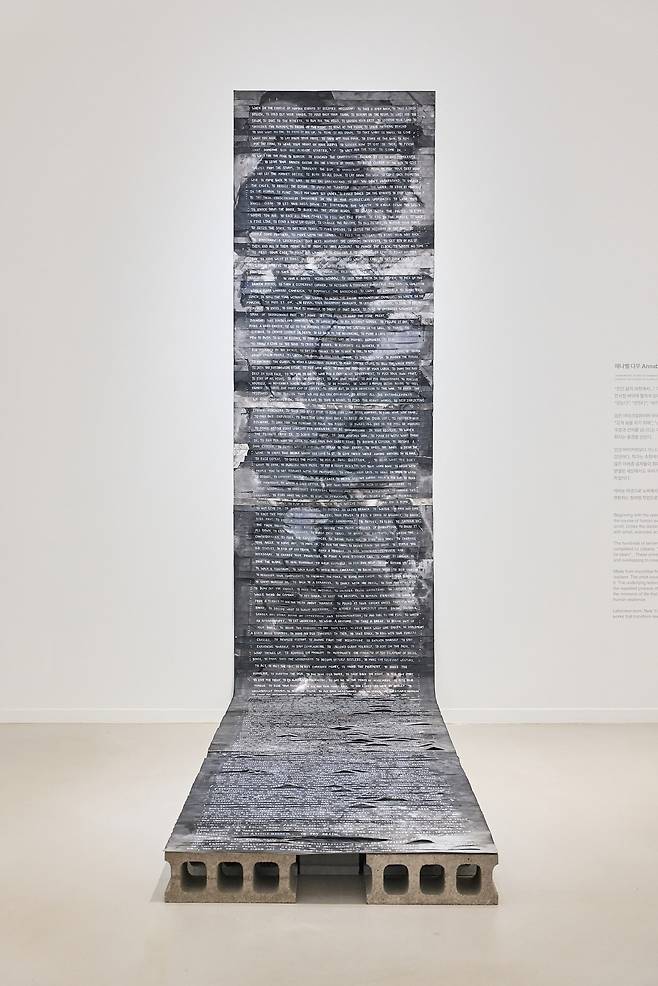
Lebanese artist Annabel Daou's scroll-like work unfurls from the gallery wall and spills out onto the floor, beginning with the phrase from the American Declaration of Independence from which it takes its name, "When in the Course of Human Events." Unlike the declaration's urgent call to action, the hundreds of sentences written in white correction fluid on black microfiber by ordinary people continue with phrases emphasizing needs, hopes and desires "to breathe deeply," "to reach out" and "to hold back tears."
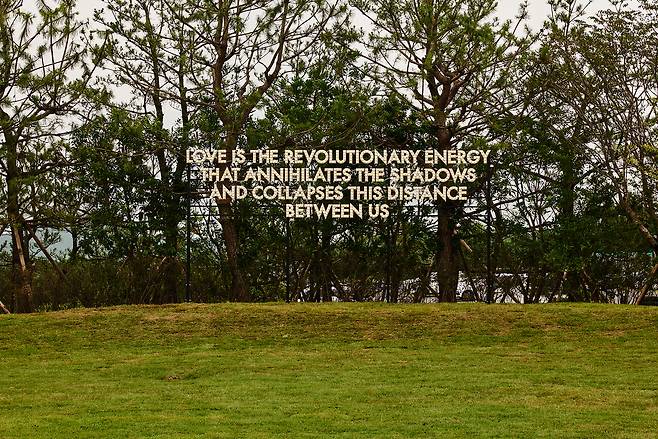
Outside the museum is an installation by Robert Montgomery where light-emitting diode bulbs create the sentence: "Love is the revolutionary energy that annihilates the shadows and collapses this distance between us."
이 글자크기로 변경됩니다.
(예시) 가장 빠른 뉴스가 있고 다양한 정보, 쌍방향 소통이 숨쉬는 다음뉴스를 만나보세요. 다음뉴스는 국내외 주요이슈와 실시간 속보, 문화생활 및 다양한 분야의 뉴스를 입체적으로 전달하고 있습니다.
SEOGWIPO, Jeju Island — Distrust, jealousy and endless desires drive us to fight and wound each other. Wars take place one after another across the globe, claiming the lives of innocent civilians. We often forget how fragile and small human beings are in the vast universe.
“We, Such Fragile Beings” at the Podo Museum on Jeju Island began with that thought.
Bringing together 13 artists from around the world, the exhibition offers comfort and compassion to visitors who are grieving, whether directly or indirectly.


“While preparing for this exhibition, I reflected on how we often get caught up in the struggles and conflicts of everyday life. If we can expand the ‘common denominator,’ whether through religion, music or any experience that transcends our immediate concerns, we can see those daily challenges from a much broader perspective,” said Chloe Kim, executive director of Podo Museum, Friday at the museum.
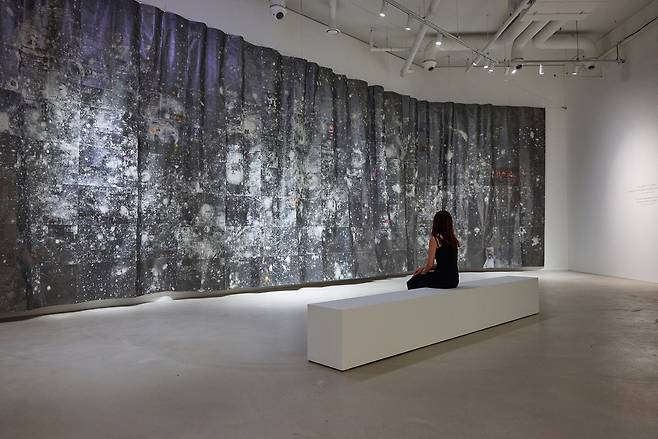
Seemingly a curtain with an image of countless stars and planets in the Milky Way, the installation “Drawings on Newspaper” by Japanese artist Sumi Kanazawa consists of newspapers with densely drawn lines using soft, dark 10B pencils. Events from different times and dates are seen where the pencil has skipped over. Standing before the work, which feels meditative, one may realize just how many things are concurrently going in this vast universe.
Lebanese artist Annabel Daou’s scroll-like work unfurls from the gallery wall and spills out onto the floor, beginning with the phrase from the American Declaration of Independence from which it takes its name, “When in the Course of Human Events.” Unlike the declaration’s urgent call to action, the hundreds of sentences written in white correction fluid on black microfiber by ordinary people continue with phrases emphasizing needs, hopes and desires “to breathe deeply,” “to reach out” and “to hold back tears.”
“It was in 2019 that I began working on it at a time when there were protests all across the world. I had this kind of sense that this was the moment, a pivotal moment.
"I started asking people to complete the sentence, and what was really interesting to me is that it was the sense of excitement — the possibility of rewriting or adapting the form of this US document that was written by wealthy white men and to put it in the voice of people across the world,” the New York-based artist said.
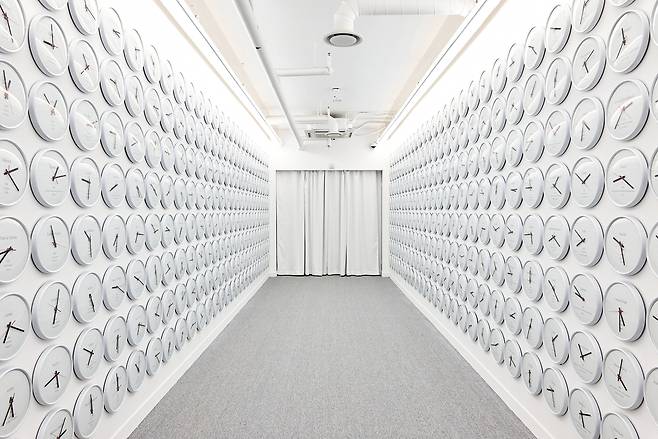
A white hallway of the museum is filled floor to ceiling with 560 white clocks, the sound of their ticking like falling rain. Each clock has a name, a job and a country. The installation by Korean artist Lee Wan shows each clock is ticking at a different speed.
"There is a formula for calculating the speed of the clocks. By entering data from the people I interviewed, such as their income, the cost of living in their country and how much they pay for a single meal, I was able to determine the pace of time for each person.
“However, this pace does not represent an eternal speed. The speed of time for everyone represented in the clocks will continue to flow as it does at this very moment,” he said.
Outside the museum is an installation by Robert Montgomery where light-emitting diode bulbs create the sentence: “Love is the revolutionary energy that annihilates the shadows and collapses this distance between us.”
The exhibition runs to Aug. 8, 2026 at the museum owned by SK Group.
Copyright © 코리아헤럴드. 무단전재 및 재배포 금지.