Why S. Korean farmers are suing Kepco
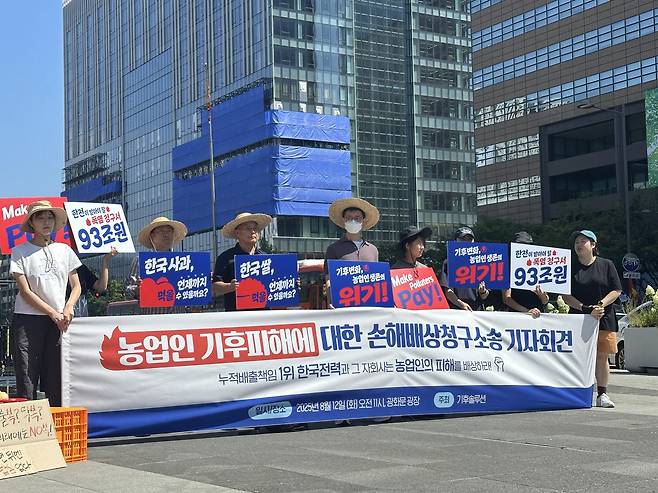
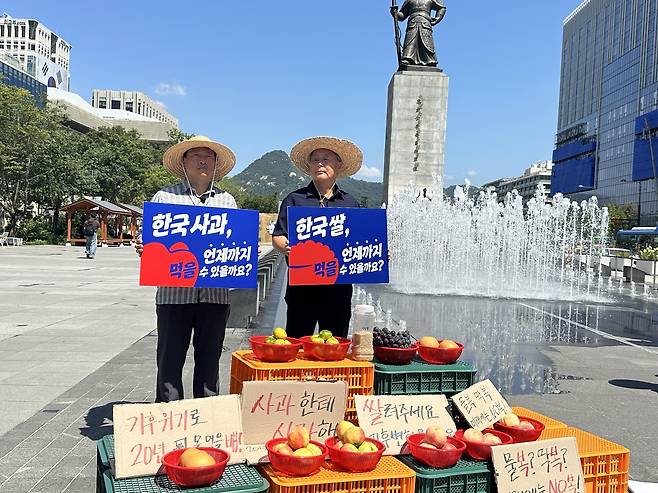
Hwang Seong-yeol, a rice farmer from Dangjin, South Chungcheong Province, wonders whether rice farming — his vocation for over 30 years — will remain sustainable enough to maintain his livelihood in the near future.
“Dangjin used to be a place where you could farm without serious droughts or major natural disasters. But in recent years, the crops I’ve grown for decades (without problems) started to suffer major damage,” said Hwang.
Hwang is also one of the many farmers who suffered severe damage to his crops after record-breaking heavy rainfall swept through his city in mid-July. After seeing cumulative rainfall of up to 451.5 millimeters in just two days, his rice paddies were completely flooded. Hwang says such weather events feel increasingly common as years go by.
For Hwang, this isn’t just bad luck; it’s the new reality of farming in a warming world — and Hwang isn’t alone.
Hwang and five other farmers across South Korea, together with climate advocacy group Solutions for Our Climate, have filed a lawsuit against Korea Electric Power Corporation and five of its power generation subsidiaries. They are demanding financial compensation for climate-related damages, marking the first case of its kind against a corporation in South Korea.
Among the plaintiffs is apple farmer Ma Yong-un from Hamyang, South Gyeongsang Province, who says shorter winters and earlier springs have thrown his harvest into chaos.
"Apple blossoms used to bloom at the end of April, but now they start in early April. If a sudden cold snap hits mid-month, the flowers freeze and die, or grow into deformed fruit," said Ma. "With climate disasters becoming an everyday reality due to climate change, it is farmers who are the first to suffer. Crops grow poorly, and we sustain various kinds of damage."
Why Kepco?
According to preliminary findings from a report by SFOC, Kepco and its subsidiaries were responsible for around 21-29 percent of South Korea’s greenhouse gas emissions between 2011 and 2022. Globally, the utility ranks among the top emitters, contributing to 0.4 percent of total emissions over the same period.
The farmers and their lawyers argue that much of Kepco’s emissions come from its coal-heavy power generation portfolio.
“While renewable energy now accounts for a growing share of electricity generation nationwide, South Korea’s renewable share remains at 9.5 percent — a structural imbalance that Kepco and its subsidiaries have maintained and, in some cases, reinforced through their market dominance,” said SFOC in an official press release.
Yeny Kim, the lead attorney for the plaintiffs from SFOC, argues that Kepco cannot hide behind its role as a public utility or claim that it was merely following government policy.
“The law now has the tools to assign responsibility for the damage caused by climate change,” said Kim. Kepco’s emissions from 2011 to 2023 caused damages equivalent to $72.9 billion in economic losses, much of it stemming from extreme heat, flooding and other climate-related disasters, she added.
Kim said Kepco’s share of emissions is “calculable,” and that “In a court of law, quantifiable harm means legal liability.”
This case builds on legal momentum from South Korea’s landmark youth climate lawsuit in 2020, when young plaintiffs argued that the government’s emissions targets were too weak to protect future generations. That case led to a major ruling in August 2024: The Constitutional Court declared parts of the country’s climate law unconstitutional, recognizing climate action as a constitutional duty.
The farmers’ lawsuit takes that principle one step further, extending the notion of legal responsibility from the state to a major corporate emitter.
What's at stake
A victory in the SFOC lawsuit could set a groundbreaking precedent in South Korea, opening the door for other climate-related damage claims against high-emission industries such as steel, cement and petrochemicals.
Legal experts say it could also push courts to more readily accept scientific attribution of damages to specific corporate emitters, strengthening the evidentiary basis for future cases.
“If the court recognizes the link between a company’s emissions and measurable harm, it will fundamentally change the legal landscape for corporate accountability in Korea,” Kim added.
For Kepco, a loss would mean far more than paying compensation for past damages. It would also increase pressure on the utility to accelerate its transition away from coal and to invest more heavily in renewable energy.
“This isn’t just about paying damages. It’s about forcing the biggest polluters to change how they operate,” said Kim.
Copyright © 코리아헤럴드. 무단전재 및 재배포 금지.