Consumers get cooked on food prices with sharpest rise in a year in July
전체 맥락을 이해하기 위해서는 본문 보기를 권장합니다.
"Korean food prices are considerably higher than those of major countries," the BOK noted previously. "The high prices of essential goods are considered a major factor driving up perceived inflation, especially among vulnerable groups, despite the slowing inflation rate."
"Climate change and an aging population are reducing the agricultural and fisheries workforce, making supply less stable and prices more volatile," said Lee Yoon-soo, a professor of economics at Sogang University. "In the long term, Korea should diversify supply chains by increasing imports of high-volatility items to stabilize price levels."
이 글자크기로 변경됩니다.
(예시) 가장 빠른 뉴스가 있고 다양한 정보, 쌍방향 소통이 숨쉬는 다음뉴스를 만나보세요. 다음뉴스는 국내외 주요이슈와 실시간 속보, 문화생활 및 다양한 분야의 뉴스를 입체적으로 전달하고 있습니다.
![Grocery shoppers browse the ramyeon section at a large supermarket in downtown Seoul on Aug. 11. The July price index for food and nonalcoholic beverages rose 3.5 percent on year to 125.75, according to Statistics Korea’s Korean Statistical Information Service database on Aug. 11. [YONHAP]](https://img4.daumcdn.net/thumb/R658x0.q70/?fname=https://t1.daumcdn.net/news/202508/11/koreajoongangdaily/20250811193540538merz.jpg)
Food prices in Korea saw the sharpest rise in a year last month, adding to household cost pressures despite overall inflation remaining in the 2 percent range — the Bank of Korea (BOK)’s key benchmark for monetary policy decisions.
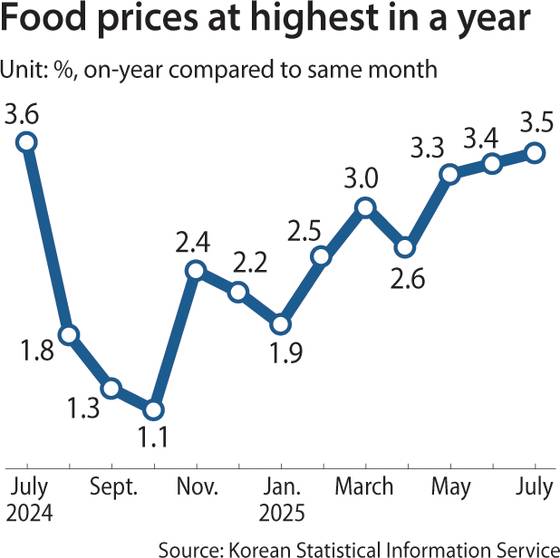
The July index for food and nonalcoholic beverages rose 3.5 percent on year to 125.75, with 2020 serving as the basis of 100, outpacing the overall consumer price index increase of 2.1 percent, according to Statistics Korea’s Korean Statistical Information Service database on Monday.
The rate of inflation was the highest for food and beverages since July 2024, when the index rose by 3.6 percent. The category also contributed the most to overall inflation among all expenditures last month, pushing prices up by 0.5 percentage points.
The category’s growth rate, which stayed in the 2 to 3 percent range from late 2024 to May this year, climbed to 3.4 percent in June and remained in the mid-3 percent range for a second month in July. The jump was attributed to extreme weather, such as summer heat waves and heavy rains, and continued increases in processed food prices.
By item, fish and seafood saw the biggest jump at 7.2 percent, the highest in two years, driven by sharp gains in dried squid, which rose 42.9 percent, yellow croaker, up 13.4 percent and mackerel at 12.6 percent. Bread and cereals rose 6.6 percent, the most since September 2023, while rice prices climbed 7.6 percent, returning to the 7 percent range for the first time since March of last year. Instant noodles rose 6.5 percent for a third consecutive month.
Other notable increases included snacks, ice cream and sugar products, which rose 5 percent, other food items in general rose 4.7 percent, while milk, cheese and eggs all rose 3.6 percent and meat prices rose 3.5 percent. Among nonalcoholic beverages, coffee, tea and cocoa-based drinks surged 13.5 percent, while bottled water, soft drinks and juice were up 3.4 percent.
![A shopper looks at produce at a large supermarket in downtown Seoul on Aug. 11. [YONHAP]](https://img4.daumcdn.net/thumb/R658x0.q70/?fname=https://t1.daumcdn.net/news/202508/11/koreajoongangdaily/20250811193141476apnh.jpg)
Public service prices, which include public transit fares, also rose. After staying below 1 percent until February, the public services inflation rate rose to 1.4 percent in March, eased slightly, and returned to 1.4 percent in July.
A 150 won (10 cent) increase in the basic subway fare in the Seoul metropolitan area — from 1,400 to 1,550 won — pushed urban rail transport prices up 7 percent, raising the daily round-trip commuting cost above 3,000 won. City gas prices climbed 6.8 percent and water rates 3.3 percent.
“Korean food prices are considerably higher than those of major countries," the BOK noted previously. "The high prices of essential goods are considered a major factor driving up perceived inflation, especially among vulnerable groups, despite the slowing inflation rate."
![Grocery shoppers browse the shleves large supermarket in downtown Seoul on Aug. 11. [YONHAP]](https://img1.daumcdn.net/thumb/R658x0.q70/?fname=https://t1.daumcdn.net/news/202508/11/koreajoongangdaily/20250811193142810ktnu.jpg)
The prices of fruit, vegetables and meat were more than 1.5 times the average for the Organisation for Economic Cooperation and Development as of 2023, according to the BOK report. Processed foods such as bread and edible oils are also expensive due to low productivity, low import penetration and high distribution costs.
Experts say that beyond the government’s item-specific supply stabilization measures, structural reforms in distribution are needed.
“Climate change and an aging population are reducing the agricultural and fisheries workforce, making supply less stable and prices more volatile,” said Lee Yoon-soo, a professor of economics at Sogang University. “In the long term, Korea should diversify supply chains by increasing imports of high-volatility items to stabilize price levels.”
This article was originally written in Korean and translated by a bilingual reporter with the help of generative AI tools. It was then edited by a native English-speaking editor. All AI-assisted translations are reviewed and refined by our newsroom staff. BY KIM KYUNG-HEE [lim.jeongwon@joongang.co.kr]
Copyright © 코리아중앙데일리. 무단전재 및 재배포 금지.
- This virus has a 50% chance of killing you — and ticks that carry it are running wild
- Watchdog demands stronger internal monitoring for 'Depression Gallery'
- Right-wing group investigated for allegedly tearing Chinese national flag banner
- ‘Nothing short of a death knell’: U.S. tariffs hit small auto firms harder
- Chicken restaurant owner beaten by customer over sign commemorating Sewol ferry tragedy
- 'KPop Demon Hunters' songwriter EJAE finally hits the big time after 'Golden' climbs charts globally
- Police reveal identity of man who allegedly killed gilfriend because she 'disrespected' him
- North Korea mirrors South and dismantles loudspeakers ahead of Liberation Day
- Chasing Felix’s keyring: Why brands spend millions on K-pop 'ambassadors'
- Director Park Chan-wook expelled from the Writers Guild of America for violating union rules