Experts doubt Google’s blurring tactic can resolve Korea's security concerns
![A Google logo is seen at a company research facility in Mountain View, California, U.S., on May 13. [REUTERS/YONHAP]](https://img3.daumcdn.net/thumb/R658x0.q70/?fname=https://t1.daumcdn.net/news/202508/12/koreajoongangdaily/20250812092306533mgoq.jpg)
[NEWS ANALYSIS]
Domestic experts warn that Google’s push to obtain Korea’s high-precision map data for free could jeopardize national security, potentially giving the U.S. tech giant control over critical geospatial layers and leaving Korea dependent on purchasing security-sensitive maps if its own mapping capabilities weaken.
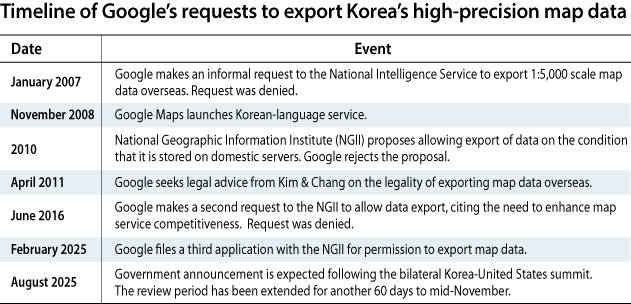
National security concerns have been the top priority for the Korean government’s multiple refusals to allow Google to access 1:5,000-scale base maps. The current 1:25,000-scale data the U.S. company uses lacks the detail needed to provide accurate guidance for turn-by-turn navigation purposes, according to Google.
Experts have cautioned that 1:5,000-scale maps, with a precision of 50 meters of data in 1 centimeter, are accurate enough to directly target artillery.
In turn, Google stated in a blog post on Aug. 5 that it is looking to implement blurring measures for sensitive sites on both Google Maps and Google Earth. It is even considering purchasing preblurred, government-approved imagery from domestic companies.
“It would likely require sending purchased satellite imagery to a Korean security firm for processing,” said Prof. Choi Jin-mu of the Geography Department at Kyung Hee University. For Google, “this procedure would be complex, and questions remain over how it will handle historical imagery already in its possession.”
The Korean government has once again deferred its decision whether to allow Google to export high-precision maps of Korea, this time upon the U.S. tech giant’s request as it seeks to come up with additional measures to address Seoul’s national security concerns.
This second postponement pushes back the decision due date to mid-November. Apple entered the fray in June with a similar request, and a ruling on its case is expected next month.
Multiple domestic reports, including from the JoongAng Ilbo, pinpoint a decision to be reached after the bilateral Korea-U.S. summit, where digital regulations are on the agenda. Google insists its request is nothing unusual, noting that the data is part of the national base map approved by the National Geographic Information Institute and already in use by domestic firms.
Yet experts say the stakes go beyond routine data access. Even if the government rejects the current requests from Google and Apple, foreign tech giants are expected to keep pressing for the information to power emerging sectors such as autonomous driving and digital twins.
“The government needs to come up with firm security safeguards to such requests,” Choi said, suggesting that Korea could release only nonsensitive layers of the 1:5,000 map that are relevant for navigation or self-driving services.
Google has previously rejected Seoul’s condition to host domestic servers in exchange for approval.
“Keeping servers in Korea isn’t just about security — it makes the company a domestic operator subject to local taxes,” said Prof. Mo Jung-hoon of Industrial Engineering at Yonsei University. “What Google wants is to leverage highly valuable data that underpins future growth engines without paying a fair price for it.”
Choi warns that the worst-case scenario would see Seoul dependent on Google for security-related map data, compelling the government and sectors such as defense to purchase Google Maps for their Geographic Information Systems. Korea’s domestic mapping industry, he adds, could collapse if Google undercuts current production costs — only to later raise prices to levels the country could hardly afford.
BY LEE JAE-LIM [lee.jaelim@joongang.co.kr]
Copyright © 코리아중앙데일리. 무단전재 및 재배포 금지.
- Air rifle, live rounds recovered in abandoned Guro factory
- Court orders YouTuber to pay 30 million won to NewJeans for sexual harassment
- Korean Air to cram extra — smaller — seat in each economy row
- Twice's Nayeon, Momo and Tzuyu create picture book for pediatric patients
- North vows 'resolute counteraction posture' to South-U.S. military drills
- 'By your side': BTS's Jin wraps up world tour with Amsterdam concert
- 'KPop Demon Hunters' songwriter EJAE finally hits the big time after 'Golden' climbs charts globally
- Watchdog demands stronger internal monitoring for 'Depression Gallery'
- Police reveal identity of man who allegedly killed girlfriend because she 'disrespected' him
- Former Rebuilding Korea Party leader Cho Kuk among 836,000 pardoned by president