Korean banks step up US push to finance post-tariff expansion
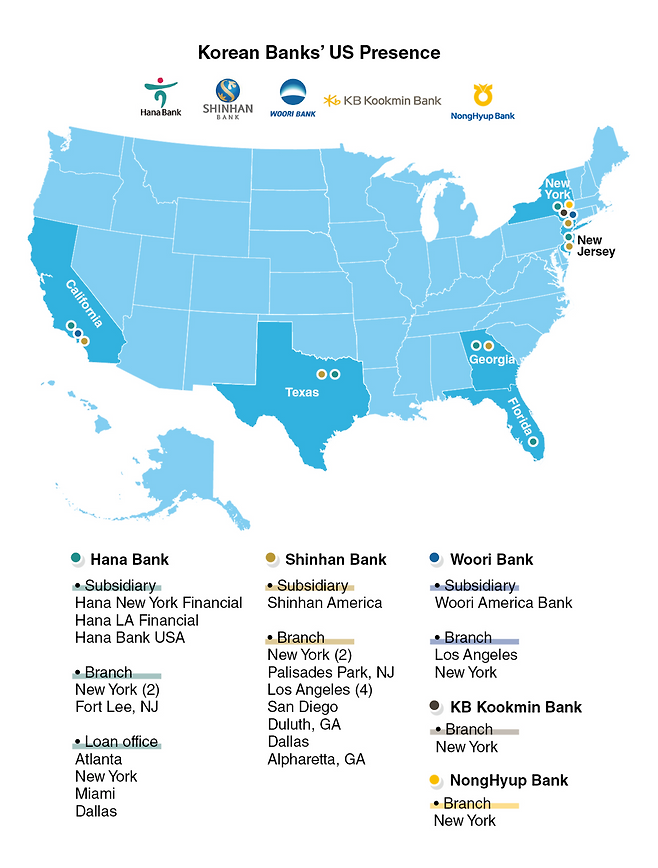
Major Korean lenders are strengthening their financial footholds in the US to support Korean companies expanding operations there, as new tariff tensions and investment commitments reshape the bilateral trade landscape.
The push follows an agreement struck at the end of July between Seoul and Washington to impose 15 percent "reciprocal" tariffs on Korean exports to the US — down from a threatened 25 percent, but far above the near-zero duties guaranteed under the 2012 Korea-US free trade agreement.
In return, Korea pledged about $350 billion in US-linked investments spanning shipbuilding, semiconductors, energy and biotechnology, plus $100 billion in US energy purchases.
The move comes amid sweeping US industrial policies such as the CHIPS Act and Inflation Reduction Act, which are pushing global manufacturers to expand stateside.
Conglomerates like Samsung and Hyundai are accelerating US production to hedge against tariff risks and secure access to policy incentives, a shift that is driving up demand for financing in high-tech manufacturing, batteries for electric vehicles and energy infrastructure.
With trade terms stabilized, Korean banks are mobilizing to meet growing financing needs, particularly in sectors tied to US industrial priorities.
Among Korea’s leading financial institutions, Shinhan Bank, Woori Bank and Hana Bank operate subsidiaries in the US, while KB Kookmin Bank and Nonghyup Bank each maintain a single branch in New York.
Shinhan Bank is reviewing plans to step up support for Korean businesses through Shinhan Bank America, its New York-based US unit.
“Following the tariff deal, we expect increased Korean investment in shipbuilding, semiconductors, energy, EV batteries and biotechnology, along with further localization in auto production,” a Shinhan official said.
Last year, the bank established a representative office in Georgia, where Hyundai Motor Group launched a new EV plant in March. Shinhan’s Georgia office is positioned to meet rising demand for project financing, energy infrastructure loans and corporate lending.
An anticipated uptick in US business could reshape that overseas earnings mix.
The bank posted over 500 billion won ($360 million) in net profit from overseas operations, mainly in Vietnam, Japan and Kazakhstan, ranking first among Korea’s top four banks in both earnings and growth.
Woori Bank, the operator of Woori America Bank, is preparing to expand liquidity support for Korean exporters and SMEs. The lender plans to open a branch in Austin, Texas, home to Samsung Electronics’ semiconductor plant and a growing cluster of Korean suppliers, by late September or early October.
“With Samsung and affiliated companies scaling up operations, we’re seeing growing Korean business and residential communities in the region,” a Woori official said. “That will create momentum for local commerce.”
The Austin location will be the first retail branch opened by a Korean lender in the city and aims to support small businesses and provide localized financial services.
Hana Bank operates three US-based subsidiaries -- KEB Hana New York Financial, KEB Hana Los Angeles Financial and New Jersey-based Hana Bank USA -- alongside its New York branch.
The bank is currently evaluating the impact of the tariff deal on financial markets and Korean companies operating in the US, while reinforcing risk monitoring and scenario planning frameworks.
“We’re closely tracking the implications of rising tariffs and are committed to ensuring Korean firms abroad receive the financial support they need,” a Hana official said.
The lender intends to expand corporate banking services tailored to Korean companies adjusting to the evolving trade environment between Seoul and Washington.
NongHyup Bank plans to expand funding channels through partnerships with local companies and financial institutions, while diversifying its loan portfolio in corporate and infrastructure finance to build a more stable revenue base.
After turning profitable in 2023, its New York branch seeks to grow into a global profit center under a long-term strategy including exploring additional affiliate entries to the US market to boost synergies between banking and nonbanking units.
KB Kookmin Bank’s sole US branch in New York plans to step up monitoring of global and US tariff agreements’ impact on the real economy, while reinforcing risk management checks.
In addition to its US operations, KB Kookmin supported Hyundai Motor Group’s struggling domestic suppliers affected by US tariffs by providing special guarantees in April.
Copyright © 코리아헤럴드. 무단전재 및 재배포 금지.