Homeplus sale tests Coupang’s appetite for offline retail push
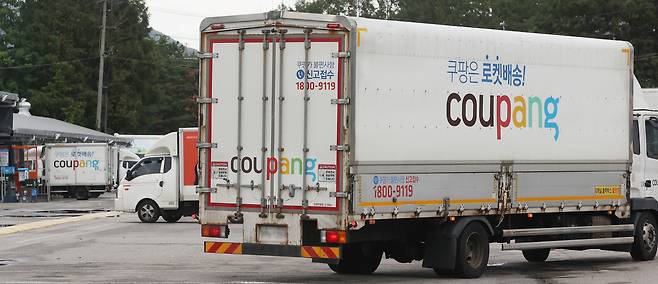
Homeplus, Korea's No. 2 discount supermarket chain, remains in limbo as it undergoes court-led rehabilitation, now up for sale through a full-package merger and acquisition process ahead of its restructuring.
While speculation swirls over which players might step in, market watchers point to e-commerce giant Coupang as best positioned to acquire the chain, becoming a full-spectrum retail powerhouse.
That, in turn, raises the question: Is Coupang prepared to take a leap of faith on this distressed asset and ultimately extend its online dominance to brick-and-mortar retail?
While no definitive suitor has yet stepped forward to acquire Homeplus, which filed for court rehabilitation in March, industry insiders have suggested retail operators, such as Coupang, the National Agricultural Cooperative Federation, Shinsegae's E-mart and Lotte.
They largely ruled out financial investors due to ongoing uncertainty in the hypermarket sector.
Coupang’s viability as a bidder stems from its financial capacity to absorb Homeplus’ distressed debt while retaining ample headroom for further capital investment. As of the end of last year, Coupang held 5.77 trillion won ($4.14 billion) in cash and equivalents, with a net cash position of 2.08 trillion won after debt.
“Only Coupang has the capital, the infrastructure and the strategic ambition to make Homeplus work,” said one industry official.
Homeplus’s estimated liquidation value stands at 3.7 trillion won, higher than its going-concern value of 2.5 trillion, which, according to the company, reflects an asset base that exceeds liabilities by roughly 4 trillion won. The retailer holds total assets of 6.8 trillion won, of which around 2.9 trillion won are liabilities.
In this light, the company stated that the sale price could fall below 1 trillion won if the buyer uses a real estate-backed financing structure.
Immediate management control would also be possible without acquiring existing shares, as private equity owner MBK Partners has signaled its willingness to forgo its 2.5 trillion won equity stake.
Coupang would also stand to gain substantially from the acquisition, much like its American counterpart, Amazon, did with its $13.7 billion purchase of Whole Foods in 2017.
Since its acquisition by Amazon, Whole Foods has increased its store count by 15 percent and grown sales by 40 percent as of last year.
In 2023, Coupang founder and CEO Kim Bom projected that Korea’s retail market could surpass $700 billion, underscoring the vast untapped potential.
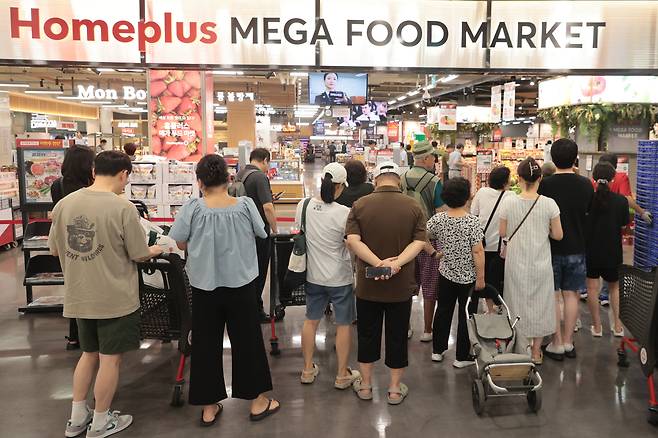
Homeplus owns 126 hypermarkets and 308 smaller-format stores across the country — locations that could immediately boost Coupang's already impressive logistics capabilities. It would add a nationwide network for food distribution, last-mile fulfillment and physical brand presence, particularly outside the Seoul area, where its current networks are weaker.
Industry officials note that a broader physical footprint could deepen the company's understanding of its consumers and strengthen brand loyalty.
“For Coupang, which currently has no market share in offline retail, acquiring Homeplus could immediately elevate its presence as a brick-and-mortar player,” said one industry insider. “The deal could enable the company to complete an Amazon-style model within the Korean market.”
Still, it remains unclear whether the online retail giant, so far silent on any formal bid, will make a move.
There are a host of complicating factors that could be giving Coupang pause, including industry stagnation, labor union resistance and Homeplus’ continued financial underperformance.
Homeplus posted an operating loss of 314.2 billion won last year, marking its fourth consecutive year in the red. The company’s labor union, which has condemned the proposed sale by MBK Partners as an “attempt to strip assets and exit,” is calling for direct government intervention and regulatory oversight should an M&A proceed.
Despite these concerns, Coupang’s potential move into physical retail could give it an edge in an e-commerce landscape increasingly defined by fierce competition — from deep-pocketed rival Naver to fast-rising Chinese players like AliExpress and Temu.
“Conventional (online) marketplaces may face an uphill battle competing against Naver, which is backed by substantial financial resources,” said one e-commerce industry insider.
According to data from analytics firm WiseApp Retail, Coupang led the domestic market in gross merchandise volume last year with a 22.7 percent share, narrowly ahead of Naver’s 20.7 percent.
Copyright © 코리아헤럴드. 무단전재 및 재배포 금지.