E-Land Group puts 9 brands up for sale as part of F&B restructuring
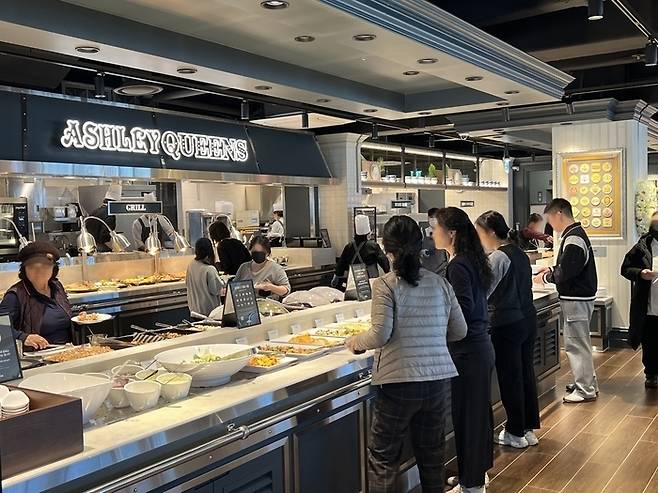
According to sources from the investment banking (IB) industry on Wednesday, E-Land recently began the process of selling nine F&B brands operated by its subsidiary Elandeats.
The company is seeking potential buyers through Samjong KPMG, which is overseeing the sale.
Elandeats was established on July 1, 2019, as a spin-off of the dining business division from E-Land Park.
It currently operates 19 restaurant brands, including buffet-style family restaurant Ashley Queens, Korean buffet chain Nature Kitchen, Pizza Mall, and shabu-shabu restaurant Loun.
Among these, six dining brands and three café/dessert brands have been put up for sale. The dining brands include Bangoong, Steak Us, Teroo, Tepanyakki Daguo, Asia Moon, and Huwon, while the café/dessert brands are The Caffe, Lugo, and Perché No.
Sources viewed E-Land’s move as an effort to streamline non-core assets to focus on its flagship brands.
Elandeats has seen its business stabilize, surpassing 400 billion won ($288.84 million) in sales about five years after the spin-off.
According to the Financial Supervisory Service’s electronic disclosure system (DART), E-Land recorded sales of 470.5 billion won and operating profit of 31.9 billion won last year, up 32 percent and 79 percent, respectively, from the previous year.
This success was largely driven by the revival of its flagship brand, Ashley Queens, which reportedly accounts for around 70 percent of total sales.
Ashley opened 33 new locations last year, bringing its total store count to 110.
During the height of the Covid-19 pandemic in 2020, Ashley’s sales had dropped to less than half of previous levels.
In 2021, the company posted a net loss of 31.7 billion won.
Since then, E-Land has closed underperforming Ashley locations and revamped its menu, leading to a strong turnaround.
The company’s focus on value-for-money dining has also paid off.
Ashley has maintained a weekday lunch price of 19,900 won for adults and has not raised prices since November 2022.
The nine brands now up for sale account for only a small portion of the company’s overall performance, sources said.
Their combined revenue and earnings before interest, taxes, depreciation, and amortization (EBITDA) stand at around 18 billion won and 2.3 billion won, respectively.
Given the EBITDA size, the sale price is expected to be in in the tens of billions of won.
However, some sources suggested that the sale process could take some time due to a saturated market for such assets.
There are also policy-related risks.
The ruling Democratic Party of Korea recently proposed an amendment to the Franchise Business Act, which includes clauses mandating that franchisors share certain costs and refrain from interfering in franchisee operations.
Under the proposal, shifting costs to franchisees unfairly could result in up to two years of imprisonment or fines up to 100 million won.
“Elandeats is currently pursuing a package deal that bundles the nine brands together,” a source said. “It seems it is looking for potential buyers through its advisor, with the intention of disposing of its non-core assets.”
Copyright © 매일경제 & mk.co.kr. 무단 전재, 재배포 및 AI학습 이용 금지
- 오늘의 운세 2025년 8월 7일 木(음력 윤 6월 14일) - 매일경제
- [속보] 삼성전자, 애플 차세대 칩 미국 파운드리 공장서 생산 - 매일경제
- ‘트럼프 관세’ 타결 일등공신이라더니…3대 암초에 삐걱대는 한미 조선협력 - 매일경제
- 홍진경, 결혼 22년 만 합의 이혼…“남은 시간 따로 잘 살고자” - 매일경제
- [단독] “노조출신은 사양”…한국조선에 도움 달라던 미국의 걱정 - 매일경제
- 트럼프 “반도체에 관세 100%”...위기의 한국 반도체 - 매일경제
- “이래도 마트 안 올래?”…‘소비쿠폰 제외’ 대형마트, 이것까지 내놨다 - 매일경제
- “우리회사도 가상화폐 모으겠습니다”…기업들, 비트코인 이어 ‘이 코인’도 산다 - 매일경제
- “스미싱문자, 언제 받았는지도 모르게 당했다”…5천만원 빼가도 모두 ‘나몰라라’ - 매일경
- [오피셜] ‘세계 축구 아이콘’ 손흥민, LA FC 이적 확정! “쏘니를 이 팀, 이 도시로 데려오는 건