Hyundai Motor braces for overhaul as US tariffs reshape export strategy
전체 맥락을 이해하기 위해서는 본문 보기를 권장합니다.
"Previously, Japan and the EU had faced higher US tariffs without a free trade agreement like Korea. Now, with all facing the same 15 percent tariff, their vehicles have gained a price advantage over Korean models," said Park Cheol-wan, an automotive engineering professor at Seojeong University. "However, Hyundai cannot pass the tariff burden on to US consumers, who will turn away if it increases prices higher than other carmakers."
Park added, "Hyundai will need to completely revamp product planning by adjusting incentives and vehicle options. This means removing features previously included as standard and diversifying options to maintain price levels as much as possible."
이 글자크기로 변경됩니다.
(예시) 가장 빠른 뉴스가 있고 다양한 정보, 쌍방향 소통이 숨쉬는 다음뉴스를 만나보세요. 다음뉴스는 국내외 주요이슈와 실시간 속보, 문화생활 및 다양한 분야의 뉴스를 입체적으로 전달하고 있습니다.
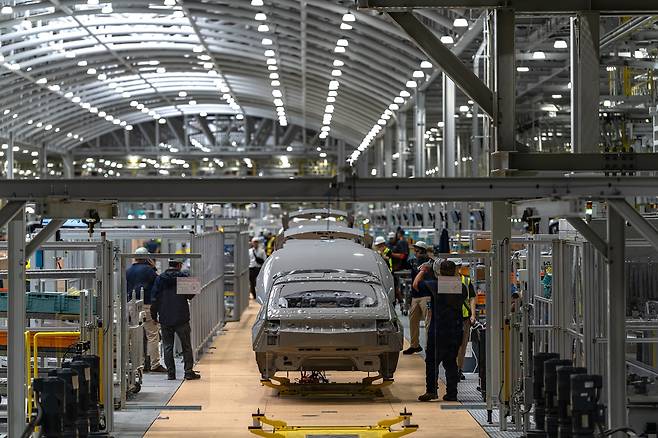
The 15 percent tariff agreement between South Korea and the US is sending shock waves through Hyundai Motor Group, which heavily relies on exports to the world’s second-largest car market.
The impact seems particularly challenging for the Korean auto giant, forcing a fundamental overhaul of its US strategy, including price adjustments and relocation of production for key vehicle models from Korea to the US.
The newly imposed 15 percent levy ― though lower than the previously threatened 25 percent ― casts a bleak outlook on Hyundai’s profit prospects, as the company cannot pursue aggressive price increases without risking its standing as the third-largest automaker in the US market.
Hyundai Motor and Kia sell about 6 million to 7 million cars globally each year, with 1.5 million exported to the US, approximately a quarter of total sales. With US tariffs now at 15 percent, multiplying this portion by the tariff rate suggests an estimated 3 to 4 percent hit to Hyundai’s overall profit margin, according to industry sources.
This implies that to protect profitability, the carmakers would have to raise vehicle prices by over 3 percent.
Asked about potential price adjustments in the US, Hyundai Motor declined to comment, citing confidentiality. Lee Seung-jo, chief financial and strategy officer of Hyundai Motor Co., had mentioned during a recent second-quarter earnings conference call, “We are adopting a fast-follower strategy rather than leading with price hikes. It’s difficult to share the specific timeline for any price increases.”
Experts suggest that Hyundai’s price adjustments are likely to be more “subtle” than rivals including Toyota, which marked up the price tags for Toyota and Lexus models by $208 to $270 from last month to mitigate tariff impacts.
“Previously, Japan and the EU had faced higher US tariffs without a free trade agreement like Korea. Now, with all facing the same 15 percent tariff, their vehicles have gained a price advantage over Korean models,” said Park Cheol-wan, an automotive engineering professor at Seojeong University. “However, Hyundai cannot pass the tariff burden on to US consumers, who will turn away if it increases prices higher than other carmakers.”
Park added, “Hyundai will need to completely revamp product planning by adjusting incentives and vehicle options. This means removing features previously included as standard and diversifying options to maintain price levels as much as possible.”
For instance, the company could tailor options by region ― offering features like ventilated or heated seats only where needed ― to limit overall price hikes.
Hyundai Motor and Kia face a more pressing issue -- negotiations with hard-line labor unions to redirect the production volume of popular vehicle models, particularly SUVs and hybrids, from Korea to the US.
“Given that it is inevitable to expand production in the US (to curb the impact of tariffs), Hyundai Motor Group has started discussions with its labor union on redirecting a portion of its domestic production volume to the US,” said a source familiar with the matter on condition of anonymity.
Hyundai and Kia’s bestselling cars in the US, such as the Santa Fe SUV, Tucson SUV and Sportage SUV, are produced both within the US and imported from Korea.
All hybrid models ― highly popular eco-friendly vehicles in the US market that significantly prevented a further profit decline in the second quarter ― are produced exclusively in Korea.
Hyundai Motor Group reported a 38.2 percent increase in its US hybrid sales, climbing to 28,733 vehicles sold in July compared to the previous year. Hyundai Motor saw a 36.4 percent rise, while Kia experienced an even greater 68.9 percent increase. Notably, the Santa Fe Hybrid reached a record high of 7,465 sold.
Kim Pil-su, a car engineering professor at Daelim University, noted, “Producing hybrid models in the US would allow Hyundai to avoid tariffs and protect its market share. But in order to do that, most importantly, it needs to get approval from the labor union, which has so far prevented the company from ramping up production in the US.”
In a 1999 collective agreement, Hyundai Motor and Kia included a clause requiring a joint labor-management committee review and approval before transferring vehicle models to overseas plants.
Park views that the annual production quotas previously agreed upon by the union for domestic plants must now be reconsidered from scratch, as the new US tariffs present a “life-or-death threat” to Hyundai Motor Group.
“With 1.4 to 1.5 million vehicles exported to North America at risk, a large part of production may need to move there,” said Park.
“Though the union is likely to resist, even the strong United Auto Workers in the US cooperated with management during the global financial crisis in 2007, when the industry’s survival was on the line. Without union concessions, Hyundai’s profit will suffer, which will ultimately affect domestic workers’ wages and incentives.”
Copyright © 코리아헤럴드. 무단전재 및 재배포 금지.