Mecca for surfing or flirting? Yangyang's struggle with online myths
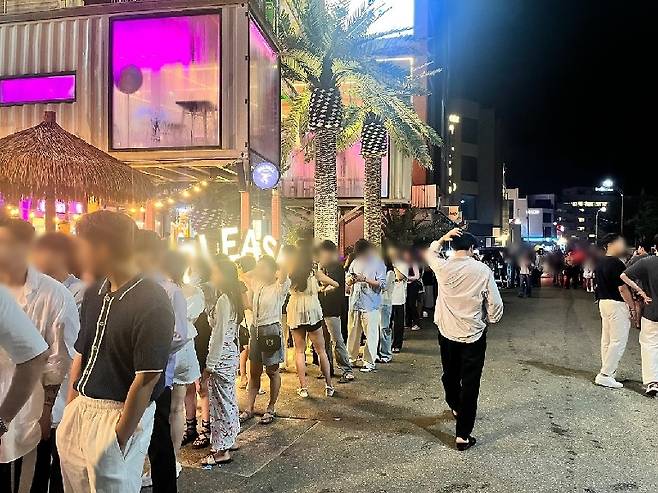
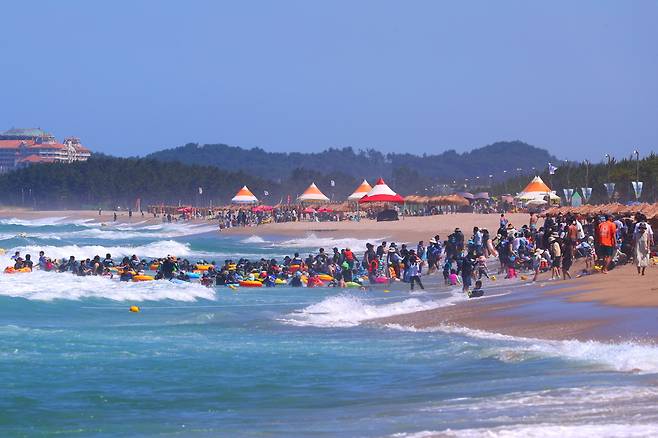
Yangyang, a coastal county in Gangwon Province, is home to scenic mountain ranges and picturesque beaches such as Surfyy Beach, Korea’s first private beach catering exclusively to surfing enthusiasts.
But while Yangyang promotes itself as a haven for nature lovers, social media tells a different story.
On most social media platforms, searches for Yangyang often bring up the unexpected related keyword “hunting,” a loan word that in Korea refers to flirting, under which flashy images and videos of nightclubs and beach parties frequently appear.
Grace Seo, a Korean American who enjoys surfing and visited Korea last month for the first time in three years, told The Korea Herald she was startled to come across Instagram posts showing half-naked men and bikini-clad women dancing closely together on a beach in Yangyang.
“It just wasn’t the kind of Yangyang I imagined, so I was a bit taken aback. I was going to take some of my foreign friends, but after seeing all those party videos, I wasn’t sure it’d be a good idea," Seo said.
Yangyang’s beaches, however, turned out not to be as provocative as the Instagram posts had led her to believe, she said, although there were some parties at a few beachside bars.
“Most tourist areas have bars or clubs where people drink and flirt. Yangyang isn’t all about partying, but with so many social media posts showing that side, outsiders like me might get the wrong idea," she said.
In addition to its image as a flirting hotspot, the beach town has been further stigmatized by groundless rumors, again circulating primarily online.
In 2023, for example, an anonymous user posted a claim on an online community that a woman who had visited a surfing beach in Yangyang was sexually assaulted by a group of foreign tourists. However, a police investigation later determined that the claim was false.
Also, expressions such as “Avoid dating anyone who’s been to Yangyang,” now widespread on social media, reflect how the area has become a target of online ridicule.
The county government, along with local residents and businesses, has stepped up to address the image crisis, warning against the spreading of false information online and citing the region’s negative reputation as a key factor behind a recent decline in tourism.
The number of visitors to Yangyang’s beaches in August last year stood at 691,160, down 10 percent from 767,560 a year earlier, while the other five cities and counties in the province, including Gangneung and Sokcho, saw an increase in beachgoers, ranging from 8 to 29 percent during the same period, according to data from Gangwon Province.
“Tourism plays a vital role in our local economy, so false rumors circulating online directly threaten the livelihoods of our residents,” a Yangyang County official said.
“We won’t tolerate false claims and will step up online monitoring.”
Some Yangyang residents have formed a group, mostly consisting of those in the restaurant and accommodation sectors who have been hit hard by false rumors about their hometown, to call on authorities to take action.
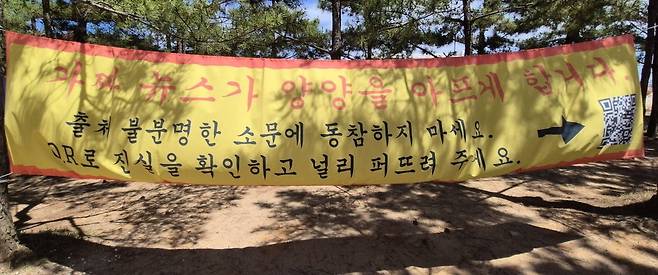
Last month, they put up a banner near Ingu Beach, a popular surfing destination, urging people not to trust the false rumors about the area circulating online. The banner featured a QR code linked to the group’s YouTube channel, where members posted several short videos challenging the claims.
Park, who has run a Korean restaurant in Yangyang since 2015 and is one of the group’s members, wrote in an Instagram post, “Many local residents now feel embarrassed to say they are from Yangyang, and companies have become increasingly hesitant to host events here.”
He also argued that nightlife venues exist in every city, including in Seoul and on Jeju Island, and that labeling the entire Yangyang region as a nightlife destination based on a few establishments is unfair.
How to fight a bad image, according to experts
According to Lee Hoon, a professor of tourism at Hanyang University, Yangyang’s image as a casual dating spot has largely been shaped by social media’s tendency to amplify and replicate certain types of content.
"Many nightlife venues in tourist destinations now actively promote themselves on social media, which is especially effective in attracting foreign visitors. In Yangyang’s case, some venues have posted provocative content that gained traction, leading people to believe these venues are more common in Yangyang than they really are," Lee said.
“To counter false online rumors, it’s important to take a proactive approach using the same social platforms by creating content featuring authentic experiences from visitors to introduce the county’s diverse attractions."
Meanwhile, a geography expert noted that the public perception of a region plays a key role in attracting tourists, pointing to a need for more proactive regional branding efforts.
“Space is socially constructed. In tourism, this means a destination’s success depends not only on physical and institutional infrastructure, but also on how people collectively perceive it,” said Kim Jurak, associate research fellow at the Korea Research Institute for Local Administration.
“In international tourism especially, where direct knowledge is limited, a region’s image is often shaped more by surrounding narratives than by reality.”
Kim emphasized the importance of consistent regional branding to improve Yangyang’s public image.
“While legal action against misinformation is important, Yangyang should also focus on creating a catchy slogan, organizing festivals and events to attract visitors, and producing online promotional content in response to the wave of negative narratives,” he said.
Copyright © 코리아헤럴드. 무단전재 및 재배포 금지.