Hanwha says US Navy chief toured Philly Shipyard ahead of Korea-US tariff deal
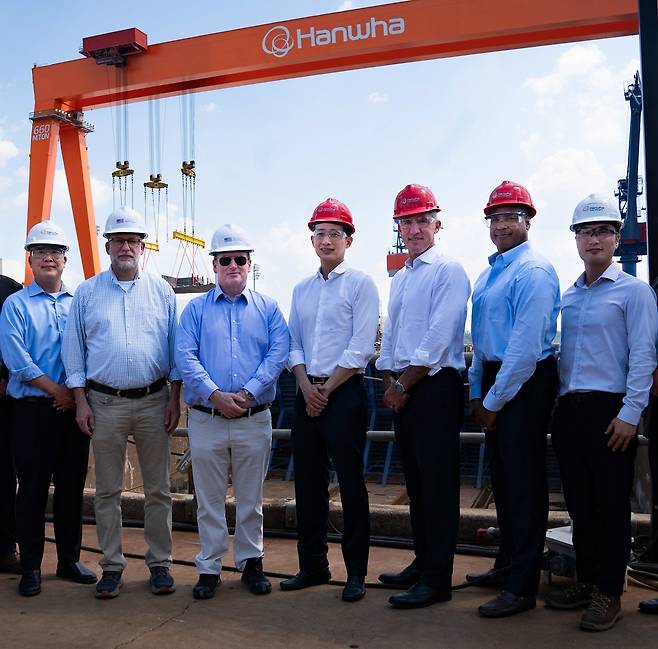
US Navy Secretary John Phelan and White House Budget Director Russell Vought visited Hanwha Group's Philly Shipyard in Philadelphia on Wednesday, just hours before South Korea and the US finalized their new tariff agreement, Hanwha said Friday.
The visit is seen as a contributing factor in the deal, with a shipbuilding partnership between the two countries reportedly playing a key role.
According to Hanwha, Phelan and Vought toured major production facilities at the Philadelphia site, guided by Hanwha Group Vice Chair Kim Dong-kwan, alongside other senior US government officials.
The US delegation also visited Hanwha’s welding training center and inspected equipment relocated from the company's Hanwha Ocean shipyard in Geoje, South Gyeongsang Province.
Hanwha said the American officials' visit focused on reviewing the company's investments to bolster local shipbuilding capacity. Phelan emphasized that establishing a robust marine industry foundation was a top priority for both the Trump administration and the US Navy.
Kim reiterated Hanwha’s commitment to supporting the revitalization of US shipbuilding by establishing new shipyards and developing related industrial networks.
On the day of the visit, Korea and the US agreed to reduce the planned reciprocal tariffs on imports to the US from 25 percent to 15 percent, including on automobiles and auto parts.
Hanwha cited a US government source as saying that feedback from the delegation was delivered to US President Donald Trump and influenced the final outcome of the deal.
During negotiations, Korea proposed the "Make American Shipbuilding Great Again," or MASGA, an initiative aimed at revitalizing the US shipbuilding industry. Of the $350 billion Korea pledged to invest in the US as part of the agreement, $150 billion will be allocated to enhancing the shipbuilding partnership.
Kim also traveled to the US to support the negotiations. Hanwha’s Philadelphia Shipyard, acquired for $100 million in 2024, has been positioned as a symbol of Korean support for the US shipbuilding industry.
Trade Minister Yeo Han-koo, a member of Korea's tariff negotiation team, said business leaders, including Kim, worked closely with the government by sharing strategic information and leveraging their networks.
“I believe their support definitely contributed to the success of the deal," Yeo said in a briefing after the tariff deal concluded on Wednesday.
Hanwha plans to expand the shipyard as a center for shipbuilding, maintenance, overhaul and repair for US naval vessels. The company said it will apply production and operations systems used in Korea to increase annual capacity from one ship to 10 by 2035.
Copyright © 코리아헤럴드. 무단전재 및 재배포 금지.