Pro-labor, broadcast reform bills to be put to vote next week
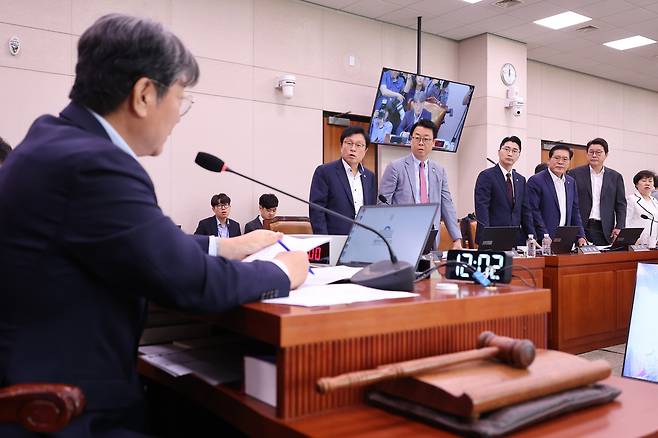
Several contentious bills, including one pro-labor bill and three aimed at reducing government influence over public broadcasters, will be put to a vote at the National Assembly next week after a parliamentary standing committee approved them on Friday.
The Assembly’s Legislation and Judiciary Committee, led by the ruling Democratic Party of Korea, voted in favor of passing the three broadcasting bills and the pro-labor bill dubbed the “Yellow Envelope Law” during a meeting. All four bills are sponsored by the ruling party and the liberal Lee Jae Myung administration.
With 16 of the 18 committee members in attendance, all bills passed after 10 voted in favor, with six abstentions. Of the total 18 members, 10 are lawmakers of the ruling party, including the committee’s chair, Rep. Lee Choon-suak of the Democratic Party. Seven are main opposition People Power Party lawmakers, while one is a member of the minor progressive Rebuilding Korea Party.
Committee members belonging to the People Power Party vocally protested during Friday’s vote. Democratic Party members, however, refused to hold a debate over the bills despite the main opposition’s request.
The bills will be put to a vote during a parliamentary plenary session scheduled for Monday. The People Power Party announced plans to launch a filibuster to delay the passage of the legislation.
The “Yellow Envelope Law” is a revision to the Trade Union and Labor Relations Adjustment Act that focuses on restricting companies from claiming damages against legitimate disputes involving labor unions. The nickname stems from the donations that the public sent to support SsangYong Motor workers in 2014, after they were laid off and faced court orders to compensate their employer for the damages made to company properties during a strike.
South Korean business lobby groups, the American Chamber of Commerce in Korea and the European Chamber of Commerce have all voiced concerns that the passage of the bill could prompt foreign companies to withdraw from the Korean market.
Meanwhile, the amendments to the Broadcasting Act, the Foundation for Broadcast Culture Act and the Korea Educational Broadcasting System Act aim to increase the number of board directors at public broadcasters KBS, MBC and EBS, respectively. The set of bills quintessentially seeks to reform the governance structure of the public broadcasters by reducing the government and the National Assembly’s power to name the board directors. The opposition claims the restructuring aims to reinforce the influence of labor unions.
All four bills were previously vetoed by former President Yoon Suk Yeol when he was in office, after the Assembly at the time, led by then-main opposition Democratic Party, passed them.
Copyright © 코리아헤럴드. 무단전재 및 재배포 금지.