Autograph of Korean marathon hero Sohn Kee-chung featured in liberation exhibition at National Museum of Korea
이 글자크기로 변경됩니다.
(예시) 가장 빠른 뉴스가 있고 다양한 정보, 쌍방향 소통이 숨쉬는 다음뉴스를 만나보세요. 다음뉴스는 국내외 주요이슈와 실시간 속보, 문화생활 및 다양한 분야의 뉴스를 입체적으로 전달하고 있습니다.
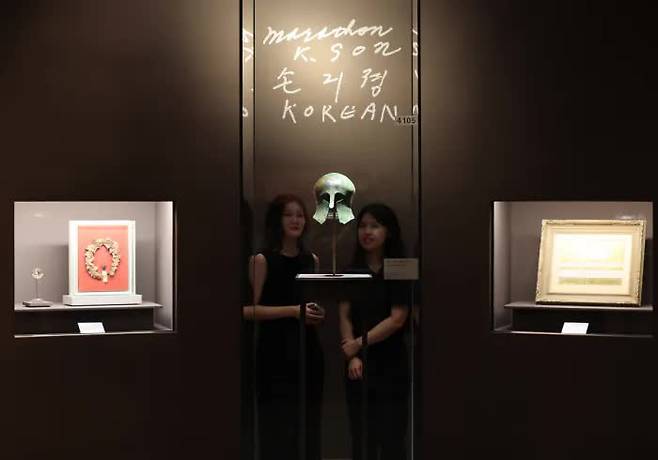
“marathon K. Son 손긔졍 KOREAN 1936 15.8”
The eye is drawn to the name “손긔졍,” handwritten on a faded postcard. Sohn Kee-chung, the winner of the marathon at the Berlin Olympics in 1936, was known to insist on signing his name as “손긔졍” rather than the Japanized version “KITEI,” even for foreign autograph seekers. In his autobiography ‘My Homeland, My Marathon” (1983), he wrote, “The biggest dilemma when meeting all those well-wishers was whether I should let them know I was Korean, not Japanese,” recalling, “Even though it often caused trouble, I would sign my name in Hangul and often include a map of Korea or the word ‘KOREA’ in English.”
By coincidence, this postcard, signed on August 15, exactly nine years before Korea’s liberation, was acquired at auction in 1979 by private collector Heo Jin-do. It is now on public display for the first time at the special exhibition “Conquering the World on Foot,” which opened on July 25 at the National Museum of Korea in celebration of the 80th anniversary of Korea’s liberation.
The iconic act of removing the Japanese flag from a photo of Sohn on the Olympic podium came to symbolize a collective reclaiming of Korean national identity. This exhibition retraces Sohn’s legacy as it intersects with modern Korean history, offering a chance to reflect on the meaning of liberation. Though modest in scale, the show features 18 rare artifacts not commonly seen together.
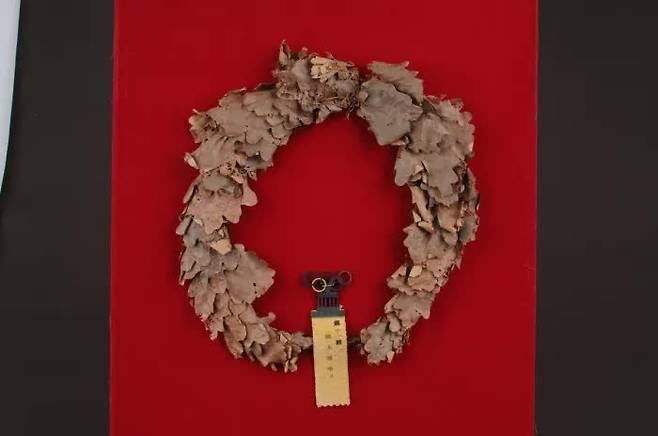
The exhibit space, Donation Room 1 on the second floor of the museum’s permanent exhibition hall, has long been home to the ancient Greek bronze helmet Sohn donated. The helmet had been awarded to him as a prize for winning the Berlin Olympic marathon, and he returned it to Korea after retrieving it 50 years later, donating it to the museum in 1994. This artifact, a Western relic from sixth-century Corinth, is now housed in a Korean national museum, and its journey is a story in itself. What makes this exhibit particularly special is that Sohn’s Olympic gold medal, laurel crown, and winner’s certificate, normally kept at the Sohn Kee-chung Memorial Hall, are also on display together with the helmet. It is the first time in 14 years, since a special exhibition held for the Daegu World Championships in Athletics in 2011, that these items have been shown side by side.
Encountering these objects is like stepping into a cinematic flashback to 89 years ago. The exhibition also uses artificial intelligence (AI) technology to recreate Sohn’s journey, from the young man forced to run under the Japanese flag in 1936, to his students who ran under the name “KOREA” in 1947 and 1950 and were celebrated with the phrase “Foot Conquers the World,” penned by independence leader Kim Koo, to the elder Sohn who carried the Olympic torch during the Seoul Olympics in 1988.
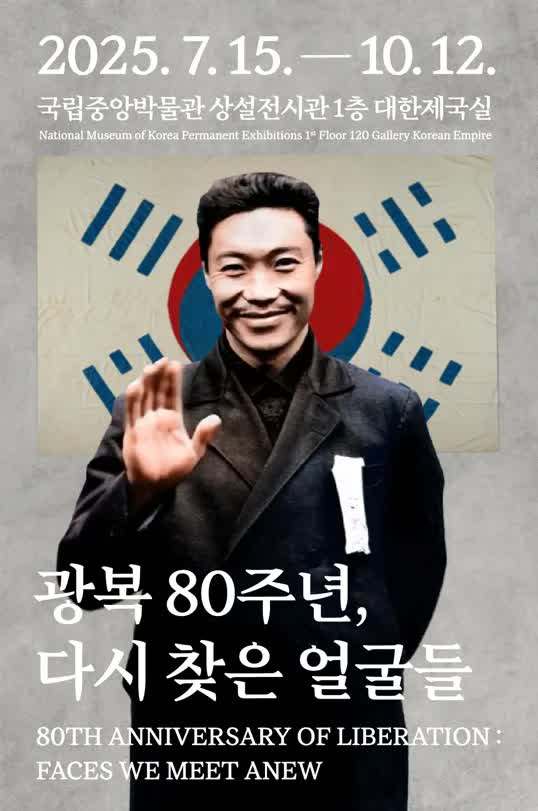
Another exhibition, “80 Years of Liberation: Rediscovered Faces,” is also being held on the first floor in the Korean Empire Gallery. This display features not only well-known independence activists like Yu Gwan-sun, Ahn Chang-ho, and Han Yong-un, but also the faces of fighters whose names have long been forgotten.
A highlight of this exhibition is the first public display of original “Surveillance Cards of Key Independence Figures,” preserved by the National Institute of Korean History. These cards were used by the Japanese Empire to systematically record personal information, prison records, and wanted histories of independence activists. Each card features a photograph taken at the time of arrest or later collected. Some 6,264 cards were accidentally discovered in the early 1980s at what was then the National Police Headquarters (now the Korean National Police Agency).
The cards began to be produced in earnest after Korea’s March 1st Independence Movement and were used as tools to monitor and suppress leading activists. Among those imprisoned during the movement, the oldest was 69-year-old Cha Je-nam, and the youngest was 14-year-old Kim Sung-jae and So Eun-myung. The unfamiliar names and faces evoke many complex thoughts.
The exhibition also includes the final records and portraits of activists who remained steadfast in the face of Japanese oppression. Items on display include calligraphy written in prison by An Jung-geun, who assassinated Ito Hirobumi in Harbin, a letter prepared by Na Seok-ju ahead of his act of resistance, and pledges written by Lee Bong-chang and Yun Bong-gil.
These activists did not live to see Korea’s liberation, but their sacrifices laid the foundation for Korea’s prosperity today. Thanks to AI technology, visitors can now encounter the reconstructed smiles of An Jung-geun, Yu Gwan-sun, Lee Bong-chang, Yun Bong-gil, Ahn Chang-ho, and others, smiles imagined as they might have looked while dreaming of a free and independent Korea.
※This article was translated by an AI tool and edited by a professional translator.
Copyright © 경향신문. 무단전재 및 재배포 금지.
- ‘레전드’ 차붐이 본 월드컵 진단 “한국, 8강 갈 만한 실력…손흥민 여전히 위협적”
- “진짜 경찰관 맞냐” 난동부리다 침 뱉어···잠실 봉쇄 시위 현장서 40대 여성 현행범 체포
- [단독] “수거함 못 찾아 종량제에” 버려진 보조배터리, 시한폭탄 된다
- 조선소 선박 묶던 대형 밧줄 튕겨···40대 노동자 사망
- 4주택자던 한성숙 총리 후보자 ‘1주택자’ 됐다···삼청동 주택 빼고 모두 처분
- 급속히 퍼지는 “트럼프는 성범죄자” 월드컵 구호···백악관 참모진, ‘트럼프 들을라’ 비상
- [여기는 몬테레이] 평균 신장 178cm 수비 허물어라···홍명보호, 남아공전 필승 카드는 ‘고공 축
- ‘이 대통령 소년범’ 모스탄, 출국정지 취소소송 재판부 기피신청 기각
- 제주행 비행기 없다 했더니···재분배 슬롯 놀린 항공사들 때문이었나
- “법까지 뒤집으려는 가해자, 피해자는 당해야 하나”···아리셀 유족의 싸움은 끝나지 않았다