Korea sails into US shipbuilding with $150b MASGA push
전체 맥락을 이해하기 위해서는 본문 보기를 권장합니다.
"Ultimately, the US market is about warships rather than commercial vessels," said a shipbuilding industry official. "The (US) warship market is huge. As (Korean shipbuilders) carry out MRO projects for the US Navy, they might be able to work with US partners to build military vessels for the US at American shipyards or even build them at Korean shipyards."
"There are good chances that Korea will expand local production of high-value-added ships such as (liquefied natural gas carriers) and warships at US shipyards and gain traction for cooperative projects with the US Navy in the future."
이 글자크기로 변경됩니다.
(예시) 가장 빠른 뉴스가 있고 다양한 정보, 쌍방향 소통이 숨쉬는 다음뉴스를 만나보세요. 다음뉴스는 국내외 주요이슈와 실시간 속보, 문화생활 및 다양한 분야의 뉴스를 입체적으로 전달하고 있습니다.
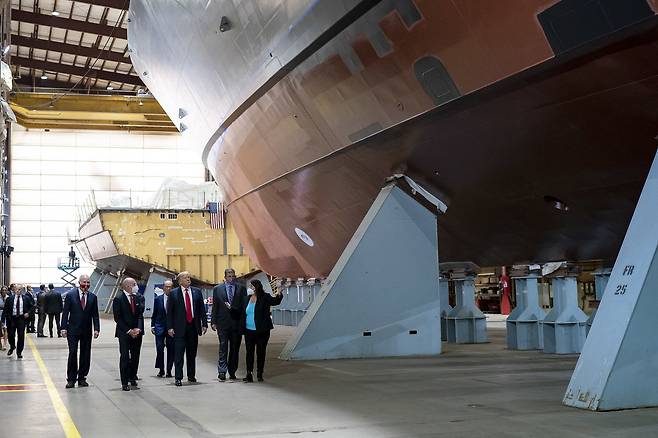
Korean shipbuilders are looking to make the most of cooperation with the US, as the Korean government on Thursday pledged a $150 billion fund to support shipbuilding investments in the US.
Korea’s Deputy Prime Minister and Minister of Economy and Finance Koo Yoon-cheol touted the Make American Shipbuilding Great Again, or MASGA, project as making the biggest difference in the tariff deal struck this week with the Trump administration.
“We expect our shipbuilders, which have world-class ship design and building capabilities, will support the revival of the US shipbuilding sector, create new opportunities and lay the groundwork for growth,” said Koo in a press conference at the South Korean Embassy in Washington.
Named after Trump’s campaign slogan “Make America Great Again,” the MASGA project will be carried out based on the needs of Korean shipbuilders, spanning the entire US shipbuilding industry -- setting up new shipyards, nurturing shipbuilding talent, reestablishing shipbuilding supply chains and conducting maintenance, repair and overhaul, or MRO, according to Koo.
Stakeholders in the shipbuilding industry forecast the $150 billion Korea-US shipbuilding cooperation fund will help Korean shipbuilders expand their businesses in the US as the financial support package includes investments, loans and guarantees.
“Ultimately, the US market is about warships rather than commercial vessels,” said a shipbuilding industry official. “The (US) warship market is huge. As (Korean shipbuilders) carry out MRO projects for the US Navy, they might be able to work with US partners to build military vessels for the US at American shipyards or even build them at Korean shipyards.”
Korea’s shipbuilding leaders -- Hanwha and HD Hyundai -- have already been at the forefront of the US shipbuilding industry’s revival even before the tariff talks began. Hanwha acquired the Philly Shipyard last year and has landed three MRO contracts for US Navy ships so far. HD Hyundai partnered with the biggest American defense shipbuilder Huntington Ingalls Industries while linking up with US shipyard and vessel operator Edison Chouest Offshore to construct ships.
“Through the shipbuilding cooperation with the US, Korea can expect a range of practical benefits such as entering the US warship and commercial vessel market and expanding its presence there, strengthening its strategic position within supply chains, localizing in response to restrictions and securing a steady flow of orders,” said Hong Jin-hee, senior researcher at the Korea Institute for International Economic Policy.
“There are good chances that Korea will expand local production of high-value-added ships such as (liquefied natural gas carriers) and warships at US shipyards and gain traction for cooperative projects with the US Navy in the future.”
The Center for Strategic & International Studies, a nonprofit Washington-based think tank, recently published a report saying it is a "no brainer" for the US to bolster cooperation with Korea in shipbuilding.
“South Korea has retained its cost-competitive edge even as its labor has grown more expensive alongside the development of its economy,” said CSIS.
“Advancements in automation and control systems within its shipbuilding industry have shifted the sector from labor-intensive to technology-driven.”
Copyright © 코리아헤럴드. 무단전재 및 재배포 금지.