S. Korea cuts US auto tariff to 15%, no further opening of rice, beef
이 글자크기로 변경됩니다.
(예시) 가장 빠른 뉴스가 있고 다양한 정보, 쌍방향 소통이 숨쉬는 다음뉴스를 만나보세요. 다음뉴스는 국내외 주요이슈와 실시간 속보, 문화생활 및 다양한 분야의 뉴스를 입체적으로 전달하고 있습니다.
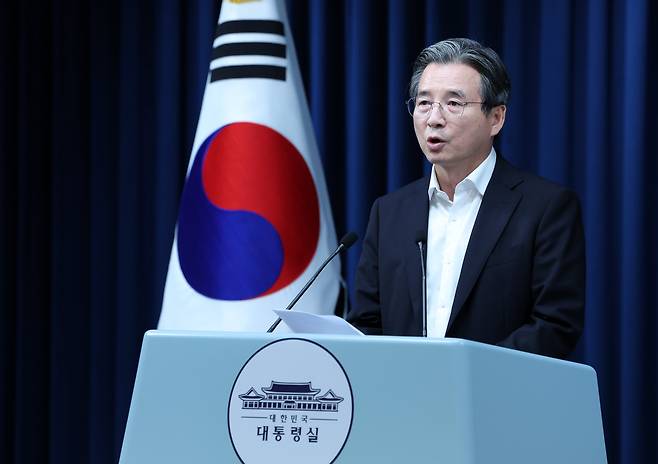
South Korea’s presidential office announced on July 31 that it had reached a tariff agreement with the United States. The planned 25% reciprocal tariff, set to take effect on Aug. 1, will be reduced to 15%. The auto tariff was also set at 15%, while rice and beef markets will not be further opened. Discussions on an investment package with the U.S. will continue at the South Korea–U.S. summit scheduled within two weeks.
Kim Yong-beom, presidential chief of staff for policy, said the government prioritized national interests and aimed for a balanced, manageable outcome. He added that future tariffs on semiconductors and medicines will be applied fairly compared to other countries.
Kim called the 15% auto tariff “disappointing.” He said, “We pushed for 12.5% until the very end, but the U.S. decision was clear—‘It’s 15% for everyone, including President Trump.’ Holding out would have unsettled the entire framework.” Because South Korea has a free trade agreement (FTA) with the United States, it needed to secure a 12.5% tariff to receive a tariff rate comparable to the levels Japan and the European Union agreed on earlier. Kim added, “The FTA is under serious strain.”
Kim said the U.S. strongly pushed for more access to agricultural markets, but South Korea agreed not to open rice and beef imports further, considering food security and sensitivities. Currently, U.S. beef imports are allowed only if the cattle were slaughtered before 30 months of age. He added that while government agencies may have different views due to political sensitivities, the president’s decision focused on protecting these sensitive sectors, taking into account their history and importance.
However, U.S. President Donald Trump earlier said that South Korea would “completely open” its market to U.S. products, including cars, trucks, and agricultural goods, which differs from Seoul’s position. In response, Kim said, “That’s a political statement, and we understand it as such. What matters are the talks held with the negotiating officials.”
Kim said the most notable aspect of the $350 billion investment pledged to the U.S. is expanded cooperation in shipbuilding, with $150 billion covering ship construction, maintenance, repair, and overhaul (MRO). He added that a separate $200 billion fund will be set up for U.S. investments in sectors where South Korean companies have strong competitiveness, such as chips, nuclear power, secondary batteries, and biotech. The amounts are not fixed by sector. He explained that most of the $200 billion fund will likely consist of loans and guarantees, with only a small portion in direct investment, adding that the figure represents an upper limit.
Kim referred to Japan’s $550 billion fund agreed upon earlier, saying, “Since the U.S. introduced reciprocal tariffs to cut its trade deficit, it’s hard to directly compare Japan’s fund with ours due to economic size differences.” He added, “In 2024, South Korea and Japan had similar trade deficits with the U.S. Excluding the $150 billion for shipbuilding, South Korea’s $200 billion is just 36% of Japan’s fund.” South Korea recorded a $66 billion trade surplus with the U.S. in 2024, compared to Japan’s $68.5 billion, showing South Korea’s deal was not less favorable.
Regarding South Korea’s plan to purchase about $100 billion worth of liquefied natural gas (LNG) and other energy products from the U.S., Kim described it as a “usual import volume.” He said some supply may shift, like replacing Middle Eastern sources with U.S. ones, but overall energy import demand stays steady, so the purchase amount is manageable.
The 50% tariffs on steel and aluminum are expected to stay. Kim said, “Since these tariffs weren’t discussed in the talks, they will likely remain.” On issues like high-precision map data exports, defense cost-sharing, and arms imports, Kim said, “These are separate issues and weren’t part of this deal.” He added, “There were no demands about the Online Platform Act or buying AI chips and graphics processing units (GPUs).”
Copyright © 조선일보. 무단전재 및 재배포 금지.
- 이란 혁명수비대 “지도부 암살하면 구글·애플 美 빅테크에 공격"
- 칸에서 한국 사극 상영된다…안보현·이성민 주연 ‘신의 구슬’, 공식 초청
- 한국문화예술회관연합회 제10대 소홍삼 회장 선출
- 교보생명, 2026 더 레이스 교보로런 마라톤 대회 파트너 참여
- 거시당국 3자 협의체 첫 가동...“과도한 원화약세, 경제에 도움 안돼"
- ‘송금 받는 사람’ 이름 바꿔 택시비 ‘먹튀’…계좌이체 사기 덜미
- “원금 두 배 갚아도 이자율 8000%” 불법 사금융 원스톱 지원 5주간 불법 추심 537건 중단
- 17일부터 다주택자 주택담보대출 만기 연장 안 된다
- 가계부채 증가율 1.5%로 억제...하반기에 대출 절벽 온다
- “美 명문대 꽂아줄게” 8억5000만원 챙긴 입시 브로커, 징역 1년 10개월 확정