Data center construction sparks NIMBY opposition amid Korea's big AI push
전체 맥락을 이해하기 위해서는 본문 보기를 권장합니다.
"Residents have been firmly against the data center from the start," a security guard told the Korea JoongAng Daily. "These are rental apartments with many young people and families with children, so naturally, concerns run high. A lot of issues remain unresolved."
"Isn't it even a win for residents as more jobs are created through the establishment?" wrote one poster who claimed to live in Deogi-dong. "I read enough articles to know it's not a problem. I don't understand why people are against it when it's not a garbage dump."
이 글자크기로 변경됩니다.
(예시) 가장 빠른 뉴스가 있고 다양한 정보, 쌍방향 소통이 숨쉬는 다음뉴스를 만나보세요. 다음뉴스는 국내외 주요이슈와 실시간 속보, 문화생활 및 다양한 분야의 뉴스를 입체적으로 전달하고 있습니다.
![Construction continues on July 25 at a KT Cloud-operated data center in Guro District, western Seoul. Protest banners are plastered across nearby apartment buildings overlooking the site. [LEE JAE-LIM]](https://img1.daumcdn.net/thumb/R658x0.q70/?fname=https://t1.daumcdn.net/news/202507/31/koreajoongangdaily/20250731070243855sups.jpg)
In Seoul’s congested Guro District, a construction site wedged in front of a residential apartment complex adds to the neighborhood’s daily churn of traffic and noise. Behind it, the apartment towers are draped with bright yellow protest banners screaming in bold red and black: “Stop the data center construction that threatens residents’ health.”
The controversial building site is for a new data center operated by KT Cloud, the cloud services arm of mobile carrier KT. The facility, set to rise eight stories above ground and descend four floors below ground, will cover 3,354 square meters (36,102 square feet ). It’s one of many such projects taking shape across the greater Seoul area amid a surge in demand fueled by the AI boom, a trend further accelerated by the Lee Jae Myung administration’s push to invest in the technology.
Yet while these centers are essential to powering AI, their rapid spread has encountered mounting local resistance as residents push back against having such large-scale facilities near their homes, particularly in the absence of proper industrial zoning. The projects have triggered protests, driven by lingering fears over electromagnetic fields (EMF), noise and heat from cooling systems. Locals worry these disruptions could not only affect their quality of life but also depress property values.
“Residents have been firmly against the data center from the start,” a security guard told the Korea JoongAng Daily. “These are rental apartments with many young people and families with children, so naturally, concerns run high. A lot of issues remain unresolved.”
Concerns about health risks from EMFs near data centers are largely unfounded, as many people confuse low-level, non-ionizing radiation from power systems with harmful ionizing radiation from, say, nuclear reactor mishaps. While some people worry that long-term exposure poses risks, no scientific evidence has been found linking typical EMF levels from data centers to adverse health effects.
![A protest banner near the KT Cloud data center in Guro District, Seoul, demands an immediate halt to construction, citing health concerns such as electromagnetic wave exposure. [LEE JAE-LIM]](https://img1.daumcdn.net/thumb/R658x0.q70/?fname=https://t1.daumcdn.net/news/202507/31/koreajoongangdaily/20250731070245566edre.jpg)
Local resistance fires up Seventeen out of 33 data centers that had received construction permits in the capital area were experiencing delays, according to a 2024 report by global real estate services firm Savills Korea.
In the Seoul area, local opposition has slowed some projects.
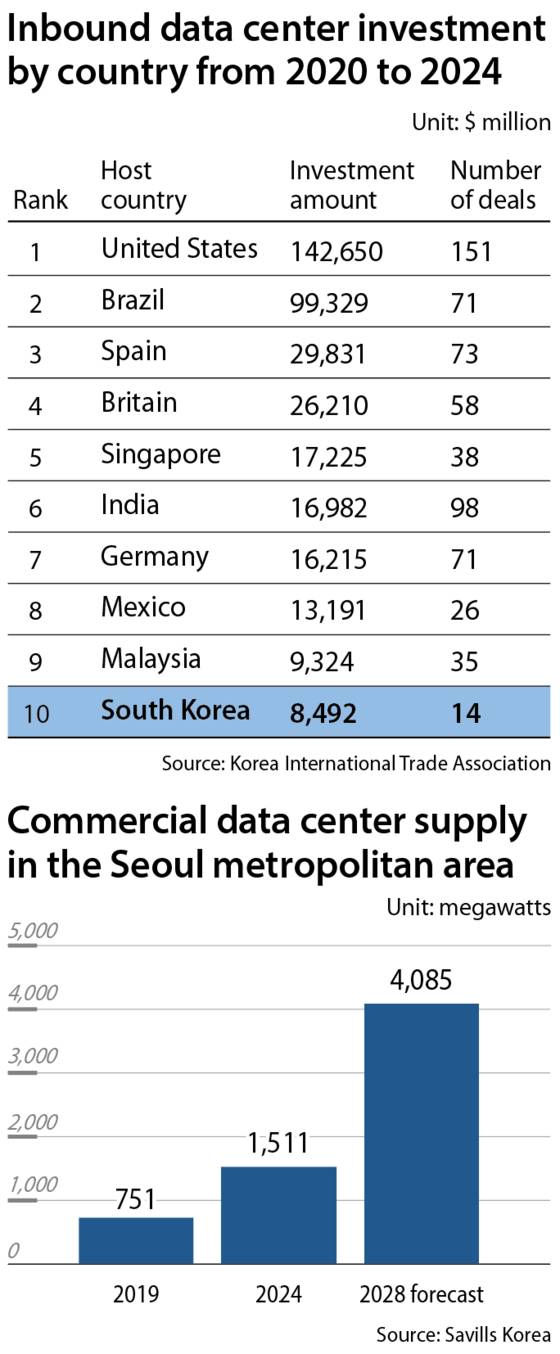
Around 90 percent of Korea’s commercial data centers are concentrated in Seoul and the surrounding capital region, with a combined power capacity of approximately 1.5 gigawatts (GW). As with many industries, this concentration is driven by the area’s dense network infrastructure, proximity to major clients and ready supply of skilled workers. By 2028, more than 40 additional data centers are expected to come online, pushing the total capacity to 4.1 GW.
Goyang, a suburban city on the western outskirts of Seoul, has emerged as a key hotspot for data center development, with nine projects either under construction, approved or already in operation. The city hall has become a recurring site of protests from civic groups and residents throughout the year, with the most recent demonstration held earlier this month.
In February 2024, Goyang City attempted to hold a public briefing to address the potential risks and safety concerns surrounding data centers, but the meeting was canceled amid strong local protests.
![A data center under construction in Ilsan, Gyeonggi Province, operated by Magna PFV, is seen on July 28. Protest banners tied to roadside trees were put up by a local opposition committee. [LEE JAE-LIM]](https://img4.daumcdn.net/thumb/R658x0.q70/?fname=https://t1.daumcdn.net/news/202507/31/koreajoongangdaily/20250731070246986hohh.jpg)
One of the controversial projects is in Deogi-dong, where a data center is being built by Magna PFV, the project finance and operations affiliate of GS Group. The facility has drawn some of the most intense public opposition seen in the city.
The Deogi-dong project faced a turbulent approval process alone, including 18 months of permit delays, administrative appeals and reinstatement, before finally receiving the green light for construction in November 2024. Even after work began, local resistance remained strong.
When this journalist visited the site, construction was underway — cranes in motion and workers on-site — but the protest banners had shifted. No longer hanging from apartment balconies, they were now tied to roadside trees lining the pedestrian paths around the site.
![An array of protest banners hang near the Ilsan data center construction site in Gyeonggi, opposing the data center facility and its operator and builder GS Group. [LEE JAE-LIM]](https://img1.daumcdn.net/thumb/R658x0.q70/?fname=https://t1.daumcdn.net/news/202507/31/koreajoongangdaily/20250731070248373qpht.jpg)
Online communities saw heated debate from both sides.
“Isn’t it even a win for residents as more jobs are created through the establishment?” wrote one poster who claimed to live in Deogi-dong. “I read enough articles to know it's not a problem. I don’t understand why people are against it when it’s not a garbage dump.”
Another poster disagreed, claiming the center “has so many problems, you can't write them all down.”
“My advice is to do some searching,” they wrote. “If you have an elderly relative at home, you need to really know what’s going on.”
Better regulations, incentives needed Although experts say the supposed health risks from electromagnetic waves are urban legends, they also say regulations and stronger incentives should be employed to pull data center clusters away from packed metropolitan areas.
The maximum electromagnetic field measured around data centers is lower than that of a typical household microwave, according to a report by the Future Radio Engineering Institute. The highest reading recorded across 16 locations was 14 milligauss (mG) — just 1.5 percent of the International Commission on Non-Ionizing Radiation Protection safety guideline of 883 mG. In many areas, levels were found to be below 1 mG.
Local tensions notwithstanding, the capital area can no longer accommodate new data centers or AI facilities due to limited power grid capacity. Between August 2024 and June 2025, a total of 290 applications were submitted to the Korea Electric Power Corporation (Kepco) for electricity use related to data center projects, according to the Ministry of Trade, Industry and Energy. Of these, 195 applications, or 67 percent, were for sites in the capital area, requesting a combined electricity capacity of 20 GW, equivalent to the output of 20 1-GW nuclear power plants.
“It would be better to relocate new data center projects to regions outside the capital area, like the Jeolla or Gyeongsang provinces, where surplus electricity is available,” said Park Jong-bae, an electrical engineering professor at Konkuk University. “To make this shift feasible, incentives are needed, such as lower electricity rates or faster power infrastructure support from Kepco.”
The southeastern city of Ulsan recently drew attention for securing Korea's largest AI data center project. Backed by a 7 trillion won ($5 billion) investment from SK Group and Amazon Web Services (AWS), the facility is set to begin construction in September.
Once operational, the center is expected to generate a local economic impact of 25 trillion won and create over 78,000 jobs through increased investment and labor inflow.
Not all regions, however, welcome large-scale digital infrastructure in their backyards, often due to external pressure or opposition from interest groups or neighboring communities.
Chai Hyo-keun, an executive director for the Korea Data Center Council, argued that government-led frameworks needed to be enforced to boost regional support.
“For example, the Special Act on Activation of Distributed Energy could designate special zones offering guaranteed infrastructure support, but no such mechanisms exist yet," he said.
Chai further points to the challenges posed by a new electricity assessment system introduced by Kepco and the Industry Ministry, which took effect in June 2024. The system was initially designed to prevent power overloads in certain high-demand areas, but companies say it has made it much more difficult to secure the electricity they need, especially in the already strained capital region.
“Due to that system, applying for electricity access, even in non-capital regions, costs billions of won. Who would take that risk when they can’t even be sure the business will succeed?”
BY LEE JAE-LIM [lee.jaelim@joongang.co.kr]
Copyright © 코리아중앙데일리. 무단전재 및 재배포 금지.
- Severe punishments, death penalty imposed in North's disaster response law, report finds
- U.S. cuts Korea's tariffs to 15% for $350B investment package
- Asiana flight to Incheon returns to Istanbul after passenger loses portable power bank
- Korean-born scientist on green card detained by U.S. immigration in 'inhumane' conditions, civic group says
- Tsunami warnings issued across Pacific after massive earthquake off Kamchatka, Korea unlikely to be affected
- U.S. commerce chief says 90% of Korea’s $350 billion investment will benefit Americans
- K League 1-0 Newcastle — as it happened
- Korea, U.S. agree on 15% tariffs, including on auto: Presidential office
- President Lee Jae Myung calls U.S. tariff deal a major diplomatic victory
- Trump says he’ll hear Korea’s 'offer to buy down' reciprocal tariffs before Aug. 1 deadline