Ramyeon makers vie to acquire suppliers for flavor 'soupremacy'
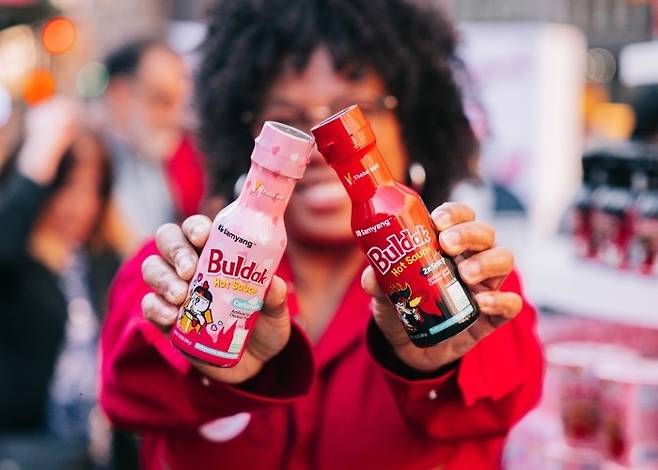
The fierce rivalry between South Korean instant noodle giants Nongshim and Samyang Foods is flaring up again. This time, it’s over control of a closely guarded flavor secret: the soup base.
Samyang Foods, the maker of the global hit Buldak noodle series, was the first to make a move, with a 60 billion won ($43 million) stock purchase deal currently in the works to acquire local sauce maker GnF.
The local sauce manufacturer has long supplied powdered seasonings to major food companies, including Nongshim, Pulmuone and Ottogi. Last year, it posted 41.7 billion won in revenue and 3.2 billion won in operating profit.
If the deal goes through, it would mark Samyang’s first merger and acquisition exceeding 50 billion won since its founding in 1961.
“The acquisition has not been finalized, including its timeline,” a company official said. “We are still reviewing various aspects of the deal.”
Yet the move is widely seen as a preemptive strike to secure production capacity amid soaring export demand.
Until now, Samyang Foods has largely relied on original equipment manufacturers to produce its liquid and powdered soup bases. The acquisition, industry insiders say, would allow the company to fast-track cost savings by making key ingredients in-house.
The deal could also send ripples through the industry, as rival clients previously supplied by GnF may now be forced to seek alternative sources for their seasonings.
Meanwhile, Nongshim Holdings, the parent company of food and beverage giant Nongshim, announced last Friday that it will acquire 100 percent of local sauce maker Sewoo for nearly 100 billion won in August.
Sewoo, known for its family ties to Nongshim Chairman Shin Dong-won, has been a key supplier of soup ingredients for Nongshim’s flagship product Shin Ramyun. The company recorded 136.8 billion won in revenue and 10.6 billion won in operating profit last year.
With the acquisition, Nongshim is expected to strengthen its in-house capabilities in seasoning and sauce production, enhancing both product quality and manufacturing efficiency.
“We decided to acquire Sewoo to reinforce synergies across our food manufacturing supply chain and boost product competitiveness,” a Nongshim Holdings official said, adding that the group plans to continue expanding its food business through strategic acquisitions.
With global demand for Korean ramyeon rising and pressures mounting from stricter quality standards and supply chain instability overseas, in-house soup production offers a strategic hedge for ingredient stability and cost control, according to industry officials.
“Bringing it in-house allows for more precise control and easier adaptation to overseas markets,” one industry insider said. “Given ramyeon’s heavy reliance on the soup base for taste and quality, it not only helps prevent technology leaks but also secures a stable supply chain."
Samyang Foods generated nearly 80 percent of its total revenue from overseas markets last year, while Nongshim earned just under 40 percent of its revenue abroad.
Soup bases, known for their complex blend of ingredients, signal a broader shift in how Korea’s food conglomerates approach sauce production, as even a minor change in formulation can dramatically alter the flavor.
“Soup bases also have broad applications beyond ramyeon, including in frozen foods and the wider seasoning market,” another industry official noted.
Copyright © 코리아헤럴드. 무단전재 및 재배포 금지.