From translator to novelist, Anton Hur is now the one translated — by one of his authors
전체 맥락을 이해하기 위해서는 본문 보기를 권장합니다.
"Translation means devoting a part of your energy to someone else's work. As a translator myself, I've often wished someone would translate my book because I know that translation is both an act of sacrifice and of great honor."
Hur recalled Chung telling him, "Even if it kills me, I want to translate this."
이 글자크기로 변경됩니다.
(예시) 가장 빠른 뉴스가 있고 다양한 정보, 쌍방향 소통이 숨쉬는 다음뉴스를 만나보세요. 다음뉴스는 국내외 주요이슈와 실시간 속보, 문화생활 및 다양한 분야의 뉴스를 입체적으로 전달하고 있습니다.
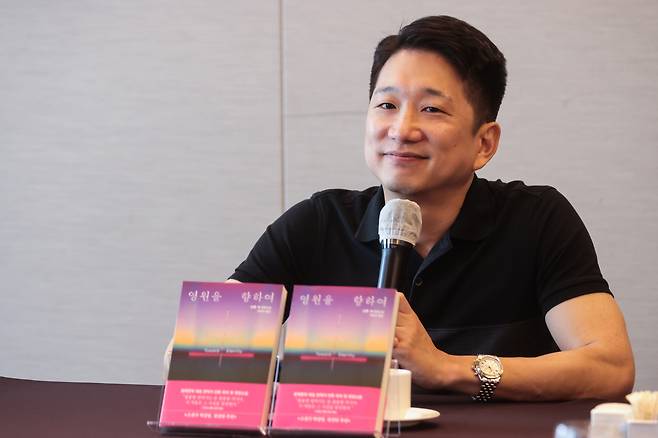
After years of introducing Korean literature to English readers, from Bora Chung’s “Cursed Bunny” to Park Sang-young’s “Love in the Big City,” Anton Hur has crossed the literary bridge in the opposite direction, debuting as a novelist with “Toward Eternity,” translated into Korean.
Written in English and first published in the US last year, the book now arrives in Korea in translation by none other than Chung -- whose books Hur translated into English, including the International Booker-shortlisted “Cursed Bunny,” “Your Utopia,” “Red Sword” and “Midnight Timetable” (to be published this September).
“It is an extraordinary honor when a translator approaches a writer first,” Hur said at a press event in Seoul on Monday.
“Translation means devoting a part of your energy to someone else’s work. As a translator myself, I’ve often wished someone would translate my book because I know that translation is both an act of sacrifice and of great honor.”
Hur recalled Chung telling him, “Even if it kills me, I want to translate this.”
“And I thought, ‘She’s so busy, how will she have time to do this?’ But I was deeply grateful,” he said.
“She translated it so well that it no longer feels like my book, which is how it should be. English and Korean are such different languages that if my book still felt like my own in Korean, something would be wrong.”
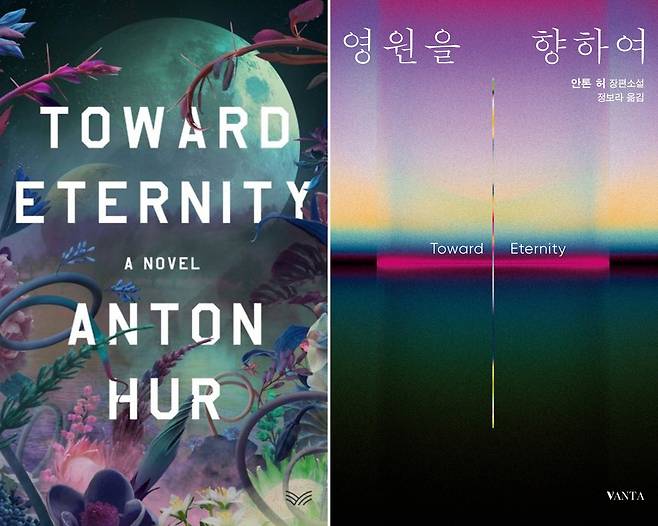
Set in a near future where a new therapy replaces human cells with nanobots that cure disease and make them virtually immortal, the novel takes the form of a diary spanning multiple millennia. Its entries shift between an ailing human who undergoes nanobot therapy and an AI that reads poetry, plays music and loves others — all the while probing the question: What does it mean to be human?
“The word ‘human’ in Korean itself is fascinating,” Hur said. “In Korean, the letter literally means ‘between people.’ Our ancestors called this humanity. It’s not something you create alone; humanity exists between people, not within one person. That’s what I wanted to explore in this book — that our humanity comes not from ourselves but from others.”
Much of “Toward Eternity” was drafted longhand during his daily commute to his studio.
“There’s something about the rhythm of the subway wheels on the rails — words start flowing unconsciously,” Hur said. “When you write by hand, there’s a slight delay between thought and word, and in that gap, so many ideas come alive. All of literature comes from that space.”
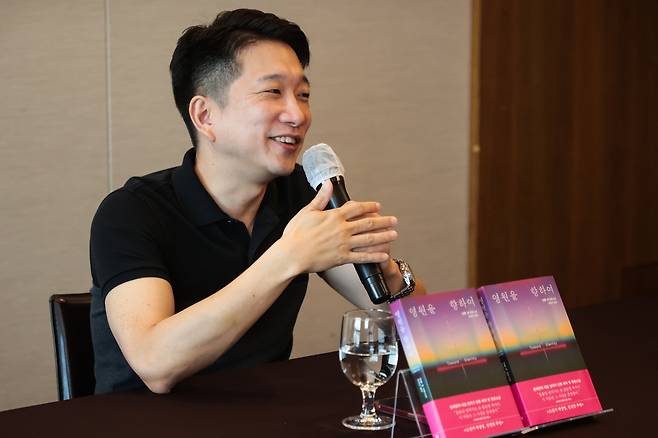
Hur said he plans to write more novels while continuing his work as a translator.
“I guess the big difference is that as a novelist, once your book is out, you don’t have to keep working to earn from it — unlike translation, where the real work begins the moment you sign the contract,” he joked.
“But there are still so many works I want to translate,” Hur added. “Korea’s literary scene is incredibly rich. There are so many talented young writers and mid-career authors with a real experimental spirit. People love, critique and care deeply about Korean fiction, which gives me endless books I want to translate.”
Copyright © 코리아헤럴드. 무단전재 및 재배포 금지.