Max Planck, IBS open nanomedicine research center in Korea
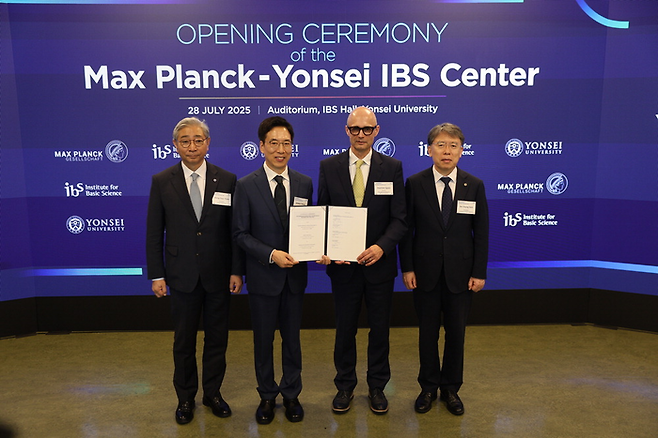
The center aims to develop world-class platform technologies for next-generation precision medicine.
According to the Ministry of Science and ICT, the Max Planck–Yonsei IBS Center officially opened Monday at the IBS building on the Yonsei University campus.
The center will focus on interdisciplinary research to non-invasively control deep tissues and cells in the human body using nanoscale precision.
Areas of collaboration include the development of nano delivery systems, precision control technologies, neuroscientific validation, clinical translation, and disease modeling.
MPI and IBS each plan to contribute up to 500,000 euros ($579,636) annually over a 10-year period to support the center’s operations.
The center will be jointly run by the Max Planck Institutes for Medical Research and Neurobiology of Behavior, along with the IBS Center for Nanomedicine.
Yonsei University Health System will also contribute to clinical research and applications.
Joachim Spatz, Director of the MPI for Medical Research, and Jinwoo Cheon, Director of the IBS Center for Nanomedicine, will serve as co-directors.
Founded in 1948, MPI is widely recognized as one of the world’s top basic science institutions and has produced 39 Nobel laureates.
It is also a leader in international collaboration, operating 18 International Max Planck Centers across 10 countries. This is the second such center established in Asia, following Japan.
Founded in 2015, the IBS Center for Nanomedicine has maintained top-tier evaluations and has built world-class infrastructure and talent in the field. The new center is expected to set new paradigms in future medicine by integrating nanotechnology with neuroscience and immunology.
Yonsei University President Yoon Dong-sup, who attended the opening ceremony, pledged full support to help the center become a world-class convergence research hub.
IBS President Noh Do-young added that the initiative will further expand the global research platform for Korean scientists.
Jung Taek-ryeol, Acting Director General of R&D Policy at the Ministry of Science and ICT, expressed hope that the new center would serve as a leading model of international collaboration in basic science, contributing to major scientific breakthroughs and enhancing bilateral ties for the benefit of humanity.
Copyright © 매일경제 & mk.co.kr. 무단 전재, 재배포 및 AI학습 이용 금지
- 주가 100만원 돌파 노린다…다음 ‘황제주’에 쏠린 눈 - 매일경제
- 신평 변호사 “尹 전 대통령, 쭈그리고 앉아 식사…처참한 주거환경” - 매일경제
- “대출 규제가 불 지폈나”…처음으로 40억원 넘긴 ‘이 아파트’ - 매일경제
- 30억 아파트 벽에 금이 ‘쩍’, 입주민은 ‘불안불안’…‘올파포’ 전수조사 착수 - 매일경제
- “신체적 학대 하지 않았다”…2살 원아 얼굴 부상, 어린이집 교사 CCTV 보니 - 매일경제
- “韓 나 만나러 스코틀랜드로 날아와”…美상무장관이 말하는 한국인의 정체 - 매일경제
- 트럼프, 아직 무역합의 안한 국가에 “관세 15∼20%일 것” - 매일경제
- [속보] 법인세 인상 속도…민주당·정부 “尹정부 낮췄던 법인세·대주주 기준 원상복구” - 매일
- “카드값 못 막는 사람 너무 많아”…상반기 카드사 실적 타격, 순익 18% 감소 - 매일경제
- ‘英 단독!’ 손흥민, 결국 LA FC로 향하나? ‘556억원’ 사우디 관심 속 영입 협상 진전…“계약