Hyundai Motor eyes Japan market rebound with INSTER EV
According to data from the Japan Automobile Importers Association (JAIA) released on Monday, the South Korean automaker sold 438 vehicles in Japan during the first six months of the year, its highest-ever first-half sales since its re-entry into the market in 2022. The figure represents 70 percent of its total annual sales of 618 units in 2024, while it sold 492 units in 2023.
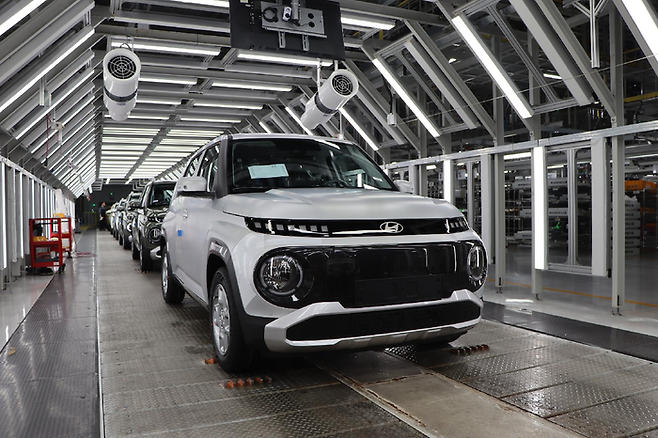
The boost in sales is largely attributable to the launch of the INSTER EV, branded as the CASPER EV in Seoul, which began deliveries in Japan in April 2025. Monthly sales have steadily increased, with 82 units sold in April, 94 in May, and 130 in June.
Hyundai Motor exports the INSTER EV to Japan from its Gwangju Global Motors (GGM) plant in Korea. The company has invested 3 billion won ($2.15 million) to establish dedicated inspection procedures for Japanese-bound vehicles and is targeting shipments of 680 units to Japan this year.
Despite electric vehicles accounting for only about 1 percent of new car sales in Japan, Hyundai Motor is positioning the INSTER EV as a competitively priced option. The model starts at 2.85 million yen ($19,100), significantly undercutting rivals such as BYD’s Atto 3 and Toyota’s bZ4X.
The INSTER EV also qualifies for Japan’s Clean Energy Vehicles (CEV) program, receiving the maximum subsidy of 560,000 yen. In comparison, the BYD Atto 3’s subsidy was reduced to 350,000 yen under the new criteria introduced in 2025, which factor in efforts to secure critical mineral supply chains.
Japan is implementing a clean energy vehicle (CEV) subsidy system equivalent to Korea’s electric vehicle subsidy that will provide subsidies based on factors such as fuel efficiency and range, with the INSTER EV receiving the maximum subsidy of 560,000 yen. From 2025, CEV subsidies will also cover safe sourcing of key minerals, and the subsidy for the BYD Ato3 will drop to 350,000 yen.
GGM plans to increase the export volume gradually while reflecting the characteristics of the Japanese market, which is picky about quality. GGM CEO Yoon Mong-hyun said, “We invested 3 billion won to establish an inspection procedure exclusively for Japanese exports,” adding, “We are targeting 680 units to be shipped to Japan this year.”
Kia will launch the PV5 in the Japanese market from 2026 onwards and signed a local sales contract with Sojitsu General Trading, one of Japan’s top five trading companies. Unlike Hyundai Motors, Kia does not have a local corporation and as the electric light commercial vehicle (LCV) market is still small in Japan, the move aims to reduce risk by choosing a trading company sales method rather than establishing a corporation.
According to U.S. research firm Mordor Intelligence, the size of the Japanese commercial vehicle market in 2024 was 28.5 billion dollars (about 40 trillion won). As in Europe, there are a lot of ‘last mile’ logistics so 74% of this figure is the LCV market, which is a competitive market for PV5. There has been little demand for electric vehicles in this area, but Toyota, Suzuki, and Daihatsu have announced plans to release three light commercial electric vehicles by the end of 2025.
Copyright © 매일경제 & mk.co.kr. 무단 전재, 재배포 및 AI학습 이용 금지
- 주가 100만원 돌파 노린다…다음 ‘황제주’에 쏠린 눈 - 매일경제
- 신평 변호사 “尹 전 대통령, 쭈그리고 앉아 식사…처참한 주거환경” - 매일경제
- “대출 규제가 불 지폈나”…처음으로 40억원 넘긴 ‘이 아파트’ - 매일경제
- 30억 아파트 벽에 금이 ‘쩍’, 입주민은 ‘불안불안’…‘올파포’ 전수조사 착수 - 매일경제
- “신체적 학대 하지 않았다”…2살 원아 얼굴 부상, 어린이집 교사 CCTV 보니 - 매일경제
- “韓 나 만나러 스코틀랜드로 날아와”…美상무장관이 말하는 한국인의 정체 - 매일경제
- 트럼프, 아직 무역합의 안한 국가에 “관세 15∼20%일 것” - 매일경제
- [속보] 법인세 인상 속도…민주당·정부 “尹정부 낮췄던 법인세·대주주 기준 원상복구” - 매일
- “카드값 못 막는 사람 너무 많아”…상반기 카드사 실적 타격, 순익 18% 감소 - 매일경제
- ‘英 단독!’ 손흥민, 결국 LA FC로 향하나? ‘556억원’ 사우디 관심 속 영입 협상 진전…“계약