Tracing the steps of Olympic marathon gold medalist Son Kee-chung
An Olympic medal is the ultimate badge of glory. It's a symbol of victory, grit and countless hours of relentless training. And behind every medal lies a personal story of hope and inspiration.
While it is a reward of a lifetime, no proud smile could be seen on gold medalist Son Kee-chung's face during the medal ceremony for the men's marathon at the 1936 Berlin Olympics. Korea was under Japanese colonial rule from 1910 to 1945, and Son clinched his victory as a member of the Japanese delegation, running under the name Kitei Son.
He set an Olympic record with 2:29:19, but received his reward with head held down and eyes downcast, revealing his resentment and grief over having to compete under the flag of the country that had colonized his own. He clutched the oak tree seedling — a gift traditionally given to Olympic victors at the time — to hide the Japanese flag on his shirt.
Although he represented Japan, his win was a powerful symbol of national pride and resistance for Koreans. It gave them hope and a sense of unity under the oppressive conditions of harsh colonial rule.
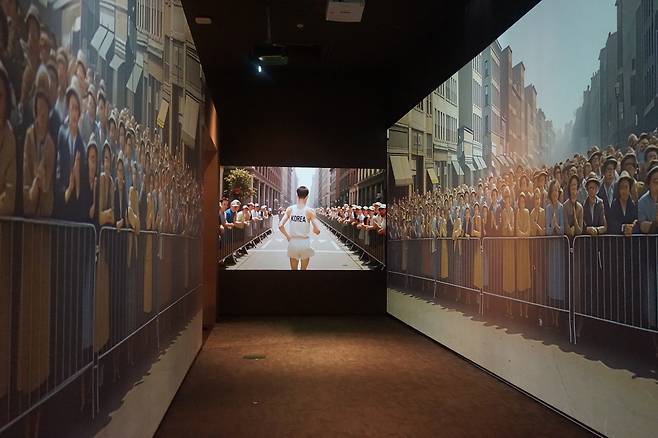
Fast forward 89 years to where Son crossed the finish line with a smile on his face and the Taegeukgi, South Korea's national flag, emblazoned across his shirt, as if his dreams had come true.
The recreation of Son's gold-medal-winning run generated by AI is part of "The Radiant Strides, Moving the World." The exhibition at the National Museum of Korea celebrates the achievements of the late runner in line with the 80th anniversary of liberation from Japan's colonial rule.
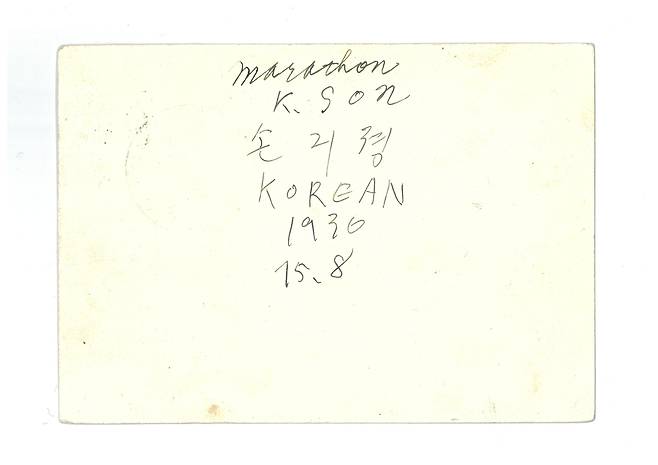
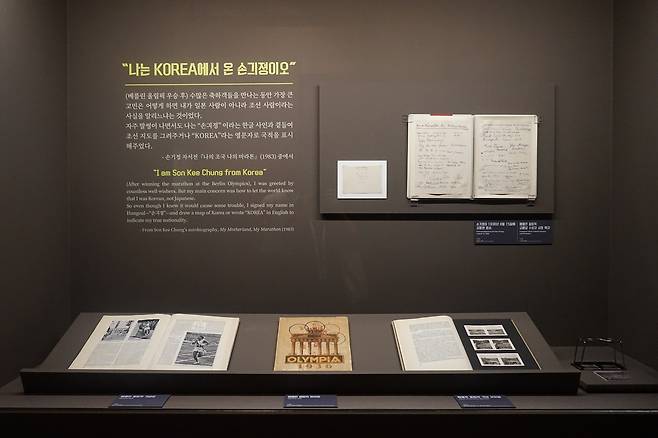
Among the exhibits is a handwritten postcard from the late Olympic champion, on which he signed "Korean" in English, along with his name written in Korean. The message is dated Aug. 15, 1936, just six days after his gold medal race.
The postcard was acquired in 1979 by Heo Jin-do, an 84-year-old collector, through a German auction house.
In a quiet act of national pride, Son consistently signed his name in Korean whenever possible, according to the museum, referring to the postcard as an important material that demonstrates his strong determination to show his Korean identity.
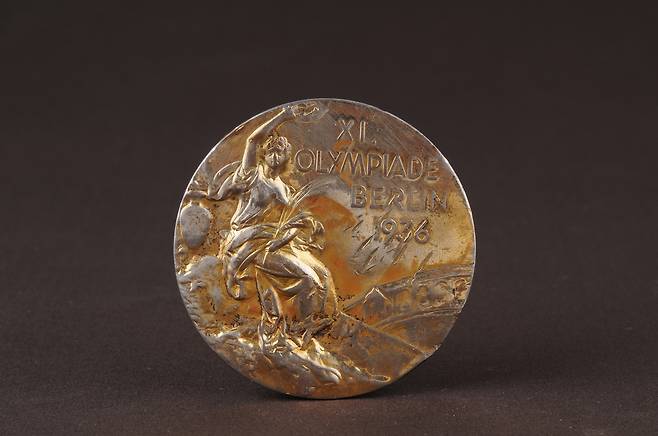
Other items on display include the gold medal, the Corinthian helmet belatedly presented to Son as a prize, a laurel wreath, and a clipping of The New York Times article detailing Son's Olympic victory.
The exhibition runs until Dec. 28 at the NMK.
Copyright © 코리아헤럴드. 무단전재 및 재배포 금지.