K-pop meets local lore: Hidden gems in 'KPop Demon Hunters'
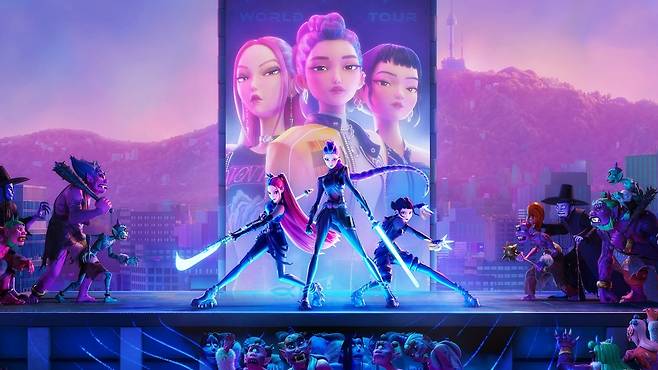
"Listen 'cause I'm preachin' to the choir. Can I get the mic a little higher? Gimme your desire, I can be the star you can rely on."
Yes, what is easier than stealing the souls of K-pop fans already under a spell? Many of you might have fallen head over heels for the Saja Boys — the Korean grim reapers who also top charts — like Abby, whose muscles pop shirt buttons, and Jinu with his charming smile.
The group is a five-member fictional boy group created for the Netflix animated film "KPop Demon Hunters," and they're not just taking the fictional world by storm — they're stealing the hearts of real-life K-pop fans, too.
But behind the animation's glittering visuals and K-pop flair, the film packs something even more powerful: a rich blend of Korean culture, age-old traditions and shamanistic elements woven into the story and characters. It is not just eye candy; it's a cultural deep dive wrapped in pop perfection.
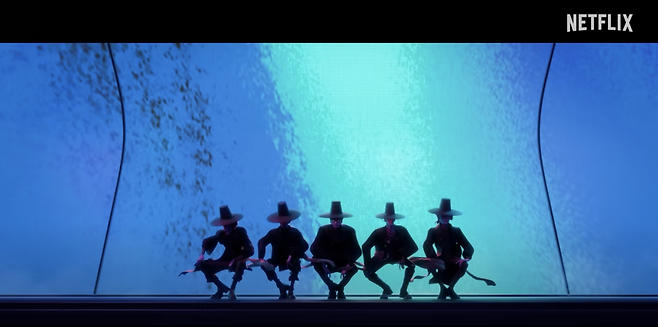
The term "Saja" translates to "lion," so people might assume the boy band chose the name to symbolize strength and power, like the lion itself. But there's a twist: The boys aren't just charming idols. "Jeoseung-saja" also refers to a grim reaper-like mythical figure who guides souls to the afterlife. In this case, the boys are demons sent to the human world to steal their fans' souls.
The blending of spiritual tradition with pop spectacle is also reflected in the trio girl group Huntrix, comprising Rumi, Mira and Zoey, who are demon hunters sworn to protect their fans from supernatural threats.
Huntrix's performances help to seal the "Honmoon," a mystical gate or barrier that separates the human world from the demon realm. The word is a combination of "hon," meaning soul, and "moon," meaning door, which is a traditional Korean shamanic "gut" ritual reinterpreted in a flashy way.
In real life, such Korean rituals are performed by shamans, or "mudang," to drive away evil spirits, bring good fortune, resolve misfortune and foster harmony between the human and spirit worlds. The rituals combine music, dance, costume and spoken incantations. So when Huntrix begins using its music to seal off the demon realm, its ruler Gwi-ma strikes back by sending the Saja Boys to weaken the Honmoon by dominating music charts.
Although produced overseas, these hidden cultural elements reflect director Maggie Kang's desire for the film to be "as Korean as possible," as she said in a Q&A video released to the press on June 26 — a vision that comes to life in every frame.
Also, each Huntrix member carries a weapon with deep cultural roots, as each blade is inspired by traditional Korean weaponry and shamanic instruments.
Rumi's sword, known as the "Quadruple Tiger's Evil Slayer," or the Four Tiger Sword, is a ritual blade dating back to the Joseon era (1392–1910). In Korean cosmology, each of the four cardinal directions is guarded by a mythical tiger, believed to protect the world from harm. Similarly, Rumi uses the sword to shield human souls from the demons, embodying the same protective spirit.

Initially mistaken for a Chinese guandao — a type of Chinese pole arm — Mira's sword, known as "gokdo," is also inspired by the Cheolyeomchu, a curved pole arm from Goguryeo Kingdom (37 BC-668 AD), which gives the weapon a distinctly Korean identity.
The spirit knife wielded by Zoey is the "shinkal," which is used during the gut ritual to fight evil spirits. Her blade is adorned with a "norigae," a traditional Korean pendant accessory worn by women, rich in both aesthetic beauty and emotional symbolism, reflecting the grace and spirit of women from the Joseon era.
But the animation is not only about mythical themes and traditional Korean elements.
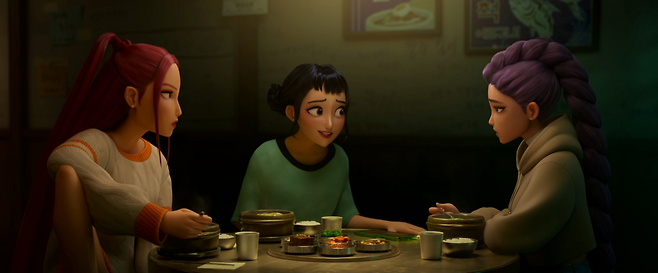
The film also does an excellent job of portraying modern-day Korea. For example, in a scene where the members of Huntrix eat gukbap — a bowl of rice and boiling soup — tissues are placed under their spoons, reflecting Korea's dining etiquette.
As the film and its spotlight on Korean culture continue to captivate audiences worldwide, pop culture critic Jung Duk-hyun noted that Korean culture is now seen as "hip" on the global stage, adding that it is one of the key reasons it resonates so strongly with international viewers.
"The success of 'KPop Demon Hunters' serves as clear evidence that stories rooted in Korean traditions, music and lifestyle can capture global attention and serve as the core of a compelling film. It highlights the strong potential of Korean culture to inspire and shape not only movies but a wide range of creative content in the future," Jung told The Korea Herald on July 15.
Yoo Seung-chul, a professor of media convergence at Ewha Womans University, echoed the sentiment, saying that the incorporation of Korean elements adds depth and richness to the film's details.
"The film takes elements audiences already recognize from K-pop, along with familiar storytelling techniques, and creatively blends them," he explained.
Copyright © 코리아헤럴드. 무단전재 및 재배포 금지.