S. Korean officials return empty-handed as US cancels 2+2 trade talks
이 글자크기로 변경됩니다.
(예시) 가장 빠른 뉴스가 있고 다양한 정보, 쌍방향 소통이 숨쉬는 다음뉴스를 만나보세요. 다음뉴스는 국내외 주요이슈와 실시간 속보, 문화생활 및 다양한 분야의 뉴스를 입체적으로 전달하고 있습니다.
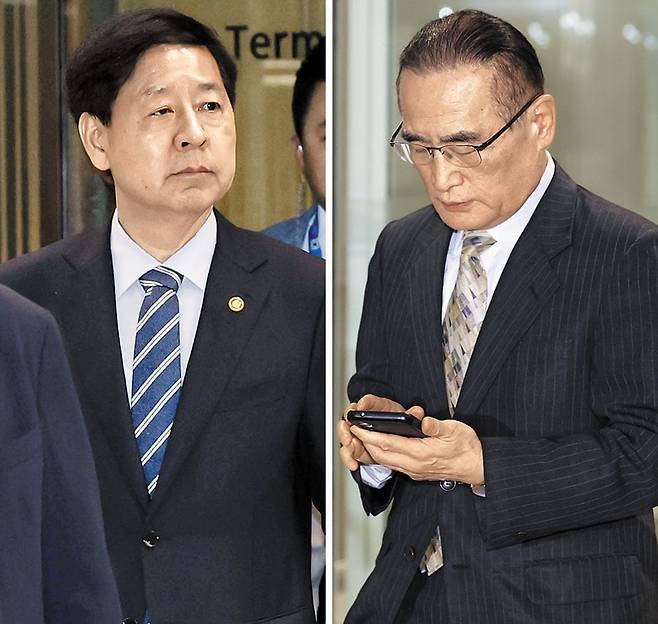
With just a week left before the Aug. 1 deadline for U.S. President Donald Trump’s 25% tariffs, South Korean officials have yet to hold face-to-face talks with their American counterparts. While Japan, the Philippines, and Indonesia have recently reached agreements with Washington, negotiations between South Korea and the U.S. remain stalled as Seoul continues to be pushed down the priority list.
Deputy Prime Minister and Finance Minister Koo Yun-cheol was scheduled to fly to Washington, D.C. on July 24 for talks with U.S. Treasury Secretary Scott Bessent, but was forced to turn back at Incheon Airport. The U.S. abruptly canceled the South Korea-U.S. “2+2” finance and trade meeting set for July 25, citing an urgent schedule for Bessent. The cancellation was notified by email just over an hour before Koo’s flight.
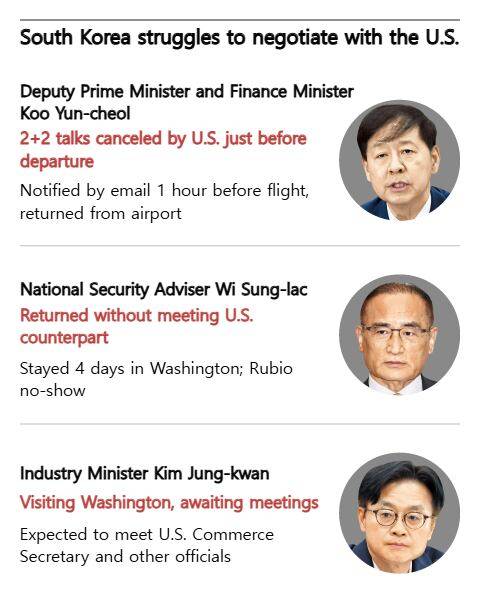
National Security Adviser Wi Sung-lac, who traveled to the U.S. on July 20, returned home without meeting his counterpart, U.S. National Security Adviser and Secretary of State Marco Rubio. Wi went to the White House on July 21 for the scheduled meeting, but was told Rubio could not attend due to an extended meeting with Trump. The following day, U.S. officials said an in-person meeting would not be possible, so Wi spoke with Rubio by phone, despite both being in Washington. He met with Commerce Secretary Howard Lutnick and U.S. Trade Representative Jamieson Greer, but was unable to meet his direct counterpart.
Industry Minister Kim Jung-kwan arrived in Washington on July 23 and met with Commerce Secretary Howard Lutnick on July 24. The Ministry of Trade, Industry and Energy also announced that Trade Minister Yeo Han-koo, who arrived a day earlier, will hold talks with USTR Representative Jamison Greer. However, with Treasury Secretary Scott Bessent set to attend U.S.-China negotiations in Sweden from July 28 to 29, it remains uncertain whether the canceled 2+2 meeting can be rescheduled.
Foreign Minister Cho Hyun tried to arrange a phone call with Rubio immediately after taking office on July 21 but was unsuccessful. Instead, he spoke with Japan’s foreign minister first. A South Korea-U.S. foreign ministers' meeting is expected next week, but the schedule is still being finalized.
The repeated cancellations of high-level talks suggest the Trump administration is using meetings as a negotiation tactic. While South Korea seeks to resolve differences through summits or ministerial talks, the U.S. demands that Seoul first offer terms or figures that would satisfy Trump before agreeing to meet.
The South Korean government had planned for President Lee Jae-myung to visit Washington after some progress in trade and security talks to make a “package deal” with Trump. During a July 7 meeting with Rubio, Wi proposed holding a summit soon to reach a mutually beneficial agreement. The U.S. side reportedly agreed but later said a summit could only happen after Korea opens its agricultural markets and eases digital trade barriers. The last-minute cancellation of the 2+2 meeting and the refusal to meet Wi during his four-day stay in Washington are seen as indirect pressure from the U.S. to bring stronger proposals like market-opening commitments or investment plans to the table.
While Wi waited in Washington on July 21 and 22, Philippine President Ferdinand Marcos Jr. finalized a trade agreement with the U.S. following talks with Trump and meetings with the secretaries of state and defense. However, South Korea is running out of time, as Trump is scheduled to visit Scotland from July 25 to 29, leaving little room for last-minute negotiations.
Copyright © 조선일보. 무단전재 및 재배포 금지.
- 굽은 목을 쭉 펴주면서 EMS 온열 마사지까지, 4만원대 초가성비 가격에 8만대 판매 돌파
- 언젠가 올 폭락장 “누구나 버핏처럼 할 수 있다, 이 3가지만 지키면”
- 국내 3위 브랜드가 작정하고 만든 70만원대 16인치 노트북
- 北 공군 6년, 대한민국 공군 19년… ‘미그기 귀순’ 이웅평
- [단독] “고작 300만원” 與 주장대로… ‘돈봉투 의혹’ 전현직 의원 10명 무혐의
- [단독] “예산 깎겠다” “10년치 자료 내라” 민원 안 들어주면 공무원에 갑질
- [단독] “40만원 니트, 나한테 사면 9만원” 짝퉁 팔고 잠수타는 인플루언서
- 수수료 20% 버리고 8% 택한 원스토어… 박태영 대표 “제살깎기 아닌 패러다임 전환”
- “美가 보낸 답장 받았다”는 이란…양국, 이번엔 통할까?
- 낡디낡은 기차에 탑승하자 캐비어와 샴페인이...베트남의 ‘완행 열차 호텔’