SK Hynix posts record quarterly earnings in Q2 on AI memory boom
이 글자크기로 변경됩니다.
(예시) 가장 빠른 뉴스가 있고 다양한 정보, 쌍방향 소통이 숨쉬는 다음뉴스를 만나보세요. 다음뉴스는 국내외 주요이슈와 실시간 속보, 문화생활 및 다양한 분야의 뉴스를 입체적으로 전달하고 있습니다.
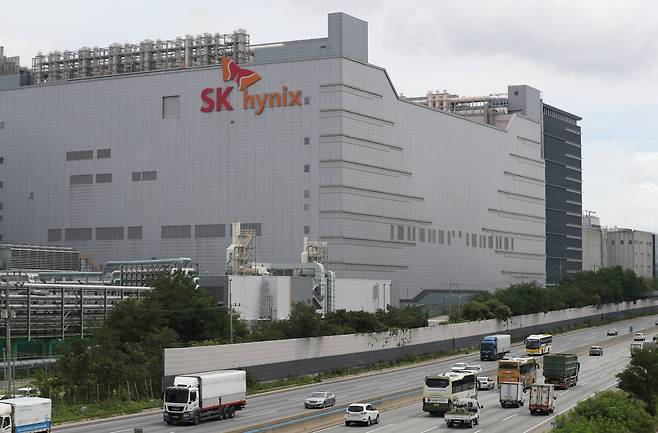
SK Hynix posted its highest-ever quarterly earnings in the second quarter, driven by soaring demand for high-bandwidth memory (HBM), a key component in artificial intelligence (AI) chips. As the AI market rapidly grows, the South Korean chipmaker’s technological edge in HBM has fueled its continued strong performance.
In a regulatory filing on July 24, SK Hynix reported an operating profit of 9.21 trillion won ($6.7 billion) for the second quarter, up 68.4% year-on-year. Revenue rose 35.4% to 22.23 trillion won, while net income jumped 69.8% to 6.99 trillion won, with a net margin of 31%. Both operating profit and revenue exceeded raised market forecasts, which had projected 9.06 trillion won and 20.72 trillion won, respectively. The operating margin stood at 41%.
Both revenue and operating profit set new company records, breaking the previous high established just two quarters ago. This quarter’s operating profit was more than double Samsung Electronics’ total, estimated at 4.6 trillion won, with only 600 billion won coming from its chip division. This marks the second time SK Hynix has outperformed Samsung’s overall earnings, following the fourth quarter of 2024.
SK Hynix attributed the strong results to the strong demand for AI memory, fueled by aggressive investments from global tech giants. “Shipments of both DRAM and NAND exceeded expectations, helping us achieve the best quarterly results,” the company said. “We expanded sales of 12-layer HBM3E in the DRAM segment, while recording growth in sales of NAND for all applications.”
Experts estimate SK Hynix holds over 60% of the global HBM market. It gained a competitive edge last year by supplying 12-layer HBM3E to Nvidia, which controls 80% of the AI chip market. HBM sells for three to five times the price of standard DRAM, boosting profits.
SK Hynix’s cash and cash equivalents rose by 2.7 trillion won from the previous quarter to 17 trillion won at the end of June. Its debt ratio stood at 25%, while net debt fell by about 4.1 trillion won, lowering the net debt ratio to 6%.
Looking ahead, SK Hynix expects memory demand to remain strong in the second half as customers increase production and prepare new products. Competition among tech firms in AI model development will also drive demand for high-performance, high-capacity memory. Long-term investments in sovereign AI—national AI systems built with domestic infrastructure and resources—are seen as a new growth driver.
SK Hynix plans to double HBM sales this year. It aims to supply sixth-generation HBM4 on schedule and launch server-grade LPDDR modules within the year. It is also developing a larger 24Gb version of GDDR7 for AI GPUs, up from 16Gb now.
For NAND, the company will keep a cautious investment strategy focused on profitability while preparing new products for a market recovery. It plans to expand sales of high-capacity enterprise SSDs based on quad-level cell (QLC) technology and build a portfolio around 321-layer NAND.
“We will make selective upfront investments this year to ensure smooth supply of key products like HBM, with clear demand into next year,” said SK Hynix President Song Hyun-jong. “By delivering top-quality, high-performance products for the AI ecosystem, we aim to become a full-stack AI memory provider that satisfies customers and drives market growth.”
Copyright © 조선일보. 무단전재 및 재배포 금지.
- 미 법원, 불법이민자 구금시설 습격 주도한 한인 남성에 징역 100년 선고
- 주식 미수거래 반대매매 5배 급증... 금감원 “빚투 영업 자제해야”
- [속보] 정청래, 민주당 대표직 사퇴…연임 도전 공식화
- 임영웅X시월이X찐친 조합, 첫 방송부터 예능 시청률 1위
- 제미나이 따라잡은 中 AI ‘즈푸’...중국 AI 자립 선봉장됐다
- 삼성전자, 10% 급등하며 시총 1위 탈환...코스피도 하루만에 반등
- KAIST 총장 공백 드디어 끝날까…29일 이사회서 선출 논의
- [단독] 정청래, 文 전 대통령 만난다...‘친문·친청’ 연대 띄우나
- 與 대표 비서실장 “정청래, 당원에게 다시 판단받는 게 좋지 않겠나”
- 전주 호텔서 ‘방화’ 추정 화재… 일가족 3명 중상·투숙객 45명 대피