Back from Japan, dragon-headed roof tiles and eaves offer glimpse of Joseon royal shrine
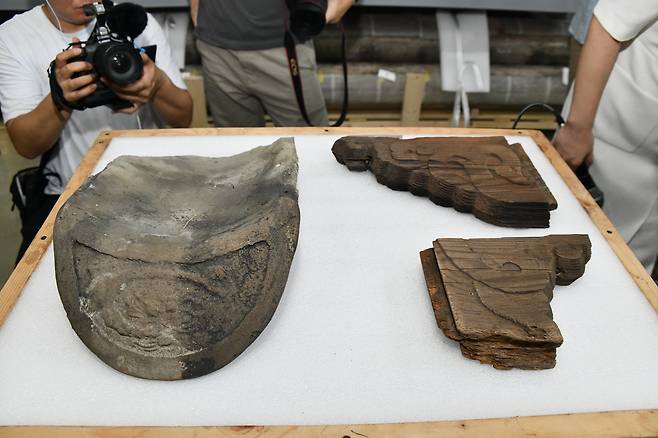
From a distance, the beam appears no different from an ordinary piece of timber.
But stepping closer, its surface reveals cracks and dents that reflect its age, along with faint inscriptions looking like the Japanese characters "ho" or "ma," indicating it was likely marked or labeled during its time in Japan.
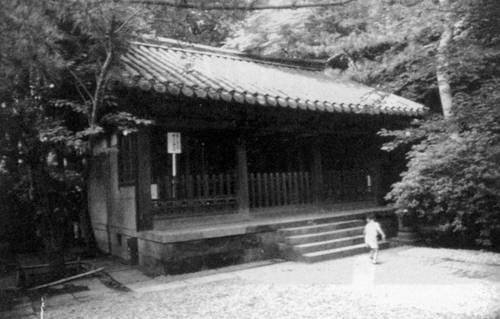
These are parts of the disassembled pieces of Gwanwoldang, thought to be a royal shrine from the Joseon era (1392-1910), which were taken to Japan during the country's colonial rule of Korea in the early 20th century. Officials believe the writings were added by Japanese carpenters when the structure was dismantled in Japan.
It was the first time the structure's components had been unveiled since its return to South Korea in May at the Korea Foundation for the Traditional Architecture and Technology — an institution dedicated to collecting and conserving traditional building frame materials — in Paju, Gyeonggi Province, Wednesday. The parts came back under an agreement reached with Kotoku-in, a Buddhist temple in the neighboring country's Kamakura city, and the Korea Heritage Service and the Overseas Korean Cultural Heritage Foundation.
The long-lost royal shrine is a traditional wooden structure spanning three bays in width. Its architectural style features symbolic patterns, including dragons, spider webs and bats — all of which are characteristics of royal shrines from the late 18th to early 19th-century Joseon period.
Research suggests that Gwanwoldang's size and structure indicate it was a royal shrine built for a "Daegun," which is a title given to the son of the king and queen, Lee Kyu-cheol, Associate Research Fellow at the Architecture and Urban Research Institute, told reporters as he toured the press.
A total of 4,982 parts — 1,124 pieces of timber, 3,457 "giwa," or traditional Korean roof tiles and 401 stone elements — were revealed during the public display of Gwanwoldang's components at the institution's storage.
They include decorative eave supports known as "choyeop," which are wooden elements placed on the sides of large traditional buildings, especially palaces, and roof tiles featuring symbolic motifs ike dragons, a symbol of royalty in Korean culture, spiders and butterflies, highlighting the architectural details that reflect the shine's royal status and aesthetics.
Each piece was carefully wrapped to keep it in good condition. The roof tiles, which are often prone to fragility, were cushioned in bubble wrap to protect them from breaking, while "dancheong," the traditional coloring on wooden buildings and artifacts, was protected with plastic and paper to shield the surface and paintwork from scratches, moisture, and abrasion. The storage facility tries to maintain humidity below 80 percent to protect the wooden materials.
The KHS and the OKCHF said they would conduct detailed studies on Gwanwoldang's components, as well as explore ways to display the pieces to the public.
The KHS also pledged to continue working on bringing Korean artifacts home.
"Over 247,000 Korean cultural assets are held overseas. Among them, many were illegally taken, especially during times of war or during the country's colonial rule. Our agency is committed to bringing back those items to Korea," Huh Min, the newly-appointed chief of the KHS, told reporters during the event.
Copyright © 코리아헤럴드. 무단전재 및 재배포 금지.