Korean skincare startups are booming. Most don't make their own products
전체 맥락을 이해하기 위해서는 본문 보기를 권장합니다.
LG Household & Health Care said it manufactures the entirety its own flagship skincare brand, The Whoo, to "provide a differentiated customer experience."
As part of this push, APR has paid high-profile celebrities like makeup mogul Kylie Jenner, who was paid to post a TikTok video in April labeling a Medicube device as part of her "current favorite glass skin routine."
이 글자크기로 변경됩니다.
(예시) 가장 빠른 뉴스가 있고 다양한 정보, 쌍방향 소통이 숨쉬는 다음뉴스를 만나보세요. 다음뉴스는 국내외 주요이슈와 실시간 속보, 문화생활 및 다양한 분야의 뉴스를 입체적으로 전달하고 있습니다.
![Korean beauty seller APR's Medicube brand is promoted on Times Square electronic billboards in March. [APR]](https://img4.daumcdn.net/thumb/R658x0.q70/?fname=https://t1.daumcdn.net/news/202507/24/koreajoongangdaily/20250724070315708eeam.jpg)
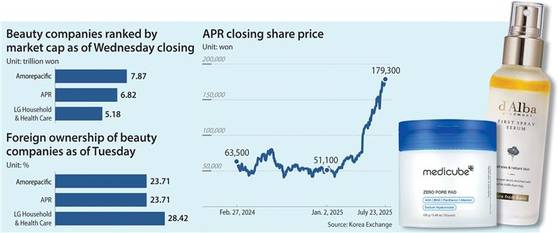
A decade ago, Amorepacific and LG Household & Health Care were the undisputed titans of Korea's cosmetics sector. They rode a wave of global popularity, powered largely by Chinese consumers to success, with Amorepacific becoming Korea's fifth-largest company by market capitalization in 2015. That ranking has since slid to No. 70 on the Kospi as of Wednesday. Meanwhile, APR, the fast-rising beauty company behind Medicube, surpassed LG Household & Health Care to become the second-largest beauty firm in Korea, after only Amorepacific, just after its stock market debut February last year.
Its share price soared more than 180-fold since it went public last February, boosting the market capitalization of the 11-year-old company to 6.82 trillion won ($4.8 billion). Its CEO was listed on the Bloomberg Billionaires Index in July with a net worth of $1.3 billion. APR products are considered in the United States to have good value for their price — unlike traditional beauty giants, which have primarily promoted luxury lineups to Chinese travelers at duty-free and department stores. But the real secret to the success of APR, as well as hot-shot peers, is not innovative products: It's innovative marketing. The company has been expanding its footprint beyond China into North America and Europe, largely through online channels and aggressive spending on publicity. APR is part of a new wave of Korean beauty brands that is rapidly gaining global traction with the use of internet-based, influencer-heavy marketing at the expense of product innovation. The new model has spelled a major shake-up for Korean cosmetics, driving the sector's Goaliaths rethink their strategies moving forward.
![An APR pop-up store that opened in Los Angeles in April [APR]](https://img4.daumcdn.net/thumb/R658x0.q70/?fname=https://t1.daumcdn.net/news/202507/24/koreajoongangdaily/20250724070317083slna.jpg)
Emerging brands go global APR's revenue jumped 79 percent year-over-year to 266 billion won in the first quarter of 2025. FnGuide projects that could reach 288 billion won in the second quarter. A whopping 71 percent of that January–March revenue came from overseas.
Revenue at d’Alba Global, an up-and-coming beauty seller known for its vegan mist serum and sunscreens, made 113.76 billion won in the first quarter of 2025, a 72 percent jump from the same period of the previous year.
Overseas sales, which accounted for 56 percent of total revenue, led the growth, driven primarily by strong performance in Japan and Russia. Shares jumped 217-fold from their initial public offering price following its May debut, boosting the market capitalization of the nine-year-old firm to 2.6 trillion won.
Goodai Global, the operator of the TikTok-viral TirTir, is not yet publicly traded. But it aims for public listing with a market value of 10 trillion won, according to a report by Invest Chosun.
Behind the recent Korean cosmetics boom is a value chain that enables the quick launch of new products and heavy spending on their marketing.
APR and its peers often outsource much of their design and production to third parties, shortening the total time it takes for a product to go from the initial idea to final delivery to consumers. Amorepacific, by contrast, self-produces upward of 90 percent of its products; LG Household & Health Care outsources some color cosmetics to outside manufacturers but makes its premium line in-house.
Outsourcing allows upstarts like APR forfeit significant control over their process. It also, potentially, compromises their formulas. While original design manufacturers (ODM) typically don't create identical for two different companies, they can easily put out similar ones. It's commonplace, in fact, for cosmetics brands to ask ODMs to make them "similar" versions of competitors' bestselling items, according to an Edaily report published in June.
LG Household & Health Care said it manufactures the entirety its own flagship skincare brand, The Whoo, to “provide a differentiated customer experience.”
On the other hand, outsourcing also saves newer firms from needing to spend money on research and development, or on proprietary factory and production lines, which is money they can instead invest heavily in marketing.
APR spent 18 percent of its revenue on marketing in the first quarter, up twofold from a year earlier, according to a Hana Securities report in May. Comparatively, Amorepacific spends around 11 to 13 percent of its revenue on advertising and promotional expenses, which includes marketing, and said it was able to decrease its advertising and promotional expenses by 9 percent year-over-year in the last quarter of 2024 after making its marketing “more efficient” in China and Korea . In its securities registration report, d’Alba Global said it would spend 14.6 billion won in operation, which includes marketing, for three years through 2027 — more than four times what it has set aside for developing new products.
“Korean indie beauty companies were able to quickly gain global traction from the onset of Covid-19 as cosmetic purchases through e-commerce surged dramatically,” said Lee Ka-young, an analyst at Samsung Securities.
As part of this push, APR has paid high-profile celebrities like makeup mogul Kylie Jenner, who was paid to post a TikTok video in April labeling a Medicube device as part of her “current favorite glass skin routine.”
One of the biggest overseas market for APR and its peers, in fact , is currently the United States, where its products are being hailed by influencers and socialites. Hailey Bieber showcased her use of a Medicube device on TikTok in 2023. Meghan Markle also expressed affection for Medicube’s Collagen Jelly Cream in March by adding it to her page on ShopMy, which curates and recommends beauty products.
The public is embracing these celebrities' choices. Medicube’s Zero Pore Pads, which just costs around $20, was named an Amazon Best Seller in Beauty & Personal Care during Amazon Prime Day earlier in July.
Big Beauty Goes Small In response to the surge in relatively new brands, established players are now eyeing the budget market to widen their consumer base.
Amorepacific and LG Household & Health Care are both working with Daiso. The widespread budget retailer has been expanding its cosmetics offerings since 2022.
Daiso, unlike beauty retailers and road shops, imposes a maximum price of 5,000 won for products sold on its shelves.
In compliance, LG Household & Health Care released Daiso versions of Carezone Plus skincare and facial lotions in July 2024, followed by Innerbeau by re:tune, a sub-brand of re:tune dedicated to the budget franchise. All LG Household & Health Care products sold at Daiso are purposely made for the retailer; it doesn't sell any of its other offerings there.
“LG Household & Health Care released Daiso-specific products to attract the millennial and Gen-Z customers,” the cosmetics and household firm said, adding that more and more consumers are looking to find products “that are both effective and cheap.”
Bye od-td, a sub-brand of LG Household & Health Care sold exclusively at Daiso, moved more than 1 million units in less than a year since it launched in 2024.
Amorepacific launched Mimo by Mamonde and Play 101 by Etude exclusively for Daiso — sub-brands of Mimo and Etude — to join the budget-friendly trend, with the company selling more than a million units of Mimo products just four months after its launch.
Other renowned brands, like Nature Republic, Clio and VT Cosmetics, have also begun offering Daiso-only variants of existing products in smaller portions. The item that fueled the popularity of cosmetics at the store, VT Cosmetics’ Reedle Shot, comes in a six-pack of 2 milliliter sachets instead of the usual 50 milliliter bottles that are sold elsewhere.
But with such giants attempting to tread on their younger turf, experts warn that the efficient system that helped indie brands rapidly rise — their outsourcing of production — could ultimately limit their long-term dominance.
“Very few of them have enduring brand power because they largely rely on third-party production,” said Professor Kim Ju-duck, a professor of the beauty industry at Sungshin Women’s University. “Regardless of the billions in revenue they’re currently generating, these up-and-coming beauty brands may lack staying power.”
Kim added, “Such products can be very easily replicated.”
And then there's the matter of tariffs, which could heavily impact smaller brands selling affordable products.
If Korea and the United States fail to reach an agreement on U.S. President Donald Trump's impending tariffs, which are currently set to take effect on Aug. 1, the price competitiveness of APR and other budget-friendly rivals could dwindle even further.
“Korean beauty sellers benefited from higher prices for China-made goods on Amazon due to tariffs,” Cho said, referring to Trump's tariffs, which hit Chinese competitors particularly hard, as a major factor that boosted the sales of Medicube's Zero Pore Pads on Amazon Prime Day.
“Once a particular product takes off in the beauty industry, it can gain massive traction with just that single hit product, boosting the entire company’s valuation” Cho said. But, the analyst added, “The popularity of brands is very cyclical.”
BY JIN MIN-JI,CHO YONG-JUN [jin.minji@joongang.co.kr]
Copyright © 코리아중앙데일리. 무단전재 및 재배포 금지.
- 2 soldiers awarded 30-day leave for retrieving North Korean in DMZ
- Former U.S. negotiator on Korea's tariff talks: 'You're going to have to give Trump something'
- Identity of mysterious North Korean general who greeted Putin on Victory Day revealed
- Korea-U.S. '2+2' trade talks canceled due to Treasury Secretary Bessent's 'urgent schedule'
- Murder suspect says son stopped giving him living expenses before deadly Incheon shooting
- Found guilty for biting off attempted-rapist's tongue 6 decades ago, Choi Mal-ja gets overdue apology
- Overworked and underappreciated, Korean doctors eye New Zealand's greener pastures
- 35 evacuated in eastern Seoul after sinkhole opens at construction site
- Gyeonggi officials face backlash for Japan trip during destructive rains
- Man fined for breaking into NewJeans' former dorm and taking photos