Cremation and natural burials shift South Korea’s funeral culture
이 글자크기로 변경됩니다.
(예시) 가장 빠른 뉴스가 있고 다양한 정보, 쌍방향 소통이 숨쉬는 다음뉴스를 만나보세요. 다음뉴스는 국내외 주요이슈와 실시간 속보, 문화생활 및 다양한 분야의 뉴스를 입체적으로 전달하고 있습니다.
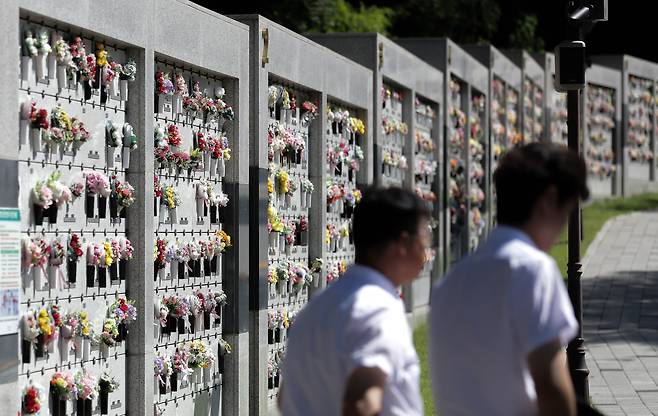
Elderly Son, who passed in early January from a heart attack, was cremated; her ashes were scattered in a man-made lake. Despite her family’s wishes for her ashes to remain in a columbarium for family visits, she wanted to “return to nature after being cremated.”
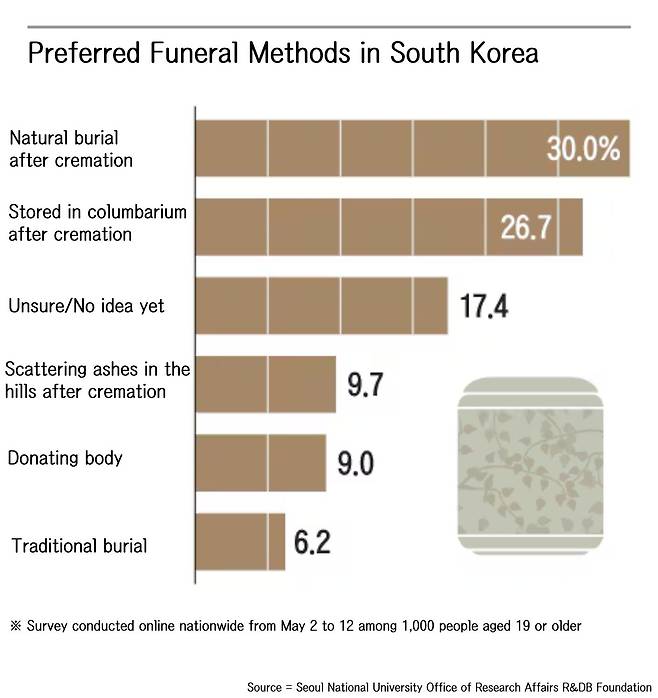
South Korea is seeing a break from traditional funeral methods. In May of 2025, the Seoul National University Office of Research Affairs and R&DB Foundation (SNU R&DB) conducted an online panel survey of 1,000 people above the age of 19 domestically. Results showed that the top preferred method of funeral procedures was natural burial after cremation (30%). In second place was being kept in a columbarium (26.7%), and burial funerals received 6.2% of the votes. Of those surveyed, 17.4% were unsure how they would like their funeral to be processed. When SNU R&DB conducted the same survey back in 2021, the first and second options were flipped—columbariums first (28.8%) and cremation before natural burial second (23%). Trends have changed in the past four years.
Natural burials began receiving more attention when former chairperson of LG Group Koo Bon-moo passed away in May 2018. Chairman Koo had wanted to be buried beneath his favorite pine tree in Hwadamsup, an arboretum in Gwangju. This choice helped gain the attention of many individuals and is thought of as a core reason behind natural burials’ rise in popularity.
Recently, the government has also stepped in to promote natural burials. Authorities changed the approval process for natural burial sites from a permit-based system to a notification-based one, allowing public institutions to lease land to create more sites. This decision has contributed to the steady expansion of natural burials. Beginning in January 2025, scattering ashes in oceans or mountains was legalized.
South Korea has a long history of being a post-burial society. According to the Ministry of Health and Welfare, cremation rates stood at a provisional 93.9% as of March this year. In the 2000s, the rate was smaller—20–30%. In the modern world, 9 out of 10 people decide to be cremated, breaking away from a long-standing tradition. Fifty-four-year-old Do, who lives in South Gyeongsang, recently cremated his in-law after their passing. Although the family had legacy land, every single relative had been cremated since 1999.
Reasons for choosing natural burials are varied, but the biggest reason is that people “don’t want to become a burden even in death.” Others explained that “our generation can tend to ancestral graves, but we don’t want to pass that responsibility on to our children.” In addition, many burial sites are situated in rural areas, which are far from children living in metropolitan Seoul. Smaller families may feel strained by the added responsibility of visiting during important days. Kwon, aged 56, who cremated his father this January, said, “Cremation felt cleaner than burial, and arrangements took less time than finding a burial plot.”
Land serving as burial plots is also running out. Many memorial parks have long since sold out their land and are no longer accepting new burials. A team leader at a memorial park in Pyeongtaek, Gyeonggi-do, said, “All three of our cemeteries have reached full capacity. We can only accept exhumations for cremation or relocation. There’s just no space for new burials.”
Copyright © 조선일보. 무단전재 및 재배포 금지.
- “롤러코스터도 먼저 타자”...이란전쟁에 널뛰는 증시, 장외거래 석달만에 4배로
- [WEEKLY BIZ LETTER] C커머스 공습에도, 아마존은 끄떡없었다…E커머스 공룡들의 3색 생존기
- 공공기관 ‘숨은 규제’ 251건 정비…물품 하자보증금·입찰 인지세 부담 낮춘다
- [그 영화 어때] 널 만나고 나서야 완성된 내 사랑의 퍼즐 , 영화 ‘위 리브 인 타임’
- “한국 드럼 최고봉” 백두산 원년 드러머 한춘근 별세
- [더 한장] 온 가족이 러닝을! 2026 서울 유아차런
- 고환율 방어에 외환보유액 40억달러 감소…처음으로 10위권 밖으로
- 김혜윤 “공포 마니아에서 호러퀸으로…좋아하는 장르라 설렜죠”
- [유석재의 돌발史전 2.0] “천황의 명을 받들라”고? 우리가 몰랐던 안중근의 ‘다른 얼굴’
- 유명브랜드 견과류 여기서 만들어요...잇츠리얼세븐 세트 3일 할인 [조멤Pick]