S. Korea kicks off national AI team competition for sovereign LLM
이 글자크기로 변경됩니다.
(예시) 가장 빠른 뉴스가 있고 다양한 정보, 쌍방향 소통이 숨쉬는 다음뉴스를 만나보세요. 다음뉴스는 국내외 주요이슈와 실시간 속보, 문화생활 및 다양한 분야의 뉴스를 입체적으로 전달하고 있습니다.
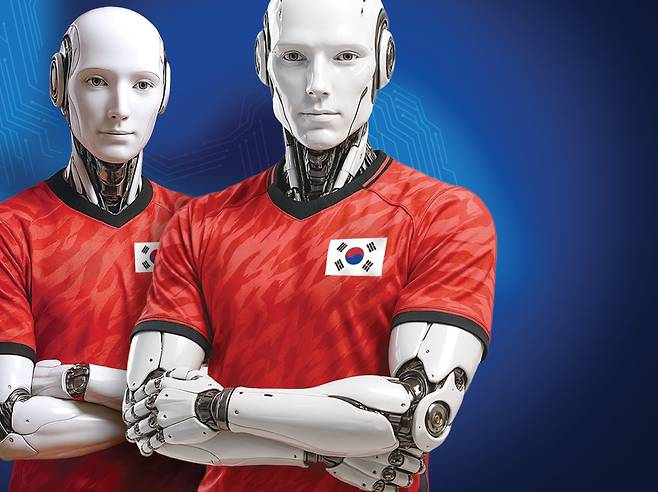
South Korea has launched its first-ever competition to select national artificial intelligence (AI) teams for its sovereign AI foundation model project. As the government’s first official certification of AI firms, the contest is expected to spark fierce technological rivalry.
The Ministry of Science and ICT said on July 21 that 15 consortiums have applied to join the government-led project to develop Korea’s own large language model (LLM), known as the sovereign AI. The initiative marks the first step toward fulfilling President Lee Jae-myung’s top campaign pledge to make South Korea one of the world’s top three AI powerhouses. To close the gap with leading nations like the U.S. and China, the Korean government will inject around 240 billion won into selected teams. “Many firms have claimed to develop generative AI, but this project will clearly separate those with real capabilities,” said an official from one of the bidding firms. “Being selected means the government officially recognizes a company’s ability to build an LLM, so the stakes are higher than ever.”
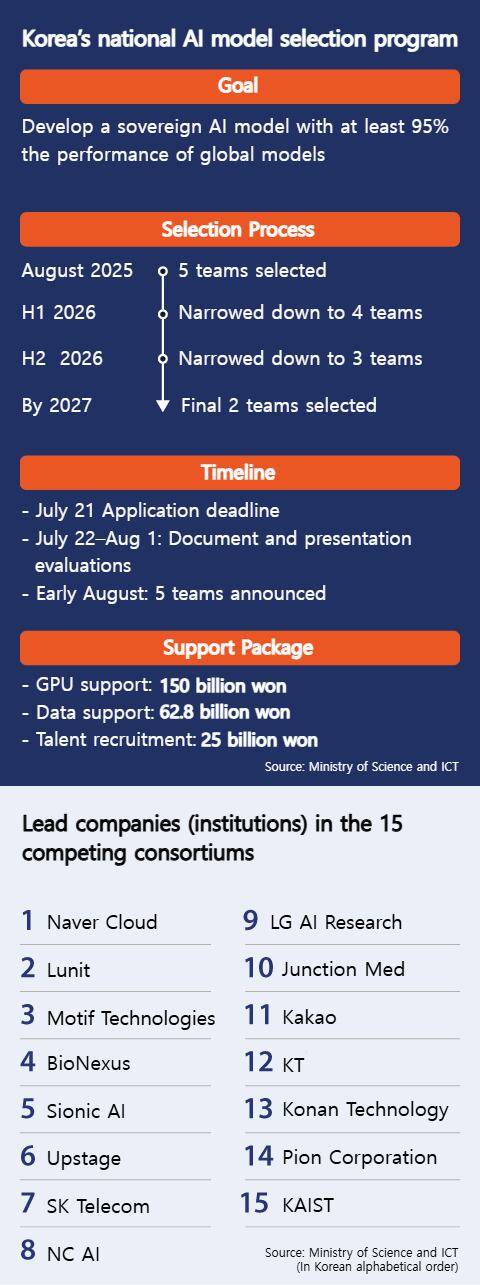
Participants include tech giants such as Naver Cloud, LG AI Research, SK Telecom, KT, Kakao, and NC AI, as well as startups like Upstage and Konan Technology. Many of these companies have formed consortiums with research institutes and universities, including KAIST, which is participating as a lead institution. The competitive atmosphere was clear at a government briefing held late last month at POSCO Tower in Seoul’s Gangnam district, where over 300 attendees packed a 200-seat venue, leaving many standing or sitting in the hallways.
What makes the competition even more critical is the government’s extensive support. Selected teams will receive 150 billion won worth of GPUs, 62.8 billion won in data resources, and 25 billion won in funding for talent recruitment. One startup participant said, “If chosen, we’ll instantly gain the three essentials for building generative AI (GPUs, data, and talent) and have strong backing from the government throughout its term.”
For many participants, the official government certification is more valuable than financial support. After two weeks of screening, including document reviews and presentations, five elite teams will be selected and granted the titles “K-AI Model” or “K-AI Company.” An executive from one AI startup noted, “This certification will be a key advantage when entering global markets. It will also make clear who’s truly built their own LLM, not just using foreign models.”
Since the announcement of the competition, companies have fiercely competed to recruit top partners from academia and industry. One executive from a large corporate AI unit said, “Many assumed professors would serve on the judging panel, so firms scrambled to bring in individuals with close ties to likely reviewers.”
Industry insiders warn that if underqualified companies are selected, it could raise concerns about lobbying. “If the results don’t match the actual technology, people will question whether influence played a role,” said one executive. To prevent such controversies, the Ministry of Science and ICT has decided to keep the names of the judges confidential.
Copyright © 조선일보. 무단전재 및 재배포 금지.
- 차량 전복 사고 낸 타이거 우즈, ‘음주·약물운전’ 혐의 체포
- ‘기부천사’ 지드래곤 나서자… 호두과자 1시간 만에 완판
- [아무튼, 주말]#인형만드는고마저씨#계급도세계관
- 2조 매출 대박 뷰티 전문가가 탈모로 고민하다 한의사와 함께 벌침으로 만든 것
- 세척·살균 끝내 바로 드실수 있어요... 해남 꿀고구마 멤버십 할인 [조멤Pick]
- “구청 직원입니다” 문 열어줬다가 당한 일
- 100만원대 못지 않은 청소기를 12만5000원에 파는 남자
- 트럼프의 외교 특사 “이란 상황, 대통령 믿자”… 미·북 대화 전망 묻자 거부
- 아이젠하워 방한은 2차례 아닌 3차례… 1946년에도 서울 왔었다
- [단독] 입양심사, 민간서 국가 관리로 바뀌자… 아동 281명 무한 대기 중