Subsidy war heats up: SKT’s final cancellation fee waiver day draws crowds to Seoul’s mobile mecca
이 글자크기로 변경됩니다.
(예시) 가장 빠른 뉴스가 있고 다양한 정보, 쌍방향 소통이 숨쉬는 다음뉴스를 만나보세요. 다음뉴스는 국내외 주요이슈와 실시간 속보, 문화생활 및 다양한 분야의 뉴스를 입체적으로 전달하고 있습니다.
"It was really disappointing. Waiving the cancellation fee wasn’t even voluntary. They just did it because the government told them to," said Mr. Park, a former SK Telecom customer.
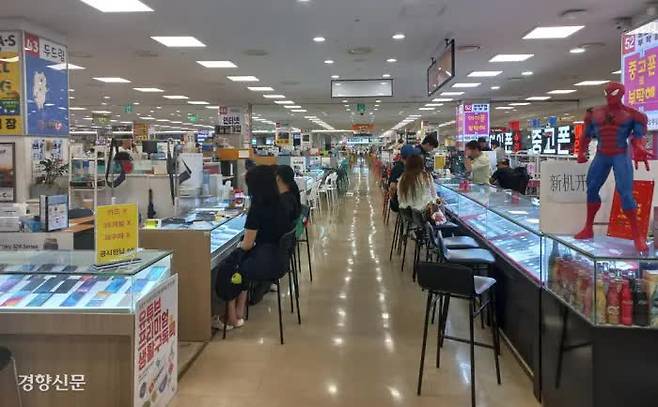
On the afternoon of July 14, just before the end of SK Telecom’s cancellation fee waiver period, groups of people were gathered at each store on the 9th floor of Sindorim TechnoMart in Guro District, Seoul. Known online as a “holy place” for buying phones, Sindorim TechnoMart has gained popularity for its generous subsidies.
It was not hard to find customers switching from SK Telecom to KT or LG U+. Park, who visited with friends, said, “I would’ve had to pay a 400,000 won penalty originally, but I came here before the waiver period ended.”
Ms. Yoo, who had used SK Telecom for 10 years, said her trust in the company was shattered by the recent hacking incident. “The so-called ‘customer appreciation package’ didn’t feel sincere at all. Today, I’m choosing a mobile carrier based purely on price.”
This place where even “illegal subsidies” are not unusual is the frontline of the fierce battle among the three major telecom companies for new customers. Not only are some new smartphones being offered for “free,” but even “negative-priced phones,” where the subsidies exceed the device price, have appeared. This is the result of the mobile carriers aggressively increasing both official subsidies and sales incentives to attract customers.
Sales incentives are paid by phone manufacturers and telecom companies to distributors such as agencies and retailers. However, in high-volume markets known as “holy places,” most of these incentives are passed on to consumers as “rebates.” Currently, offering additional subsidies exceeding 15 percent of the official subsidy amount is illegal. But with the upcoming abolition of the Enforcement Decree of the Mobile Device Distribution Improvement Act set for July 22, the line between what is legal and illegal appears to have already collapsed.
“The subsidy offer ends at 3 p.m. today. You need to decide quickly.”
While the reporter was browsing phones, the manager of Store A said, “SK Telecom is offering the highest subsidies, but the deal is ending soon.” According to Store A, the total subsidies, including official subsidies, exceeded 1.2 million won for all three major mobile carriers.
For example, with a new SK Telecom subscription, customers could receive a Galaxy S25 essentially for free and even get an additional 200,000 won on top of that, if they chose the 109,000 won monthly plan. Choosing the 69,000 won plan would still get them the S25 for free.
LG U+ was offering 150,000 won for those who signed up for the 115,000 won monthly plan, while KT offered 120,000 won with a 110,000 won plan.
SK Telecom’s aggressive subsidy strategy may have helped it hold its ground. Since the hacking incident was reported on April 22, the net loss of SK Telecom subscribers stands at 601,376. While 835,214 customers left, about 230,000 returned.
One factor that helped prevent a massive exodus was SK Telecom’s decision to exclude bundled services like TV and internet from the penalty waiver. Mr. Kim, encountered at TechnoMart, said, “My whole family’s internet, phone, and TV are bundled with SK Telecom. The calculations were too complicated, so I just gave up.”
While the cancellation fee waiver ends on July 14, the competition over subsidies among the carriers shows no signs of cooling down.
“The last time subsidy wars flared up like this was nearly 10 years ago,” said the manager of Shop A. “Mobile carriers may play a waiting game for now, but once one raises subsidies, the others will have no choice but to follow.”
※This article was translated by an AI tool and edited by a professional translator.
Copyright © 경향신문. 무단전재 및 재배포 금지.
- 박지원 “국힘 대미투자법 상정 반대? 이러면 민주당이 하반기 상임위 독점할 수도”
- “너 나와 인마” “어디서 감히…” 아수라장된 국힘 의총, 한동훈 제명 놓고 정면 충돌
- “사랑 방해 말라”던 70대 할머니···30분 설득 끝에 ‘로맨스 스캠’ 막은 경찰
- 실종된 여성 찾았는데 “가정 꾸렸으니 성폭행 아니다”…검찰 불기소 처분에 공분한 중국 [플
- 트럼프 “공화당이 선거 절차 접수해야”···중간선거 패색에 ‘부정선거’ 밑밥 깔기?
- 잇단 ‘시민 사살’ 뒤에야···미 정부, 이민단속 요원 전원 보디캠 의무화
- 대구 ‘박정희 동상’ 앞 출마선언 러시···시민단체 “민주주의 모욕이자 독재자 미화”
- [속보]‘5100선 탈환’ 코스피…4% 급등에 매수사이드카 발동도
- [속보]청문회 위증 혐의 박대준 쿠팡 전 대표, 경찰 출석···“성실히 조사받겠다”
- [속보]경찰, 최재해·유병호 ‘군사기밀 누설’ 관련 감사원 압수수색