Kospi could soar 50% in 2 years: JPMorgan
전체 맥락을 이해하기 위해서는 본문 보기를 권장합니다.
"Korea remains a key overweight market in Asia and among emerging markets," the strategists wrote, as cited by Bloomberg. "The Kospi Index, which has gained 32 percent so far this year and is approaching a record high, could reach around 5,000."
"Even as Kospi earnings forecasts are being revised downward, the index is outperforming global peers on the back of a broader market rerating, rather than earnings strength," said Shin Seung-jin of Samsung Securities. "If a tariff deal sparks rotation into previously lagging sectors, the Kospi could break past its 2021 peak and move to a new level."
이 글자크기로 변경됩니다.
(예시) 가장 빠른 뉴스가 있고 다양한 정보, 쌍방향 소통이 숨쉬는 다음뉴스를 만나보세요. 다음뉴스는 국내외 주요이슈와 실시간 속보, 문화생활 및 다양한 분야의 뉴스를 입체적으로 전달하고 있습니다.
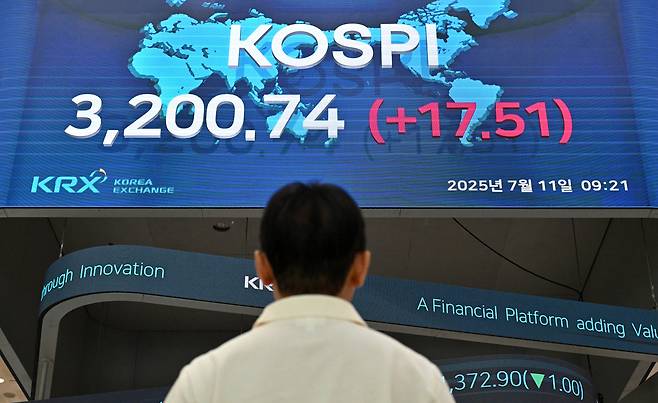
Once deemed wishful thinking, an ambitious target for 5,000 points for South Korea’s benchmark Kospi is now firmly on the radar, with JPMorgan Chase & Co. forecasting the index could climb over 50 percent from current levels within just two years — if the government follows through on its pledge to accelerate corporate governance reforms.
The bullish forecast was reported by Bloomberg on Saturday, citing a note from JPMorgan strategists.
“Korea remains a key overweight market in Asia and among emerging markets,” the strategists wrote, as cited by Bloomberg. “The Kospi Index, which has gained 32 percent so far this year and is approaching a record high, could reach around 5,000.”
JPMorgan upgraded Korean equities to “overweight” from “neutral” earlier this week, pointing to President Lee Jae Myung’s efforts to narrow the "Korea Discount" — the persistent valuation gap with peers like Japan and Taiwan — and deliver what the bank called “the next phase of governance reforms” during his five-year term.
In pledging to lift the Kospi to 5,000 points, Lee has promised measures aimed at improving shareholder returns, raising transparency and strengthening corporate accountability. The target represents a 57 percent gain from Friday’s close of 3,176.
“We continue to recommend adding on any volatility as long as the reform process remains on track,” the strategists said. “Any volatility in global or regional equities over the summer on tariff concerns, growth slowdown, bond market volatility could thus quickly invite buying.”
Investor enthusiasm over Lee’s agenda is already rippling through markets. The Kospi has surged 18 percent from below 2,700 points ahead of his June 3 election, repeatedly testing near-four-year highs over the past month. With a six-month gain of 32 percent, it ranks among the world’s top-performing indexes and leads Asia in 2025.
On Friday, the country's benchmark index climbed to an intraday high of 3,216.7 points — breaking above the 3,200 level for the first time in 46 months, since September 2021. A day earlier, the rally had pushed its total market capitalization to a record 3,000 trillion won ($2.2 trillion).
JPMorgan projected Kospi could surpass its all-time high this year, projecting a trading range of 3,200 to 3,500. The previous peak was an intraday high of 3,316 on June 25, 2021.
Other market watchers echoed the upbeat view, pointing to policy momentum and a broader market rerating as key drivers of continued gains.
“The recent alignment of policy moves — a rate cut by the central bank, the supplementary budget and pro-market measures — has fueled Korean equities more strongly than ever,” said Byun Jun-ho, a strategist at IBK Securities. “We expect this trend to continue into the second half.”
Ample liquidity is also underpinning the rally.
“About 65 trillion won in retail investor deposits remains on hold, while foreign buying continues and inflows into domestic equity funds are rising sharply,” said Na Jung-hwan of NH Investment & Securities. “We anticipate this liquidity will keep flowing into sectors and stocks benefiting from policy-driven momentum.”
JPMorgan added that foreign investment — typically a key driver of the Kospi — has been relatively subdued in the first half this year compared to 2024, leaving room for further inflows. “Given the interest we receive from global investors, we believe investors are looking for better entry points,” the strategists said.
Some analysts flagged external risks, including tariff uncertainty and US inflation data. “The upcoming US June Consumer Price Index is worth watching, as it could reflect the inflationary impact of Trump’s tariff measures,” said Kang Jin-hyuk of Shinhan Securities.
Na added, “If inflation indicators come in high in the third quarter due to tariffs, it could delay the US Federal Reserve’s rate-cut timeline — an emerging risk worth monitoring."
Still, some see any pullback as a buying opportunity.
“Even as Kospi earnings forecasts are being revised downward, the index is outperforming global peers on the back of a broader market rerating, rather than earnings strength,” said Shin Seung-jin of Samsung Securities. “If a tariff deal sparks rotation into previously lagging sectors, the Kospi could break past its 2021 peak and move to a new level.”
Copyright © 코리아헤럴드. 무단전재 및 재배포 금지.