Central bank hits pause on interest rate cuts in white hot housing market
전체 맥락을 이해하기 위해서는 본문 보기를 권장합니다.
"The pace of price increases in the capital area is faster than in August last year," said BOK Gov. Rhee Chang-yong at a press briefing held on Thursday in central Seoul. "The level of concern now is even higher."
"We are weighing the trade-off between growth and financial stability," Rhee said, acknowledging the dilemma. "If that conflict intensifies, the board may become more divided in its views."
이 글자크기로 변경됩니다.
(예시) 가장 빠른 뉴스가 있고 다양한 정보, 쌍방향 소통이 숨쉬는 다음뉴스를 만나보세요. 다음뉴스는 국내외 주요이슈와 실시간 속보, 문화생활 및 다양한 분야의 뉴스를 입체적으로 전달하고 있습니다.
![Bank of Korea (BOK) Gov. Rhee Chang-yong speaks during a press briefing at the BOK headquarters in Jung District, central Seoul, on July 10. [JOINT PRESS CORPS]](https://img4.daumcdn.net/thumb/R658x0.q70/?fname=https://t1.daumcdn.net/news/202507/10/koreajoongangdaily/20250710200946453cyhb.jpg)
The Bank of Korea (BOK) decided to pause its rate-cutting cycle, wary that a premature move could further fuel soaring home prices in Seoul.
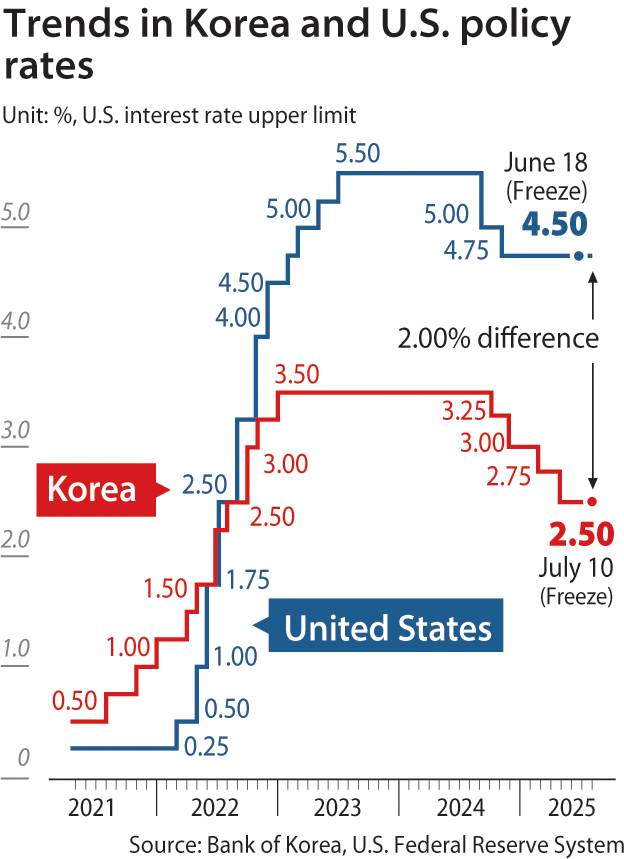
At its monetary policy meeting on Thursday, the BOK’s monetary policy board unanimously voted to keep the base interest rate steady at 2.5 percent. This marks a temporary hold as the board evaluates the impact of recent lending curbs introduced on June 27 to cool the overheated housing market before determining the timing and scale of future cuts.
What held back a rate cut was the unrelenting rise in Seoul's housing prices.
“The pace of price increases in the capital area is faster than in August last year,” said BOK Gov. Rhee Chang-yong at a press briefing held on Thursday in central Seoul. “The level of concern now is even higher.”
The central bank also refrained from a rate cut in August last year, citing housing market overheating risks despite expectations of policy easing.
Apartment prices in Seoul rose by 0.43 percent in the fourth week of June week-on-week, the biggest weekly jump since September 2018, according to the Korea Real Estate Board.
As expectations of further price increases mount, low interest rates could further boost demand, particularly among those willing to stretch their borrowing capacity to buy property.
The BOK predicts that the increase in housing transactions before the June 27 measures will continue until August and September due to the increase in housing mortgage loans.
![Bank of Korea (BOK) Governor Rhee Chang-yong speaks during a press briefing at the BOK headquarters in Jung District, central Seoul, on July 10. [JOINT PRESS CORPS]](https://img3.daumcdn.net/thumb/R658x0.q70/?fname=https://t1.daumcdn.net/news/202507/10/koreajoongangdaily/20250710200949584fmzl.jpg)
In particular, it is estimated that housing mortgage loans will surge to nearly 8 trillion won ($5.83 billion) in August this year, the highest level since August of last year, when the figure stood at 8.5 trillion won.
Excessive household debt is a drag on consumption and broader economic growth. In a highly real estate-dependent economy like Korea’s, a future drop in housing prices could deepen consumption slumps and lead to bad debts at banks. If people cannot repay their debts, the asset soundness of banks that lent money using houses as collateral will also deteriorate.
“Household debt now stands at nearly 90 percent of GDP, a critical threshold beyond which it begins to constrain consumption and growth,” Rhee warned.
The government and BOK aim to reduce this ratio gradually to below 80 percent.
![Amid high inflation, shoppers look around discounted products at a market in Dongdaemun District, eastern Seoul, on July 6. [YONHAP]](https://img2.daumcdn.net/thumb/R658x0.q70/?fname=https://t1.daumcdn.net/news/202507/10/koreajoongangdaily/20250710194838322gdzq.jpg)
The uncertainty regarding the timing of additional interest rate cuts in the U.S. is also the background for this freeze. Despite the aftermath of U.S. President Donald Trump's tariff policy, economic indicators such as employment are still showing favorable trends.
The market sees a high possibility that the U.S. Federal Reserve will freeze interest rates at the end of July and slow the pace of rate cuts in the future.
Several of the 19 Fed officials flagged inflation risks, with seven predicting no rate cuts this year, according to the June Federal Open Market Committee minutes.
If Korea lowers its interest rate first and the interest rate gap with the United States widens to more than 2 percentage points, export companies may face difficulties due to the depreciation of the won.
If the recovery in domestic demand is delayed and exports are also hit by U.S. tariffs, it is predicted that the economy may fail to grow even in the 1 percent range.
![A loan window at a bank in Seoul is seen on July 7, amid the implementation of strict lending regulations limiting housing mortgage loans. [YONHAP]](https://img1.daumcdn.net/thumb/R658x0.q70/?fname=https://t1.daumcdn.net/news/202507/10/koreajoongangdaily/20250710194840087beyo.jpg)
Rhee mentioned on Thursday that private consumption is improving compared to the outlook in May, but construction investment has worsened. However, it is expected that the additional 32 trillion won supplementary budget plan, including the people's livelihood recovery consumption coupons, will prevent a further slowdown in the growth rate.
The BOK estimated that this year's annual growth rate will rise by 0.1 percentage points from the 0.8 percent forecast presented in May due to this supplementary budget.
The market is currently leaning toward a rate cut in August. Four out of the six BOK monetary policy board members are open to a rate cut within three months.
However, the worst-case scenario, in which housing prices do not stabilize and the negative impact of tariffs increases, still needs consideration.
“We are weighing the trade-off between growth and financial stability,” Rhee said, acknowledging the dilemma. “If that conflict intensifies, the board may become more divided in its views.”
Translated from the JoongAng Ilbo using generative AI and edited by Korea JoongAng Daily staff. BY KIM KYUNG-HEE [lim.jeongwon@joongang.co.kr]
Copyright © 코리아중앙데일리. 무단전재 및 재배포 금지.
- 삼성, 평택 신규 공장 건설 박차...HBM4로 반격 시도
- Woman hit by falling teen dies a day after 11-year-old daughter in same incident
- North Korean defector sues Kim Jong-un in historic first
- Tuna travesty as massive bluefin haul off Korea's east coast dumped due to fishing quotas
- U.S. calls to 'modernize' alliance with South Korea may put Seoul-Washington ties at a crossroads
- Too hot for school: Summer break may come early
- North Koreans no longer tuning in to South Korean radio channels
- 'Unbearably hot': Ex-President Yoon to endure summer heat in cell alone as he awaits trial
- Court issues warrant returning ex-President Yoon to custody over martial law bid
- This golfer is joining the PGA tour — after playing only 30 rounds of real golf