BOK halts easing cycle to counter soaring home prices
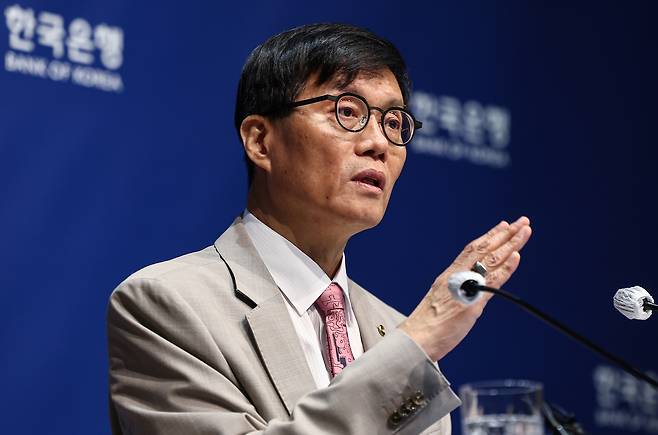
The Bank of Korea held its base rate steady Thursday, aiming to rein in mounting household debt amid a resurgent property market.
The central bank maintained the rate at 2.5 percent. The rate freeze was supported by all six members of the Monetary Policy Board excluding BOK Gov. Rhee Chang-yong, whose individual vote is not disclosed.
Amid the financial authorities’ move to impose strict lending regulations, such as capping mortgage loans at 600 million won ($437,000) in the Greater Seoul area, the BOK has also signaled its intent to curb the debt surge by keeping the base rate unchanged.
"Housing prices, especially in the Seoul metropolitan area, are rising faster than they did in August last year," BOK Gov. Rhee Chang-yong said at a press conference held shortly after the rate-setting meeting.
“The policy priority lies in stabilizing the market expectation and managing household loans to prevent a rise in housing prices,” Rhee said.
A sharp increase in household loans could pose a threat to the country’s financial stability by heightening the risk of nonperforming loans, while also dampening overall consumption.
“The mounting household debts entail many side effects. The amount of the loan has already neared a tipping point that poses constraints on consumption and overall growth,” Rhee said.
Driven by increased housing transactions and soaring home prices, outstanding household loans at banks stood at 1,161.5 trillion won at the end of June — the largest monthly gain in 10 months — according to central bank data released on the previous day.
"The BOK has long held the view that the scale of a rate cut should be carefully managed so as not to fuel further increases in property prices," Rhee said.
The rate hold puts the brake on BOK’s recent rate-cut cycle. Since October, the bank has been alternating between rate cuts and holds, bringing down the policy rate by a cumulative 1 percentage point to support the sluggish economy.
The widening Korea-US interest rate gap, now at a record 2 percentage points, is another key factor in the central bank’s cautious stance. With the US Federal Reserve expected to hold its rate this month, an additional rate cut by the BOK would have widened the differential to 2.25 percentage points, raising concerns over foreign exchange market volatility.
"It is not that the Korea-US rate gap should not exceed a certain level mechanically," Rhee said, underlining that the central bank does not adhere rigidly to a specific threshold in setting its policy.
"While the dollar is expected to remain on a weakening trend, we will need to closely monitor the situation, though Korea’s dependence on US monetary policy has lessened compared to the past."
Though the BOK kept the rate steady Thursday, market analysts viewed the central bank remains on track for a rate cut cycle.
“The Korea-US rate gap is concerning, but solely waiting for a rate reduction from the US is not viable. The external policy burden is expected to ease significantly once the tariff negotiations scheduled for Aug. 1 are confirmed,” said Yoon Yeo-sam, an analyst at Meritz Securities.
“While the rate cut could be delayed until October as the BOK assesses the impact of the real estate policies, the possibility of a rate cut in August remains high, provided the low-growth trend does not change significantly,” Ahn Ye-ha, an analyst at Kiwoom Securities, viewed.
Copyright © 코리아헤럴드. 무단전재 및 재배포 금지.