'Pain pill, not candy': BlueSpace founder bets on off-road autonomous driving
전체 맥락을 이해하기 위해서는 본문 보기를 권장합니다.
"You need to believe that this is a complex problem," she said. "It's not a solved problem and out of where, there's going to be a small company that's going to present the solutionIf you believe that the first movers like Waymo, for example, will solve everything, think about Skype. Skype was No. 1, but now it's gone You never see what's possible so you need to keep the door ajar and be open-minded that even a small company could present a solution that's pretty revolutionary."
"Now that we have to work with (original equipment manufacturers) and there is Hyundai and Kia. There is Hanwha in defense. So I get to work with all of these Korean companies, which makes me feel proud. There is K-pop, K-culture -- but now Korean companies are everywhere."
이 글자크기로 변경됩니다.
(예시) 가장 빠른 뉴스가 있고 다양한 정보, 쌍방향 소통이 숨쉬는 다음뉴스를 만나보세요. 다음뉴스는 국내외 주요이슈와 실시간 속보, 문화생활 및 다양한 분야의 뉴스를 입체적으로 전달하고 있습니다.
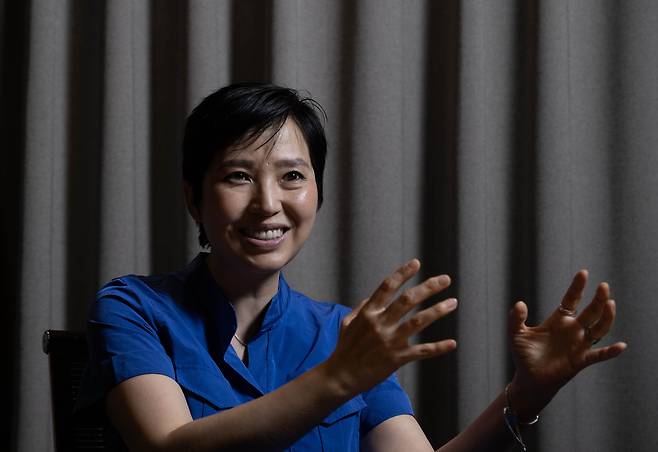
Christine Moon, a Korean American entrepreneur with over 15 years of experience in Silicon Valley at major tech firms like Google and Dropbox, is no stranger to uncharted paths. Now, she's pioneering a more rugged and overlooked frontier in autonomous driving: off-road terrain.
As co-founder and president of BlueSpace, Moon is tackling environments where conventional autonomous driving technology doesn't apply -- industries like mining, agriculture and defense.
“As a software startup, you fall into three categories: 'pain pill,' 'vitamin' and 'candy.' To me, Waymo Robotaxi is fun. It’s like the future. It’s sort of like candy because you can still get around with Ubers and Lyfts and you can drive,” said Moon in an interview with The Korea Herald in Seoul on Thursday.
“The problems that we address -- we’re a pain pill because there’s a shortage of labor for mining, farming and defense. None of (the younger generations) are signing up to be like ‘I want to be underground mining all day so I don’t have to see the sunlight or I want to do trucking so I can be away from my family two weeks at a time.’ Even in developing countries like India, young people don’t want to do hard jobs. They don’t want to be out in the sun toiling and farming away because they have options … So I think what that means is that as we fast-forward, the future is robots, humanoid, quadrupeds and autonomy.”
Noting that BlueSpace is not here to compete against Tesla or Waymo, Moon explained that those off-road working environments, where high-definition maps and clear road markings do not exist, require different technology from on-road technologies that face certain restrictions due to their reliance on geofencing. As such, BlueSpace is developing a physics- and math-based approach unlike traditional autonomy systems that rely on HD maps, signals from the global positioning system, or GPS, and large datasets.
“We don’t need a lot of data and priors, which means cost savings,” she said. “And there’s a shortage of (graphics processing units) today but we are (central processing unit-based), so that’s very welcoming.”
According to Moon, BlueSpace’s autonomous driving technology can define objects by motion leveraging 4D sensors that capture not only position but velocity of objects with higher accuracy and faster reaction time. Due to its high performance, cost efficiency, explainability and usability, BlueSpace secured a $1.6 million contract with the United States Army to enhance perception sensing for future unmanned ground vehicles in 2023, about four years after its establishment.
“We meet a lot of military officials and they say you have to think about the 18-year old kid who graduated from high school and he’s sitting in the Abrams tank all day and he is the one who is operating it,” she said.
“So what’s important is showing just the right amount of data so that the person can understand, which is what BlueSpace presents.”
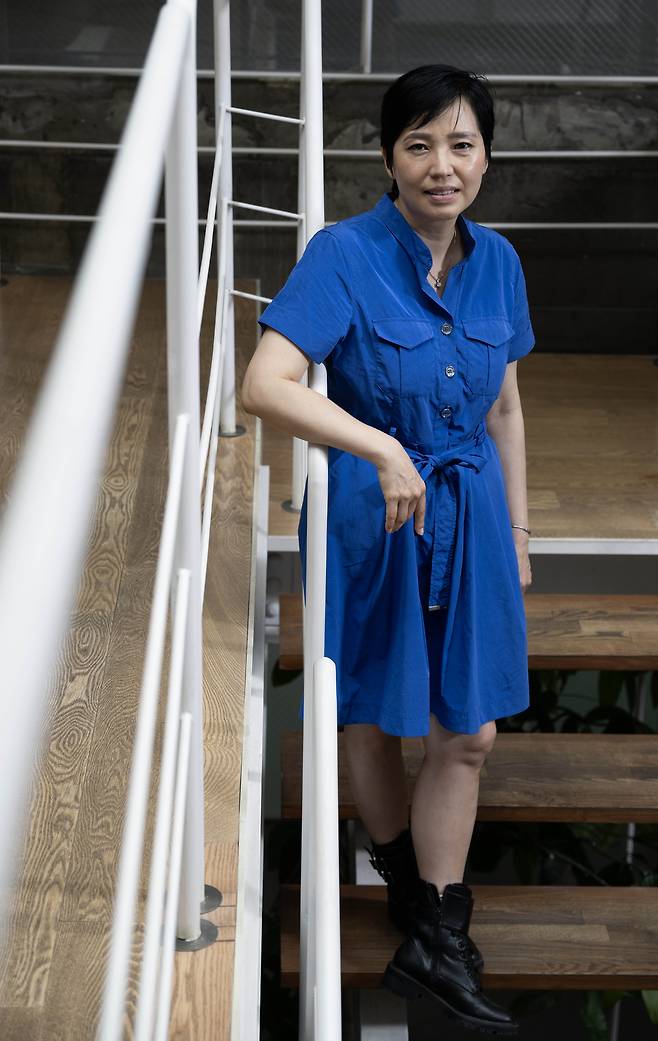
BlueSpace raised $3.5 million in seed funding that included YouTube co-founder Steve Chen, Kakao Ventures and Lee Soo-man, founder of K-pop powerhouse SM Entertainment. With the goal of raising $15 million in Series A funding, the startup has so far raised $12.5 million while generating $2.5 million in revenue. BlueSpace estimates that it will be able to log $30 million in revenue in 2027.
As the startup has been gaining attention in the construction and defense sectors, Korea’s defense conglomerate Hanwha Group took notice and decided to partner with BlueSpace in October last year, announcing that the two sides will work together to bring state-of-the-art autonomous solutions to US defense customers.
“(Hanwha) believes that they have to break into the US market,” she said. “They are not the only big, global defense company looking to enter the US market. Even though we are a small company, we are getting contacted by major defense firms from Israel and Italy… If they can load our software onto their products, it could play to their advantage when dealing with the US government’s ‘Buy American Act.’”
Quoting Dmitri Dolgov, co-CEO of Waymo, as saying, “There’s no single model that solves everything,” Moon pointed out the importance of having redundancy in software and different failure models as the autonomous driving sector continues to move forward as a whole.
“You need to believe that this is a complex problem,” she said. “It’s not a solved problem and out of where, there’s going to be a small company that’s going to present the solution…If you believe that the first movers like Waymo, for example, will solve everything, think about Skype. Skype was No. 1, but now it’s gone … You never see what’s possible so you need to keep the door ajar and be open-minded that even a small company could present a solution that’s pretty revolutionary.”
Moon, who moved to the US after graduating from Yonsei University in Seoul and earned her Master’s degree from Yale University, began her career at Morgan Stanley, where she worked in mergers and acquisitions for three years. But she wanted to do something she was passionate about and forge her own path, so she joined Google in 2004.
“During my career, I never sought out Korean companies to work with but I was the head of Android partnerships at Google and we were working with Samsung and LG,” she said.
“Now that we have to work with (original equipment manufacturers) and there is Hyundai and Kia. There is Hanwha in defense. So I get to work with all of these Korean companies, which makes me feel proud. There is K-pop, K-culture -- but now Korean companies are everywhere.”
The Top 100 Global Innovators series spotlights the trailblazers shaping Korea’s future across a range of industries — from bold entrepreneurs and tech pioneers to research leaders — whose innovations are making a global impact beyond Korea. More than a celebration of success, the series offers a deeper exploration of the ideas, breakthroughs and strategies driving their achievements. — Ed.
Copyright © 코리아헤럴드. 무단전재 및 재배포 금지.