Seoul mulls tax cut on dividends to spur payouts, investment
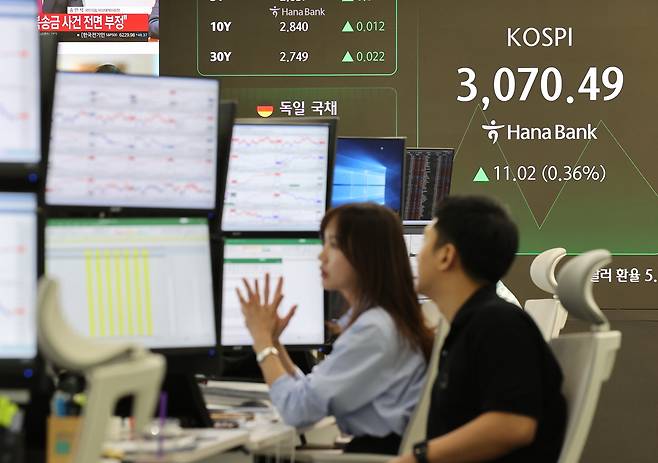
Expectations are high that President Lee Jae Myung’s push to revitalize Korea’s capital markets could be bolstered by reforms to the country’s dividend tax system, potentially unlocking value through higher payouts.
Under the current tax regime, if annual dividend income exceeds 20 million won ($14,640), it is combined with other financial income such as interest and pensions for comprehensive tax assessment, resulting in a combined effective tax rate of up to 49.5 percent.
This high tax burden discourages investors, especially large shareholders, many of whom are also company insiders or top executives, from accepting dividend payouts. This contributes to the persistent low dividend payout ratios that leave Korea’s stock market undervalued relative to global peers.
“High dividend taxes drive management and major shareholders to keep payouts low or expand subsidiaries to avoid heavy tax burdens,” President Lee said during his visit to the country’s main bourse operator Korea Exchange on June 11.
Korea’s dividend payout ratio stands around 26-27 percent, much lower than 42 percent in the US, 36 percent in Japan and 31.3 percent in China.
To counter this, he cited a bill proposed by Rep. Lee So-young of the ruling Democratic Party of Korea, designed to promote higher dividends through a revised tax approach.
The proposed bill seeks to apply a separate, lower tax rate to dividends received from listed companies with payout ratios of 35 percent or higher, independent of the existing comprehensive income tax system.
Under this plan, dividends up to 20 million won would be taxed at 15.4 percent, amounts between 20 million and 300 million won at 22 percent, and dividends exceeding 300 million won at 27.5 percent.
This reform could significantly reduce the maximum tax rate from nearly 50 percent to around 25 percent for major shareholders, providing a strong incentive to increase dividend payouts.
But the government says smaller shareholders would also benefit, as higher payouts tend to improve dividend yields and enhance investment appeal.
“Applying separate taxation to companies with a payout ratio of 35 percent or higher can reduce investors’ tax burden, encourage long-term investments, and stabilize the capital market,” said DS Investment & Securities analyst Kim Soo-hyun.
Analysts said that the success of these reforms depends on companies not only maintaining high payout ratios but also demonstrating a consistent trend of dividend growth.
Daishin Securities analyst Lee Kyung-yeon recommended identifying "true value stocks" with strong dividend capacity, an explicit desire to expand payouts and potential tax advantages.
The brokerage firm identified several companies likely to benefit from the proposed tax changes, including Jinyang Holdings, SeAH Be Steel Holdings, Amore Pacific Holdings, CJ, Huons Global, SK Discovery and Orion Holdings.
These firms have maintained an average payout ratio above 35 percent over the past five years and have substantial ownership stakes by major shareholders.
Companies with payout ratios between 25 and 34 percent, such as Kolon, Hankook & Co. and Daesang Holdings, are also on the radar, as they have incentives to push past the 35 percent threshold and unlock additional benefits.
If separate taxation on dividend income is introduced, financial holding companies are expected to shift their focus from stock buybacks and cancellations to increasing dividends.
Although the total shareholder return, combining buybacks, cancellations and dividends, stands at around 40 percent for major groups like Woori, Hana, KB and Shinhan, their dividend payout ratios are below 30 percent as of the end of the first quarter, indicating they have room to raise dividends if the new tax policy encourages it.
Copyright © 코리아헤럴드. 무단전재 및 재배포 금지.