Goryeo, Joseon relics return home
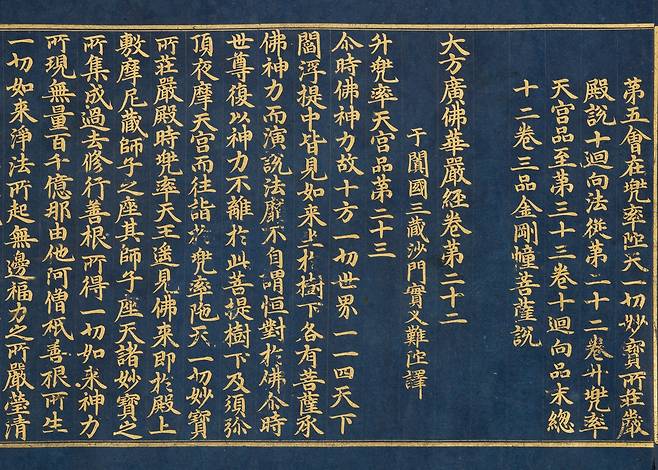
A Buddhist scripture from the Goryeo Kingdom (918-1392) and a rare Buddhist painting created during the early Joseon era (1392-1910) have made their way back home from Japan, the Korea Heritage Service and the Overseas Korean Cultural Heritage Foundation said Tuesday.
"The repatriation of these cultural artifacts is particularly meaningful as we are showing it to the public for the first time just a month before the 80th anniversary of Korea's liberation from Japanese colonial rule," Cho Eung-chon, who heads the KHS, told reporters during a press briefing at the National Palace Museum of Korea.
Korea was liberated from 35 years of Japanese colonial rule on Aug. 15, 1945.
Unveiled Tuesday was a transcription of the Zhou version of the Vatamsaka Sutra, also known as the Flower Garland Sutra, Vol. 22, which was written by hand using a special ink made from gold powder mixed with glue, on indigo paper.
The handwritten Buddhist scripture is a copy of the Avatamsaka Sutra, one of the most essential texts in Hwaeom Buddhism, a major school of thought in East Asian Buddhism. It was repatriated from Japan in April.
This manuscript contains a written prayer stating that Jeongdokmandara, a Korean from the Goryeo Kingdom who traveled to Yuan Dynasty China during King Chungryeol's reign and became a eunuch there, completed the transcription of 81 volumes of the Avatamsaka Sutra in 1334. He undertook this work to express his deep gratitude to his parents and the emperor for their kindness.
When fully unrolled, it measures 10.9 meters in length and features a cover adorned with five lotus flowers painted in gold and silver, surrounded by an intricate vine pattern.
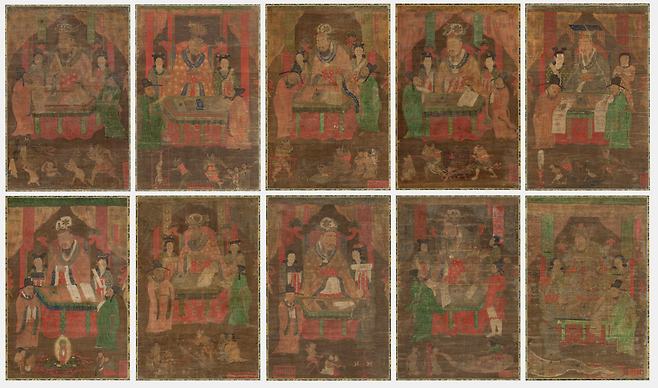
Another repatriated artifact shown Tuesday was a set of paintings on silk depicting the Ten Underworld Kings created during the early Joseon era. It returned to Korea in November last year.
The paintings portray the 10 kings of the underworld who pass judgment on the sins committed by the deceased in their lifetime. The set consists of 10 hanging scrolls, each depicting one of the 10 kings and a scene of hell, with a clear contrast between divine authority and suffering.
The artifacts are being temporarily stored at the National Palace Museum of Korea to assess their condition and to determine their preservation needs. The agency added that it would also consider hosting various public events, such as an exhibition, to showcase the artifacts to the public.
Copyright © 코리아헤럴드. 무단전재 및 재배포 금지.