South Korea ramps up AI-driven drug development amid global investment surge
이 글자크기로 변경됩니다.
(예시) 가장 빠른 뉴스가 있고 다양한 정보, 쌍방향 소통이 숨쉬는 다음뉴스를 만나보세요. 다음뉴스는 국내외 주요이슈와 실시간 속보, 문화생활 및 다양한 분야의 뉴스를 입체적으로 전달하고 있습니다.
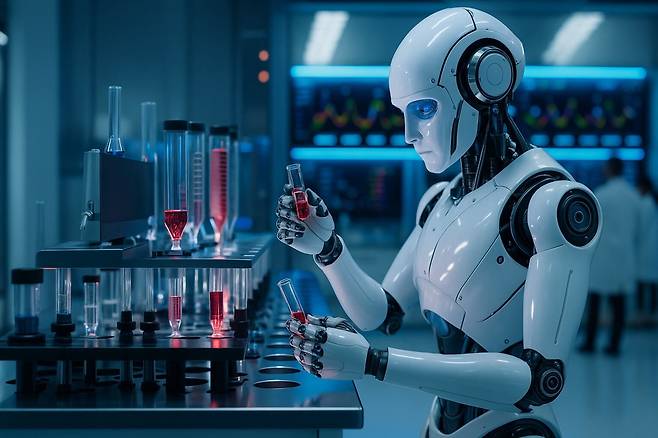
The administration of South Korean President Lee Jae-myung, which has positioned itself as an “artificial intelligence (AI)-driven government,” is moving to expand support for AI-powered drug development—a sector attracting massive investment worldwide. From identifying therapeutic candidates to clinical trials and personalized treatments, AI is rapidly emerging as a critical tool across the pharmaceutical value chain. The South Korean government aims to reduce both the development timeline, which typically exceeds a decade, and the cost—estimated at around 2 trillion won ($1.46 billion)—by more than half.
Pharmaceutical and biotech companies around the globe are increasingly adopting AI, which can analyze vast datasets—ranging from chemical compound libraries to disease-related protein structures—at a speed and accuracy far beyond human capacity. According to the Korea Health Industry Development Institute, the global AI drug discovery market is projected to grow from $902.7 million (1.26 trillion won) in 2023 to $2.89 billion (4.06 trillion won) by 2028.
On July 4, lawmakers announced that the National Assembly’s Health and Welfare Committee approved a supplementary budget proposal jointly drafted by the Ministry of Health and Welfare and the Ministry of Science and ICT to support AI-based drug development. The funding will go toward initiatives aimed at building AI-enabled preclinical and clinical modeling capabilities and accelerating the development of antibody-based “biobetter” drugs through AI applications.
One effort, allocated 2.18 billion won ($1.57 million) this year, focuses on developing AI-powered platforms and technologies to identify therapeutic candidates and advance them into clinical trials. The government plans to invest a total of 49.5 billion won ($35.6 million) in the initiative through 2029.
Another program, receiving 3.3 billion won ($2.38 million) in initial funding, is centered on discovering and validating next-generation antibody drugs—known as biobetters—that offer improved efficacy or greater dosing convenience compared to existing biologics. Using dual-antibody technologies, the initiative is expected to receive 40.4 billion won ($29 million) in government support by 2027.
South Korea’s investment push comes amid a global boom in AI-driven pharmaceutical development. Major tech firms including Google, Amazon, and Nvidia are making large-scale investments in the sector, accelerating its advancement.
Isomorphic Labs, an AI drug discovery company under Alphabet, Google’s parent firm, signed co-development deals last year worth 2.4 trillion won ($1.7 billion) with U.S. pharmaceutical giant Eli Lilly and 1.7 trillion won ($1.2 billion) with Swiss drugmaker Novartis. In another major move, U.S.-based Recursion Pharmaceuticals acquired British AI drug developer Exscientia in a 1 trillion won ($720 million) deal.
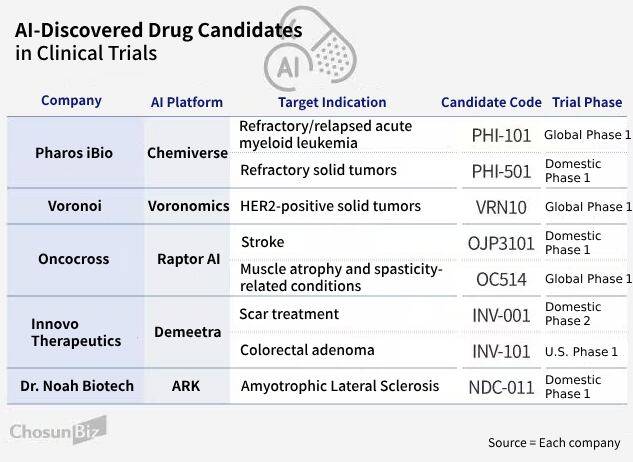
By comparison, South Korea’s AI drug discovery ecosystem is still in its infancy. Thus far, only about 10 AI-identified drug candidates have entered clinical trials. Most remain in Phase 1, and just one—INV-001, a topical scar treatment developed by Innovo Therapeutics—has progressed to Phase 2.
Despite early interest and progress, most domestic players continue to operate at a loss. Innovo Therapeutics, widely viewed as a frontrunner in the field, posted a 13 billion won ($9.4 million) deficit last year. Pharos iBio, the first Korean AI drug developer to initiate clinical trials, reported a 12.6 billion won ($9.1 million) loss in 2024. Standigm, which had gained recognition for securing international investment, recently cut its workforce from 80 to 27 employees as part of a broader restructuring.
Copyright © 조선일보. 무단전재 및 재배포 금지.
- 작년 불수능 만들었던 영어… 6월 모평서도 70% “어려워”
- 정청래 비판하는 글에 ‘좋아요’…김민석 “페북에 저도 모르는 ‘좋아요’ 눌려”
- 뉴욕 닉스, NBA 챔프전서 샌안토니오 스퍼스에 2경기 연속 원정 역전승
- 이란, 헤즈볼라 공개 지지... 중동 종전협상 더 꼬였다
- “나름 선전” “지도부 도움 안돼” 국힘 당권파·비당권파 충돌
- CU편의점 택배도 정보 유출... 이름·주소·폰번호 털렸다
- “李정부가 무모한 강경 좌파?” 靑, WSJ 칼럼에 반박 기고
- 전인지 2라운드 1타차 3위...새 스윙으로 11년만의 US여자오픈 우승 도전
- 변협 “투표용지 부족 사태, 참정권 침해…선관위 책임 규명해야”
- 美·이란, 또 공격 주고받았다... 호르무즈 발포 두고 신경전