New Sejong Institutes to open amid growing demand for Korean language classes
Amid surging global interest in Korean language and culture, the King Sejong Institute Foundation, which oversees Korean language education abroad, is expanding its network to ease waitlists and meet growing demand for Korean classes worldwide.
This year, 11 new King Sejong Institutes, named after King Sejong the Great (1397-1450), who created the Korean alphabet Hangeul, will open across nine countries, according to the Ministry of Culture, Sports and Tourism on Friday. With the additions there will be a total of 252 institutes in 87 countries.
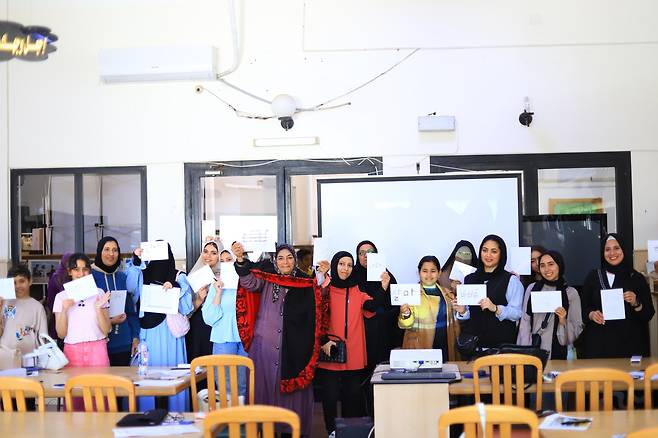
In Egypt, where the only KSI in Cairo faced a waitlist of more than 1,200 students, two new centers will open at Ain Shams University and Alexandria University to accommodate learners eager to study Korean for academic, professional, and cultural reasons. The expansion reflects the growing presence of Korean businesses in Egypt, which has increased local demand for Korean language skills for employment.
Uzbekistan, which already hosts seven KSIs, will gain an additional center at Ajou University in Tashkent, responding to rising demand among students preparing for study in Korea and seeking Korean language proficiency for employment opportunities. The country now sends over 12,000 students to Korea each year, the fourth highest after China, Vietnam and Mongolia.
In Asia, new KSIs will open in Kuala Lumpur in Malaysia, Dubai in United Arab Emirates, Shenyang in China, Taipei in Taiwan, and Munoz in the Philippines, while Europe’s expanding Korean language demand has led to new centers in Bonn in Germany, Turin in Italy, and Miskolc in Hungary.
In 2024 alone, a total of 210,374 students studied Korean both online and offline at King Sejong Institutes worldwide. This is a significant increase from 2007, when the first King Sejong Institute opened in Ulaanbaatar, Mongolia, with just 13 centers in three countries opening that year, with 740 students.
The ministry said that it planned to gradually expand the number of King Sejong Institutes to more than 350 by 2030 to ensure that Korean language learners worldwide can access classes as demand continues to grow.
Copyright © 코리아헤럴드. 무단전재 및 재배포 금지.