Dataiku commits to accelerating S. Korea’s AI journey with universal AI platform
이 글자크기로 변경됩니다.
(예시) 가장 빠른 뉴스가 있고 다양한 정보, 쌍방향 소통이 숨쉬는 다음뉴스를 만나보세요. 다음뉴스는 국내외 주요이슈와 실시간 속보, 문화생활 및 다양한 분야의 뉴스를 입체적으로 전달하고 있습니다.
“Dataiku is seeing strong interest and great potential in the Korean market,” said Clément Sténac, co-founder and chief technology officer of the universal AI platform provider, at a media conference in Seoul on July 3. “There have been changes in South Korea, with growing focus on AI innovation, and we believe that we can help Korean companies on their path to AI.”
At the event, Dataiku shared its vision for the South Korean market and outlined strategies to accelerate digital transformation across industries. Sténac was joined by Vice President of Platform Strategy Jed Dougherty, Korea Country Manager JD Kim, and Senior Solutions Engineer Woo Jae-ha, who introduced Dataiku’s global direction, platform capabilities, and collaborations with major Korean companies.
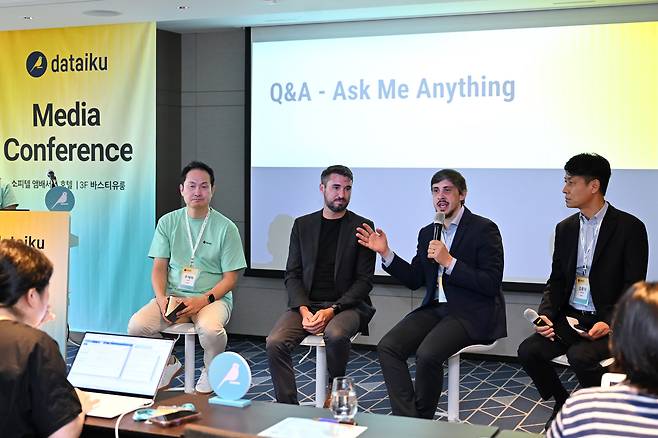
Founded in France in 2013, Dataiku serves over 700 clients worldwide, including more than 220 Fortune 2000 firms. It operates 13 offices globally with over 1,100 employees. Since establishing its local presence three years ago, Dataiku has doubled its Korea team and expanded into new sectors including finance, retail, and advertising. Its major clients in South Korea span industries such as manufacturing, finance, and semiconductor packaging, with names like LG Chem, POSCO, Doosan, and Nepes.
At LG Chem, Dataiku’s platform drives AI projects in quality prediction, anomaly detection, pricing, and contract analysis. Business users lead hundreds of AI initiatives using no-code tools, eliminating the need for SQL or programming skills. “The platform automatically handles queries and analysis,” explained Woo.
Doosan uses predictive models to optimize steel production and reduce energy consumption. It also employs generative AI to simplify internal content creation, significantly cutting production time. Nepes leverages Dataiku to improve product quality and reduce testing costs by running virtual experiments and applying AI-based fault detection.
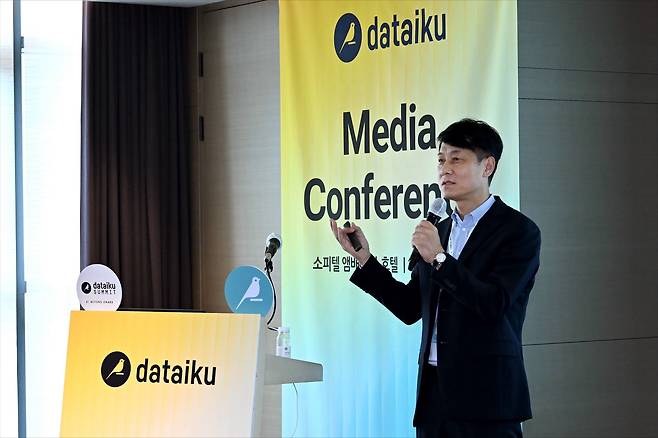
Sténac highlighted Dataiku’s core strength as its universal AI platform, which allows users of diverse technical skills and domain expertise to collaborate effectively. “Our platform balances agility with governance and security, helping enterprises scale AI responsibly,” he said. “It’s future-proof and vendor-agnostic, providing flexibility in a fast-evolving market.”
Dataiku offers enterprises robust governance and security frameworks certified under ISO 27001 and SOC 2 Type II standards. Dougherty emphasized Dataiku’s strong data privacy approach, saying, “We never take or own our clients’ data. Our platform operates on top of their existing databases, allowing clients to build and control AI agents without our staff accessing their data.”
To support broader enterprise adoption, Dataiku has partnered with Nvidia to co-develop a scalable AI agent architecture for the financial sector. “At Nvidia’s recent conference, their CEO Jensen Huang announced our partnership, noting that Dataiku can deploy large language models on their latest cutting-edge Blackwell chips without writing a single line of code,” Dougherty said.
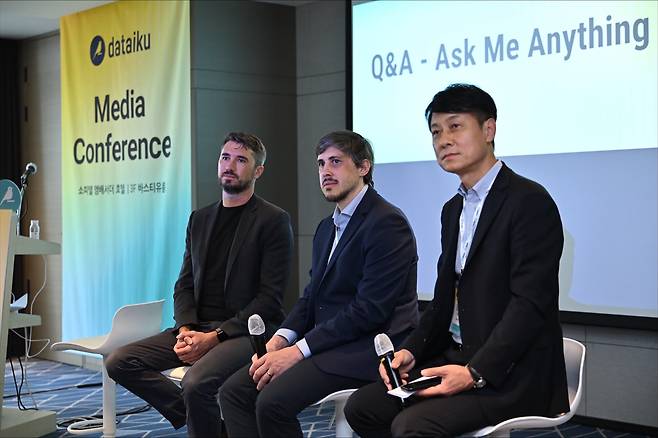
Korea Country Manager JD Kim outlined Dataiku’s vision to guide Korean companies from AI curiosity to implementation. “Many want to adopt AI but don’t know where to start,” he said. “Our flexible platform lowers barriers and supports adaptation to new technologies, helping Korea boost its industrial competitiveness.”
Dataiku has been recognized as a Leader in Gartner’s Magic Quadrant for Data Science and Machine Learning Platforms for four consecutive years. On maintaining leadership, Sténac said, “There is no big secret. We listen to the market and our customers and balance between reacting quickly and making sure things make sense.”
“AI is the next industrial revolution, following the internet and cloud,” Sténac said. “With more than a decade of global experience, we’re ready to support Korea’s AI journey including sovereign AI.”
Copyright © 조선일보. 무단전재 및 재배포 금지.
- [유광종의 漢字로 보는 중국] [14] ‘漢 문명’의 인기 왜 시들해졌나
- [동서남북] CEO봇, 상전인가 조수인가
- [팀 알퍼의 런던 Eye] [31] 한국 창문이 그립다
- [기자의 시각] 우주선에 화장실이 필요한 이유
- [논설실의 뉴스 읽기] “인간 소설가는 내리막길서 달리기하는 신세… AI 소설 선 넘으면 그땐 절
- 조지 클루니 “트럼프 발언 전쟁 범죄”… 백악관 “당신 발연기가 범죄”
- [김교석의 남자의 물건] [34] 내복으로 태어나 무비스타의 겉옷으로 출세
- [오늘의 날씨] 2026년 4월 10일
- [유현준의 공간과 도시] 역사적 공간에서 권력을 노래한 BTS
- [황유원의 어쩌다 마주친 문장] [75] 그대의 음성