Hyundai, Kia brace for tariff impact in US
전체 맥락을 이해하기 위해서는 본문 보기를 권장합니다.
"We need to make a big deal ... If we get the tariffs down to the 10 percent range or a single-digit (percentage), I think that would be a great success."
"Other automakers are almost being forced to hike their prices," said the official. "(Hyundai and Kia) have been selling well in the first half of this year, but they will need to make tough but necessary decisions to keep expanding their market presence in the US."
이 글자크기로 변경됩니다.
(예시) 가장 빠른 뉴스가 있고 다양한 정보, 쌍방향 소통이 숨쉬는 다음뉴스를 만나보세요. 다음뉴스는 국내외 주요이슈와 실시간 속보, 문화생활 및 다양한 분야의 뉴스를 입체적으로 전달하고 있습니다.
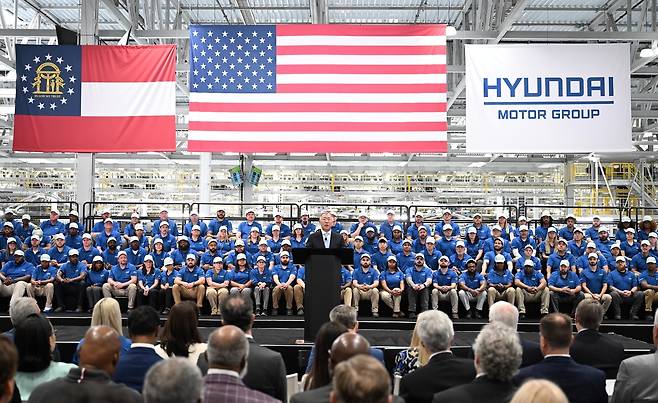
Despite their recording-setting first-half performance in the US market, Hyundai Motor and Kia are buckling up for the impact of new tariffs as President Donald Trump recently confirmed that the 25 percent levies on auto imports to the US will take effect next week.
Hyundai and Kia reported on Wednesday that they sold a record-high 893,152 cars in the US in the first half of this year, up 9.2 percent from the same period last year, with hybrid vehicles leading the growth.
Both companies have so far resisted raising prices in response to the looming tariffs, denying speculation they might hike sticker prices to offset costs. In contrast, rivals including Toyota and Ford have reportedly begun increasing prices to cope with the expected duties.
Hyundai and Kia’s US plants are already running at full capacity. According to the companies’ business reports in the first quarter of this year, Hyundai’s Alabama plant and Kia's Georgia plant logged operation rates of 102.8 percent and 99.8 percent, rolling out 90,600 and 89,800 cars, respectively.
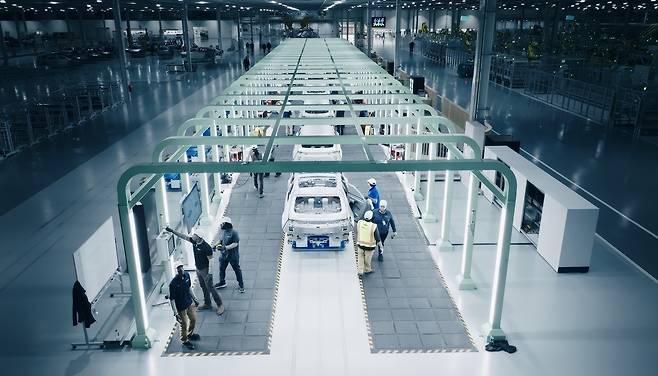
Hyundai could turn to its newly opened Hyundai Motor Group Metaplant America in Georgia to ramp up local production to avoid the tariffs, having decided to speed up plans to expand its annual production capacity to 500,000 units from the previous figure of 300,000 units.
But that is unlikely to solve the imminent problem of tariffs as the automaker said it will begin producing hybrid vehicles at HMGMA, which was initially designed exclusively for electric vehicles, next year.
While the automakers are expected to unveil measures in response to the US tariffs in their second-quarter earnings announcements later this month, experts and industry officials are calling for a package deal from the Korean government to minimize potential damage to the country’s auto industry, which plays a crucial role in its overall exports.
“There are things that the US could ask for (from Korea) such as shipbuilding,” said Kim Pil-su, an automotive engineering professor at Daelim University.
“We need to make a big deal ... If we get the tariffs down to the 10 percent range or a single-digit (percentage), I think that would be a great success.”
An auto industry official noted that if the preannounced 25 percent tariffs on auto exports to the US go into effect, Hyundai and Kia might have no choice but to raise prices.
“Other automakers are almost being forced to hike their prices,” said the official. “(Hyundai and Kia) have been selling well in the first half of this year, but they will need to make tough but necessary decisions to keep expanding their market presence in the US.”
Market analysts have lowered their expectations for Hyundai and Kia for the rest of the year amid the looming tariff risks.
Meritz Securities forecast that if the US maintains the 25 percent duty on auto imports from the Korean automakers, Hyundai Motor’s annual operating profit would be cut by 6.26 trillion won ($4.62 billion) this year, which equals about 44 percent of the company’s annual operating profit last year.
Hanwha Investment & Securities estimated that Kia will have to bear approximately 2.3 trillion won in costs due to the tariffs this year, adding that a 3.7 trillion won cut in profit is expected throughout next year, should the tariffs stay in place.
According to market analysis FnGuide, the projected operating profits of Hyundai Motor and Kia for this year were reduced by 1.8 trillion won and 1.4 trillion won, respectively.
Copyright © 코리아헤럴드. 무단전재 및 재배포 금지.