South Korea’s LCCs push into long-haul routes
이 글자크기로 변경됩니다.
(예시) 가장 빠른 뉴스가 있고 다양한 정보, 쌍방향 소통이 숨쉬는 다음뉴스를 만나보세요. 다음뉴스는 국내외 주요이슈와 실시간 속보, 문화생활 및 다양한 분야의 뉴스를 입체적으로 전달하고 있습니다.
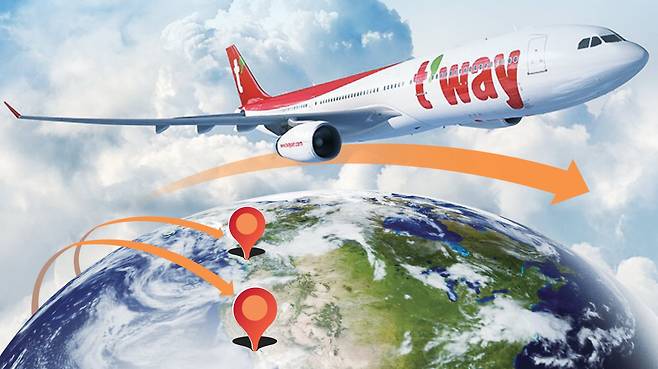
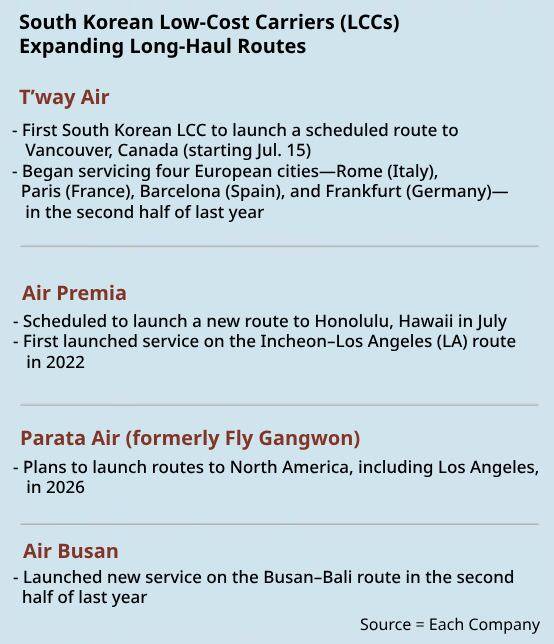
T’way Air is set to become the first South Korean low-cost carrier (LCC) to operate a scheduled route to Vancouver, Canada, starting July 15. The flight is expected to take approximately 10 hours. Another budget carrier, Fly Gangwon—recently rebranded as Parata Air—is preparing to resume operations in the second half of this year, with plans to expand into North American markets, including Los Angeles, as early as next year. The airline has signed a lease for an Airbus A330, a mid-size aircraft capable of transpacific flights, signaling its intent to compete aggressively in long-haul service. Other South Korean LCCs are also moving into long-distance markets. Air Premia is scheduled to launch a new route to Honolulu, Hawaii later this month, while Air Busan began operating flights to Bali in October of last year.
After years of concentrating on short-haul destinations, South Korea’s budget airlines are now charting longer routes, backed by the introduction of larger aircraft and years of accumulated operating experience. These carriers are entering medium- and long-haul markets traditionally dominated by full-service carriers (FSCs). For travelers, this shift means more affordable access to destinations such as Europe and the United States, along with increased choice due to growing competition between FSCs and LCCs. First-time travelers, newlyweds, and budget-conscious younger passengers—who often seek cost-efficient options—are fueling growing interest in long-haul travel with budget airlines.
Until recently, budget carriers in South Korea were largely associated with domestic and short international routes to nearby regions such as Japan, Southeast Asia, and China—typically lasting three to four hours. In the airline industry, routes are generally categorized by flight time: under four hours is considered short-haul; four to eight hours, medium-haul; and more than eight hours, long-haul. Destinations like Japan and Hong Kong fall into the short-haul category, while Central Asia and Singapore are regarded as medium-haul. The United States and Europe are classified as long-haul.
This is not the first time South Korean LCCs have attempted to enter the long-haul market. In December 2022, T’way Air launched service between Incheon and Sydney. Last year, it expanded into Europe with new routes to Zagreb, Croatia and Rome, Italy—each requiring 10 to 13 hours of flight time.
The shift toward medium- and long-haul operations is driven largely by profitability. Traditional short-haul markets such as Japan and China have become oversaturated and fiercely competitive on pricing, making it increasingly difficult for carriers to generate profit. In contrast, long-haul routes offer higher base fares, providing stronger revenue potential. North America, in particular, presents stable demand from the Korean expatriate community, giving carriers a more predictable and resilient revenue stream.
The planned merger of Korean Air and Asiana Airlines has further opened the door for LCC expansion. As part of efforts to address monopoly concerns, certain traffic rights and airport slots previously held by the two legacy carriers have been reallocated to competitors. This redistribution has allowed carriers like Air Premia and T’way Air—both operating medium- to large-size aircraft—to expand into new medium- and long-haul routes across Europe and North America.
Travelers have largely welcomed the availability of more affordable long-haul flight options to destinations such as the United States and Europe. As of July 1, a round-trip ticket from South Korea to Paris for travel between August 1 and 9 was listed at 1.61 million won (approximately $1,170) on T’way Air. A comparable fare on Asiana Airlines was priced at 2.27 million won (approximately $1,650)—a difference of roughly 660,000 won ($480).
However, budget carriers still face challenges in enhancing service quality to improve perceived value. While ticket prices may be lower, many LCCs offer minimal onboard amenities. Aside from bottled water, additional items such as beverages, blankets, slippers, and toothbrushes typically come at a cost. Entertainment options commonly offered on full-service carriers—such as movies, music, and games through in-seat monitors—are usually not available on LCCs, which often encourage passengers to use personal devices instead. With long-haul flights now in the mix, industry observers warn that insufficient in-flight services could result in a poor passenger experience, ultimately undermining the appeal of low-cost long-distance travel.
Copyright © 조선일보. 무단전재 및 재배포 금지.
- 임광현 국세청장 “세무조사 시기 선택 시작…기업부담 완화”
- 삼성전자·SK하이닉스 빼면 영업이익 뒷걸음질, 반도체 투톱에 가려진 코스피 ‘민낯’
- 설계 오류에 지반조사도 소홀…신안산선 터널 붕괴 원인은 ‘부실 공사’
- “토막살인에 성폭행까지”...한국인 많이 가는 발리 여행주의보
- “손 잡거나 몸 만지지 마…사진 사양” 이효리 요가원, 수강생에 공지
- 전재수, 부산시장 출마선언...“해양수도 꿈 실현”
- “산소마스크에 산소 연결 안돼”…대한항공 ‘美승객 기내 사망사고’ 손해배상 피소
- 檢 “한덕수, 대선 출마 결심하고 150만원 기부” 韓측 “출마 선언 직전 결심... 권한대행 통상
- SK AX, 사람 대신 여러 AI 에이전트가 인프라 운영하는 서비스 내놔
- [집중취재] 세계는 드론 전쟁 시대, 한국군은 드론작전사령부 해체