Samsung gears up for new factory construction in Pyeongtaek, aims to lead in HBM4
전체 맥락을 이해하기 위해서는 본문 보기를 권장합니다.
A Morgan Stanley report published on June 19 identified Samsung's potential HBM4 sample approval for Nvidia's Rubin GPU as a key catalyst that could come as early as September. Such approval, the report noted, would not only trigger a revaluation of Samsung stock due to "significant new TAM [total addressable market] opportunity" and reshape "the current competitive dynamics in the HBM market."
"Until there is clear stabilization, the stock is likely to remain rangebound."
이 글자크기로 변경됩니다.
(예시) 가장 빠른 뉴스가 있고 다양한 정보, 쌍방향 소통이 숨쉬는 다음뉴스를 만나보세요. 다음뉴스는 국내외 주요이슈와 실시간 속보, 문화생활 및 다양한 분야의 뉴스를 입체적으로 전달하고 있습니다.
![An aerial view of Samsung Electronics' chip complex in Pyeongtaek, Gyeonggi [SAMSUNG ELECTRONICS]](https://img4.daumcdn.net/thumb/R658x0.q70/?fname=https://t1.daumcdn.net/news/202506/30/koreajoongangdaily/20250630070244425vsow.jpg)
[NEWS ANALYSIS]
Samsung Electronics is gearing up to accelerate the construction of its chip plant in Pyeongtaek, Gyeonggi, with the key approvals awarded by the city's government over the past months. The move follows months of stalled construction activity for new factories, as the Korean chipmaker seeks to regain lost ground in the high bandwidth memory (HBM) race against SK hynix and Micron.
Samsung has obtained several temporary occupancy permits for the P4 facility this year, the most recent of which was granted in early June, according to a Pyeongtaek city official with knowledge of the matter. These permits allow Samsung to begin limited use of the site — such as installing equipment, conducting test operations or allowing restricted work force access — before full construction is completed. “The city does not have detailed information on which parts of the P4 facility are covered by the partial access permits," the official added. “There have been no recent permit requests filed for P5." Construction of P4 — covering phase 2 and phase 4 lines whose final use, whether it be memory or foundry, has yet to be confirmed — along with the adjacent P5 plant, had been paused since early 2024 due to weak chip demand and internal capital allocation. However, recent activities at P4 suggest Samsung is scaling production efforts in line with its goal to reclaim the crown in the memory market with next-generation HBM4.
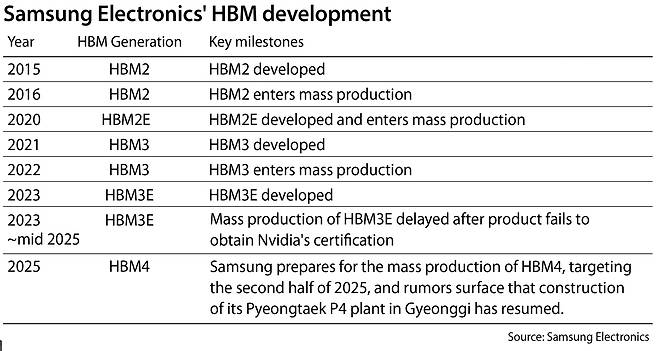
Its bet centers on its advanced “1c process," which the upcoming HBM4 could use. Both SK hynix and Micron Technology plan to use their previous-generation 1b process nodes, although a move to 1c may not automatically result in superior performance.
Samsung Electronics disclosed on its April earnings call that it was preparing to begin the mass production of HBM4 in the second half of this year. To stay on schedule, the company aims to approve the product internally and stabilize its yield by the third quarter.
A Morgan Stanley report published on June 19 identified Samsung’s potential HBM4 sample approval for Nvidia’s Rubin GPU as a key catalyst that could come as early as September. Such approval, the report noted, would not only trigger a revaluation of Samsung stock due to “significant new TAM [total addressable market] opportunity” and reshape “the current competitive dynamics in the HBM market.”
To support HBM4 production — currently reporting yield rates around 40 percent — Samsung is ramping up investments to expand capacity at Pyeongtaek Phase 2 and 4 and Hwaseong line 17, outlets including IT Chosun and ZDNet Korea have reported.
A Samsung Electronics spokesperson declined to comment on the expansion.
Yet hurdles remain. Song Myung-seob, an analyst at iM Securities, cautioned that Nvidia's qualification process involves far stricter performance standards — particularly around speed and power consumption — than Samsung's internal benchmarks. The company has yet to receive Nvidia's certification for its 12-high HBM3E, a milestone already cleared by both SK hynix and Micron.
Despite this, market sentiment regarding memory remain positive, supported by continued strong demand from the AI sector. Hyundai Motor Securities recently projected that the global HBM market would to grow 133.4 percent year-over-year in 2025 to $43 billion and surge to $135 billion by 2028 as Nvidia’s Rubin Ultra with 1TB of memory enters full-scale deployment.
Analysts see pricing tail winds as well. “While the initial pricing of HBM4 may fall short of expectations — estimated at a 30 to 40 percent premium over HBM3E 12-high — tight supply conditions and the introduction of customization starting with HBM4 are likely to drive further average selling price increases,” said Daishin Securities analyst Ryu Hyung-keun.
However, scaling up production may not be easy. Samsung faces rising technical hurdles, including limited capacity and more complex chip architecture. HBM4's bandwidth upgrades require denser via holes and more intricate through-silicon via structures, making the manufacturing process significantly more difficult.
“Clear visibility into sixth-generation DRAM and HBM4 is what investors are watching for,” said Ko Young-min, an analyst at Daol Investment & Securities said. “Although 1c yields have improved, the technology is still at a development stage, and many investors are likely waiting for more concrete signs of product readiness.
“Until there is clear stabilization, the stock is likely to remain rangebound.”
Meanwhile, California's AMD unveiled its MI350 AI accelerator on June 12, featuring 288GB of 12-layer HBM3E supplied by both Samsung and Micron. Notably, this is the same HBM3E product still undergoing Nvidia's certification process.
BY LEE JAE-LIM [lee.jaelim@joongang.co.kr]
Copyright © 코리아중앙데일리. 무단전재 및 재배포 금지.
- Six under investigation for attempting to send bottles of dollar bills and rice to North Korea
- Gong Cha launches two taro milk teas inspired by Stray Kids' Felix
- North Korea gives hard pass to Trump's negotiation overtures
- 'Dojeon!': BTS's Jin embarks on new challenge with first show of debut world tour
- Is it safe to travel to Japan? Korean travelers worry amid July quake rumors.
- Putin turns away from Iran, raising questions in Pyongyang
- Nurse sacked for posting offensive images of hospitalized newborns
- 'When Life Gives You Tangerines,' 'Harbin' honored at Baeksang Awards — as it happened
- Victory or foul? Jeong Hyun-gyu's win on 'The Devil's Plan' season two sparks viewer backlash
- Just B's Bain says he had more to gain than lose when deciding to come out as gay