Viral map of 'top talent' border shows capital concentration of good jobs
전체 맥락을 이해하기 위해서는 본문 보기를 권장합니다.
"We still operate an R&D center in Daejeon," said a representative from LG Energy Solution, "but we need highly educated young talent with an IT background for next-generation battery development, which is why we had to set up in the capital region."
"Even with KAIST in town, it's hard to recruit young IT workers," they said. "I can't fire my Daejeon staff and move, but I tell my junior colleagues to start in Seoul from the beginning."
이 글자크기로 변경됩니다.
(예시) 가장 빠른 뉴스가 있고 다양한 정보, 쌍방향 소통이 숨쉬는 다음뉴스를 만나보세요. 다음뉴스는 국내외 주요이슈와 실시간 속보, 문화생활 및 다양한 분야의 뉴스를 입체적으로 전달하고 있습니다.
![A render of the Suwon R&D Science Park in Gyeonggi [SUWON CITY GOVERNMENT]](https://img1.daumcdn.net/thumb/R658x0.q70/?fname=https://t1.daumcdn.net/news/202506/29/koreajoongangdaily/20250629185933491jbdt.jpg)
A viral map circulating on Korean social media is sparking debate over a stark reality: If you want a good job, don’t go south of Suwon.
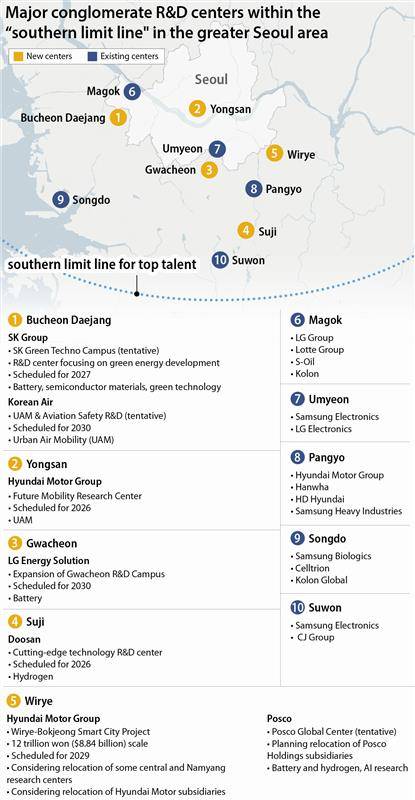
Nicknamed the “southern limit line for top talent,” the map marks the informal boundary where young professionals believe quality jobs — especially in research and development (R&D) — start to disappear. Anchored by regions like Songdo in Incheon to the west, Suwon in Gyeonggi to the south and Wirye in Gyeonggi to the east, the line outlines what many see as the last stop for high-paying, career-track positions in Korea’s capital region.
It reflects not only job market realities but also the rising real estate value in areas north of the line, where top employers are increasingly clustered.
Major examples include Hyundai Motor’s future mobility research center in Yongsan District, central Seoul, LG Energy Solution’s expanded R&D center for next-generation batteries in Gwacheon, Gyeonggi, and Korean Air’s urban air mobility and aviation safety research complex under development in Bucheon, Gyeonggi.
The map is an updated version of another past concept referred to as the “southern boundary of IT talent,” and it highlights a growing awareness that preferred jobs — and the quality of life that comes with them — are becoming more concentrated in the capital region.
Data compiled by the JoongAng Ilbo in partnership with job search portal JobKorea shows the concentration is only intensifying. In 2014, 57.33 percent of job openings posted by Korea’s top 30 conglomerates were in the capital region. That number rose to 86.51 percent in 2022 and 90.56 percent in 2023.
Although the figure dropped to 70 percent in 2024, JobKorea attributed the decline to the sharp decrease in job postings overall due to the U.S.-China trade conflict and inflationary pressures, therefore creating a “temporary” rather than meaningful shift in hiring geography.
Startups are no exception. According to a 2023 report from the Startup Alliance, 67.4 percent of Korean startups — 2,359 out of 3,500 — were based in Seoul. When including the wider capital area, the figure rises to 82.3 percent, or 2,877 companies.
The magnetism of Seoul stems from a self-reinforcing cycle: Companies move to the capital region to access a talent pool, while young professionals flock to Seoul in search of opportunities. That cycle continues.
![Nicknamed the “southern limit line for top talent,” this map has gone viral on social media as it marks the informal boundary where young professionals believe quality jobs — especially in research and development — start to disappear in the greater capital region. [SCREEN CAPTURE]](https://img2.daumcdn.net/thumb/R658x0.q70/?fname=https://t1.daumcdn.net/news/202506/29/koreajoongangdaily/20250629185936416vwhy.jpg)
According to a report released by the Seoul Metropolitan Government on Wednesday, until 2018, Seoul saw a net outflow of young people, but starting in 2019, that trend reversed into a net inflow. Aside from a brief reversal in 2021, Seoul has seen a steady net inflow: 31,551 in 2022, 27,704 in 2023 and 15,420 in 2024.
“There’s a paradox where so many young people are crowding into Seoul that it becomes harder to find a job,” said an official at the Ministry of Employment and Labor. “Because it costs more to live in Seoul, young job seekers expect higher wages, which is one of the reasons behind the rise in the so-called ‘resting youth’ who are taking time off from working.”
Even companies are now moving closer to the talent.
“We still operate an R&D center in Daejeon,” said a representative from LG Energy Solution, “but we need highly educated young talent with an IT background for next-generation battery development, which is why we had to set up in the capital region.”
But not everyone can make the move. A CEO of an educational technology startup in Daejeon said he regretted launching his company there.
“Even with KAIST in town, it’s hard to recruit young IT workers,” they said. “I can’t fire my Daejeon staff and move, but I tell my junior colleagues to start in Seoul from the beginning.”
![A render of SK Bioscience's research and process development center in Songdo, Incheon [SK BIOSCIENCE]](https://img3.daumcdn.net/thumb/R658x0.q70/?fname=https://t1.daumcdn.net/news/202506/29/koreajoongangdaily/20250629185936738dvwn.jpg)
Regional businesses are now relying on government subsidies just to hold onto their younger workers. A small transportation company in North Gyeongsang created an “MZ allowance” using a government employment subsidy. A textile manufacturer in Ulsan increased wages for new hires with government help — but still hired only two new employees in all of 2024.
The Lee Jae Myung administration is trying to push jobs to the noncapital regions, including relocating the Ministry of Oceans and Fisheries to Busan shortly after taking office earlier this month.
But experts say relocating government offices isn’t enough. To break the cycle of youth and corporate flight, more comprehensive strategies are needed — not just to create jobs but to make regional cities places where young people actually want to live.
“The main reason young people leave their hometowns for Seoul isn’t just salary differences,” said Yoon Dong-yeol, a business professor at Konkuk University. “Working conditions, welfare, career development, livability and cultural life all fall short.”
Kang Dong-woo, a research fellow at the Korea Labor Institute, echoed that sentiment. “It’s not just about creating jobs in the regions. We need to concentrate quality jobs in major cities and improve living conditions there as part of a broader regional development strategy.”
Prof. Yoon added that support needs to go beyond individual counties and focus on larger economic zones. “We need differentiated strategies tailored to the population size and characteristics of each metropolitan region,” he said.
Translated from the JoongAng Ilbo using generative AI and edited by Korea JoongAng Daily staff. BY KIM YEON-JOO [shin.minhee@joongang.co.kr]
Copyright © 코리아중앙데일리. 무단전재 및 재배포 금지.
- Six under investigation for attempting to send bottles of dollar bills and rice to North Korea
- Gong Cha launches two taro milk teas inspired by Stray Kids' Felix
- Nurse sacked for posting offensive images of hospitalized newborns
- 'Don't buy it': Why Korea's cup bingsu craze is drawing crowds to cafes — whether staff like it or not
- Is it safe to travel to Japan? Korean travelers worry amid July quake rumors.
- ‘Squid Game’ parade lights up Seoul for the season finale — in pictures
- Seoul, Washington launch working-level talks on 5% defense spending target
- K-drama meets K-tourism: 'Squid Game' finale event to light up Seoul's Gwanghwamun this weekend
- In 'KPop Demon Hunters,' Maggie Kang brings genre out of its comfort zone
- North Korea gives hard pass to Trump's negotiation overtures