Xiaomi opens first Korean store amid Chinese tech expansion
이 글자크기로 변경됩니다.
(예시) 가장 빠른 뉴스가 있고 다양한 정보, 쌍방향 소통이 숨쉬는 다음뉴스를 만나보세요. 다음뉴스는 국내외 주요이슈와 실시간 속보, 문화생활 및 다양한 분야의 뉴스를 입체적으로 전달하고 있습니다.
Around noon on June 25, the Xiaomi Store at IFC Mall in Seoul’s Yeouido district was packed with office workers browsing a broad lineup of products, ranging from smartphones and televisions to robot vacuum cleaners. The 200-square-meter space—approximately 60 pyeong—was already drawing crowds despite not yet being officially open. “I used to think Chinese products were cheap and low-quality, but now they seem not only affordable but also high-performing,” one office worker said.
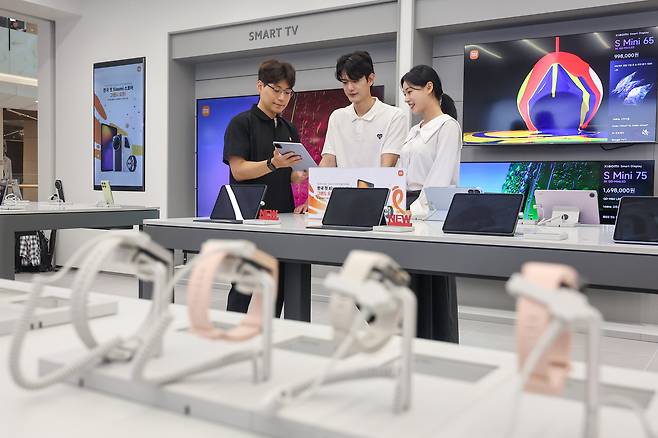
Chinese electronics giant Xiaomi is set to launch its first brick-and-mortar store in South Korea on June 28. Though not yet formally opened, the location is currently in trial operation and accessible to the public. Situated within IFC Mall—home to global tech brands such as Dyson and Apple and located near a Samsung Electronics store—the new outlet marks Xiaomi’s formal entry into the South Korean market, following the establishment of its Korean subsidiary in January.
“We plan to expand stores throughout the country, including in the Gyeonggi region,” said Johnny Wu, president of Xiaomi Korea.
On the same day, the company rolled out its latest devices in the domestic market: the Xiaomi 15 smartphone and the Smart Band 10. Notably, South Korea is one of the initial countries included in the first global release wave for the Smart Band 10.
Xiaomi is not alone in its shift toward physical retail. Chinese companies are increasingly expanding their presence from online platforms to offline retail spaces across South Korea. Chinese television manufacturer TCL, which launched its Korean subsidiary in 2023, now sells products both online and through major brick-and-mortar retailers such as Lotte Himart, Electromart and Costco. Hisense, another Chinese home appliance firm, sells its TVs through Coupang and offers local after-sales service.
Chinese electric vehicle manufacturer BYD introduced its passenger EV, the Atto 3, to the South Korean market for the first time this year. BYD Korea plans to expand its service network from the current 12 locations to more than 25 by year’s end, and more than double its number of showrooms. The company also plans to release the Seal, a midsize electric sedan, in the second half of the year.
Chinese firms are also targeting South Korea’s premium product segment, traditionally dominated by local brands. Some robot vacuum models from Chinese brand Roborock are priced higher than comparable devices from Samsung Electronics and LG Electronics. Roborock has already launched 12 new products in South Korea this year alone and holds a dominant position in the domestic robot vacuum cleaner market, with a market share in the mid-40% range.
Copyright © 조선일보. 무단전재 및 재배포 금지.
- “이란을 석기시대로” 또 뒤집은 트럼프
- 李 “소나기 아닌 폭풍우 위기… 추경은 국민 삶 지킬 방파제”
- 인류, 다시 ‘달의 문’을 열다
- 호르무즈 톨게이트… 이란 “위안화·코인으로 배럴당 1달러 징수”
- 트럼프 연설 직전 5500 뚫은 코스피, 45분 만에 5300선 무너졌다
- 나토 나가겠다는 美, 실제 탈퇴는 어려워… 병력 줄여서 흔드나
- 트럼프 “한국, 호르무즈 문제 도움 안 줘”… 무역·안보 청구서 가능성
- 이란 군부 “더 파괴적 보복”… 트럼프의 ‘석기시대 위협’ 일축
- 군사 국가로 재편되는 이란… 더 위험한 ‘중동의 북한’ 되나
- 감사원 국장급 물갈이… 文정부 감사한 간부들, 좌천되거나 외부 파견