‘Maybe Happy Ending’ writer Park Chun-hue: ‘I had breakfast with the Tony trophy on my table’
이 글자크기로 변경됩니다.
(예시) 가장 빠른 뉴스가 있고 다양한 정보, 쌍방향 소통이 숨쉬는 다음뉴스를 만나보세요. 다음뉴스는 국내외 주요이슈와 실시간 속보, 문화생활 및 다양한 분야의 뉴스를 입체적으로 전달하고 있습니다.
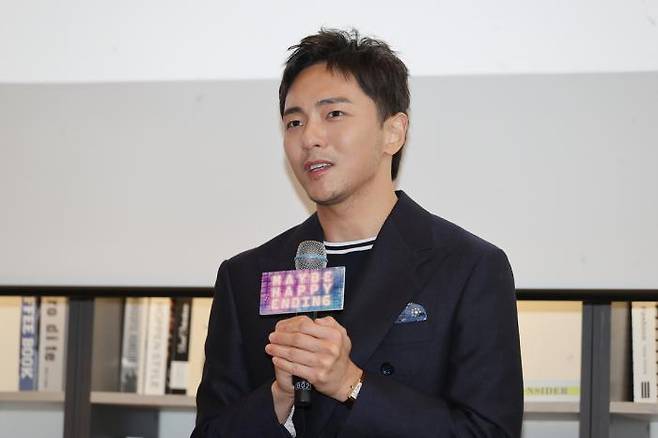
"Creating a musical is like waiting for the planets to slowly fall into alignment. It takes an extraordinary mix of luck and perseverance before the opportunity finally comes. As an immigrant who moved to New York later in life, I faced many twists and turns, but by enduring those moments, I was eventually given my first major break as a Korean playwright."
On June 24, Park Chun-hue, 42, the writer of the musical “Maybe Happy Ending,” which won six awards at the 78th Tony Awards on the 8th, met with reporters at Community House Masil in Myeong-dong, Seoul. “I had breakfast with the Tony trophy sitting on my modest dining table in my house in New York. It still feels surreal,” he said. When asked why the musical resonated so deeply on Broadway, he answered, “If I knew, I’d keep writing hits,” but added, “Will [Aronson] and I are the kind of collaborators who can spend days debating over a single word or letter. I think that kind of sincerity was something the audience could truly feel and understand."
“Maybe Happy Ending” is being hailed as a milestone in “K-musicals” because it was written by a Korean playwright, premiered in Korea, and is set in Korea. Park said, “To be honest, the term ‘K-musical’ isn’t as widely used as something like ‘K-pop,’” but continued, “It was a proud moment when audiences recognized it as a Korean musical and when cast members backstage studied Korean and greeted each other with phrases like ‘Have you eaten?’”
Just as Korean audiences affectionately referred to themselves as “Helperbots,” a fanbase called the “Fireflies” has emerged in the U.S., drawing attention. Like Korea’s so-called “revolving door” audience, those who return to see shows multiple times, American audiences also show a high rate of repeat attendance. Park said, “What struck me most was that American audiences laughed and cried at the same moments as Korean audiences,” adding, “When Oliver and Claire confirm their love or share their first kiss, American audiences tend to respond more physically with applause and cheers.”
The musical’s origin in a creative development program run by the Wooran Cultural Foundation has also sparked conversations about how to better support emerging creators.
“Just like how living abroad made us realize how great Korea is, I’ve come to appreciate how well-structured Korea’s support system for creative works is,” Park said. “But since Korea’s musical history is only 20 to 30 years old, the systems for compensation, like royalties, are still lacking.” He added that when the show had a tryout in Atlanta of the U.S., he was impressed by its regional partnership program that supported the work at the local level, and hopes similar regional support can be offered in Korea to help creators develop their work.
Park believes that “Maybe Happy Ending” succeeded precisely because it defied conventional expectations. “It’s an original story with no famous source material. Darren Criss, while well-known, doesn’t exactly have Broadway box office power and is still seen as a young actor. And about the setting, robots in the future in Korea, some people said, ‘Who would want to see that?’ But maybe that’s exactly why it resonated.”
He also shared the backstory behind his now-famous acceptance speech line, which is “Unlike in the show, I’m still single.” “Everyone told me to keep my speech short and witty, but I got a little irritated,” he laughed. “People think Will and I are a couple, but he’s happily married, and I’m the only single one. So I just said, ‘We’re not a couple. I’m single,’ and I didn’t expect it to make such waves.”
Park has often talked about his sense of being an outsider, shaped by living between New York and Seoul. “Writing ‘Maybe Happy Ending’, ‘Ghost Bakery,’ and ‘Il Tenore,’ I’ve come to realize I’m someone deeply drawn to loneliness,” he said. "As a writer, I feel compelled to create works that empathize with the feeling and offer comfort."
He made headlines after revealing that he received a congratulatory message from filmmaker Steven Spielberg following his Tony win. Park said he took the opportunity to tell Spielberg about “Il Tenore,” which is set in colonial Seoul during the 1930s. He also expressed hope that some of his other works premiered in Korea could be staged internationally.
“Sometimes I wonder if a musical set in 1930s Korea with 24 Asian actors on stage is too ambitious. But then I remember ‘The King and I,’ set in 19th-century Siam. It’s a performance that virtually every Asian actor aspires to be a part of. One of the things I want to accomplish before I die is to bring ‘Il Tenore’ to Lincoln Center and make it into the 21st-century version of ‘The King and I.’”
※This article has undergone review by a professional translator after being translated by an AI translation tool.
Copyright © 경향신문. 무단전재 및 재배포 금지.
- 청와대 이장형 비서관, 테슬라 주식 94억어치 신고…조한상 비서관, 강남3구 부동산 4채 보유
- [단독]합수본, 20·21대 국회의원 대상 통일교 ‘쪼개기 후원’ 들여다본다…54명 특정도
- [속보] 한미 ‘관세 재인상 사태’ 첫날 협의 종료···“결론안났다”
- 김건희 1심 재판부, 시세조종에 계좌 동원·수익 배분 인정하고도 “무죄”
- 이 대통령, 스캠 범죄 “한국인 건드리면 패가망신, 빈말 같나”
- 미 재무부, 한국 ‘환율 관찰 대상국’으로 재지정…중·일 등 10개국 명단에 올라
- 윤석열 골프연습장 초소로 속이고 설치···욕조 1484만원, 캣타워 173만원 짜리
- [속보]정교유착 합수본, 신천지 첫 압수수색
- 홍준표 “김건희, 방조범으로 처벌할 수 있는데…정치판 전혀 모르는 판결”
- 청와대, 미국의 ‘환율 관찰 대상국’ 지정에 “긴밀히 소통할 것”