Grim reapers as K-pop idols? Netflix’s animated film ‘KPop Demon Hunters’ takes world by storm
이 글자크기로 변경됩니다.
(예시) 가장 빠른 뉴스가 있고 다양한 정보, 쌍방향 소통이 숨쉬는 다음뉴스를 만나보세요. 다음뉴스는 국내외 주요이슈와 실시간 속보, 문화생활 및 다양한 분야의 뉴스를 입체적으로 전달하고 있습니다.
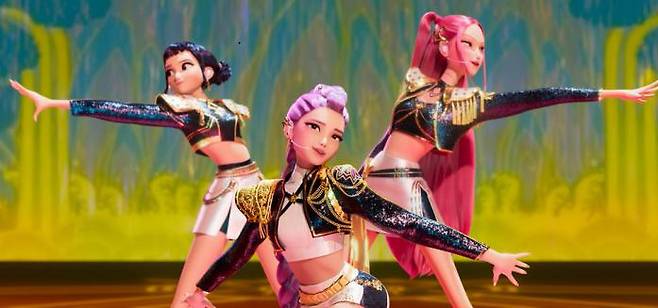
Animated characters dressed as Korean grim reapers wearing traditional gat hats sing and dance to a pounding beat. “Mesmerized by my ecstasy, you can’t look away.” The pounding beat, lyrics blending Korean and English, and perfectly synchronized choreography in tight formation all feel eerily familiar. “This is K-pop,” you think. The brightly colored hair peeking out from beneath their gat hats and the dazzling stage effects only reinforce the feeling that it could not be anything but a Korean idol performance.
Last weekend, the five-member grim reaper boy group “Saja Boys” stirred up a frenzy online with their performance video of “your idol.” Though animated, their music, dance, and character design rivaled that of real-life K-pop idol groups. The boy group turned out to be the villains in Netflix’s new original animated film “KPop Demon Hunters,” released on June 20, adding to the film’s growing buzz.
“KPop Demon Hunters” centers on “HUNTR/X,” three-member K-pop girl group who protect the human world from evil spirits. Using the power of music, they safeguard the “Honmoon,” a spiritual barrier that keeps malevolent entities out. The flashy Saja Boys are a boy group sent to the human world by the demon king “Gwi-Ma” to steal HUNTR/X’s fans and undermine their morale.
Surprisingly, the story has depth. Though HUNTR/X’s members, Rumi, Mira, and Zoey, find joy in being together, they hide their personal insecurities behind the pressure to appear strong. Jinu, the voice of whom is played by Korean actor Ahn Hyo-seop, is the Saja Boys’ leader who exploits these vulnerabilities to disrupt the trio’s teamwork.
Despite its Korean theme, the film is a U.S. production. It was developed by Sony Pictures Animation, the studio behind “Spider-Man: Across the Spider-Verse” and “Hotel Transylvania.” Korean Canadian director Maggie Kang and Chris Appelhans directed the film.
In an interview with Forbes, Kang said she grew up in Canada as a fan of first-generation K-pop idols like H.O.T. and Seo Taiji. When creating the characters, she referenced today’s K-pop stars extensively. Real-life industry talent also contributed to the project, including producers like Teddy, 24, and ido from The Black Label worked on the music, while top choreographer Leejung designed the dance routines, boosting the authenticity of the film’s musical scenes.
The creative team conducted in-depth research on the K-pop industry to flesh out HUNTR/X and Saja Boys convincingly. Stars express their love for their fans, and in return, enthusiastic fans show up at concerts waving light sticks. Releasing new songs or albums is called a “comeback,” and the groups follow a familiar routine of fan sign events and variety show appearances, just like the K-pop groups we all know.
The film’s Korean elements go far beyond the music. Set in modern-day Seoul, the story draws visual and thematic inspiration from Korean folktales and mythology. A dokkaebi (goblin), a grim reaper, and even a three-eyed magpie appears. A particularly popular character is “Derpy,” a tiger seemingly leapt from a Korean folk painting, whose adorable appearance is winning fans.
“KPop Demon Hunters” has enjoyed immediate global success after its release. According to FlixPatrol, a platform tracking streaming content, the film ranked No. 1 worldwide on Netflix for two consecutive days (June 21 and 22). As of the 22nd, it topped the Netflix film charts in 26 countries.
Interestingly, the film currently ranks second in Korea, suggesting overseas audiences are responding more quickly to Korean-themed content. This mirrors the success of Netflix’s romantic comedy “XO, Kitty,” set in an elite boarding school in Seoul, which found greater success abroad than in Korea, content rooted in K-culture continues to resonate more strongly with international audiences.
Some analysts note that the dual appeal of Seoul, combining cutting-edge urban aesthetics with traditional Eastern beauty, is especially attractive to international creators and audiences. The Korean musical “Maybe Happy Ending,” which recently won six awards at the Tony Awards in New York, retained Korean elements such as “Seoul” and “Jeju Island” in its Broadway adaptation, a creative choice that has been praised for adding a sense of freshness to the production.
※This article has undergone review by a professional translator after being translated by an AI translation tool.
Copyright © 경향신문. 무단전재 및 재배포 금지.
- 차기 연준 의장은 ‘쿠팡 주식 130억 보유’ 케빈 워시···“그린란드 병합” 조언한 로더 사위
- “이재명 죽어야” 집유 나온 손현보 목사 “미국이 가족 초청…감사”
- [속보]김민석 총리, ‘색동원 성학대 의혹’에 범부처 TF 구성 긴급 지시
- 지하철역 화장실서 발견된 뱀, 알고보니 멸종위기종 ‘볼파이톤’···국립생태원 이송[서울25]
- [단독]김경 녹음파일 속 “돈 줘야 한다”···민주당 당직자 이례적 인사발령
- 권성동 판결문에 적힌 ‘정교유착’…법원 “1억 전달 만남 후 긴밀 관계로 발전”
- 심은경, 일본 ‘키네마 준보’ 여우주연상…한국 배우 최초
- [속보]김건희 특검, ‘도이치·무상 여론조사 등 무죄’ 1심 선고에 항소
- 세계 1위 파운드리의 힘···AI 타고 펄펄 난 대만, 22년 만에 1인 GDP 한국 추월
- 양승태 ‘사법농단’ 기소 7년 만에 일부 유죄로 뒤집혔다···헌정 첫 전직 대법원장 ‘유죄’