Kospi breaks 3,000 for first time since 2021 despite Middle East conflict
전체 맥락을 이해하기 위해서는 본문 보기를 권장합니다.
"With increased oil supply from the United States since 2010, the global market has become more resilient to Middle East tensions. While short-term fluctuations are possible, the broader market is unlikely to be derailed by the current Middle East situation."
"If the United States faces near-stagflation in the second half of the year, it will pressure the Korean market. The impact of tariffs could also make it difficult for domestic companies to sustain their earnings."
이 글자크기로 변경됩니다.
(예시) 가장 빠른 뉴스가 있고 다양한 정보, 쌍방향 소통이 숨쉬는 다음뉴스를 만나보세요. 다음뉴스는 국내외 주요이슈와 실시간 속보, 문화생활 및 다양한 분야의 뉴스를 입체적으로 전달하고 있습니다.
![Kospi closed at 3,021.84 on June 20, up 1.48 percent from the previous trading session, breaking the 3,000-point threshold for the first time since December 2021. [JOONGANG SUNDAY]](https://img3.daumcdn.net/thumb/R658x0.q70/?fname=https://t1.daumcdn.net/news/202506/23/koreajoongangdaily/20250623070044389ynwg.jpg)
Korea’s benchmark Kospi surpassed the 3,000-point threshold on Friday for the first time in three and a half years, despite already heightened geopolitical tensions in the Middle East, which escalated further with U.S. strikes on Iran’s nuclear facilities on Sunday.
Kospi peaked at 3,022.06 points on Friday, up 1.49 percent from the previous trading session, driven largely by foreign and institutional investors. Shares of chipmakers and battery manufacturers fueled the growth.
The last time the index crossed the 3,000-point threshold was in December 2021.
Despite escalating tensions in the Middle East, the market rally is expected to remain resilient.
“Financial markets did not collapse during previous events such as the Russia-Ukraine war [in 2022] or the Gulf Wars in 1991 and 2003,” said Kim Hak-kyun, senior managing director at Shinyoung Securities.
“With increased oil supply from the United States since 2010, the global market has become more resilient to Middle East tensions. While short-term fluctuations are possible, the broader market is unlikely to be derailed by the current Middle East situation.”
The latest rally has also been supported by the government’s proposal for a large supplementary budget.
“The government’s large-scale supplementary budget and expectations of one or two more rate cuts by the Bank of Korea this year have boosted the stock market,” said Kang Jin-hyeok, a market analyst at Shinhan Securities.
On Thursday, the Ministry of Economy and Finance proposed 20.2 trillion won ($14.7 billion) in new government spending to spur economic growth and support vulnerable sectors.
“With both monetary and fiscal policy easing, the influx of liquidity tends to flow into asset markets,” Kang said.
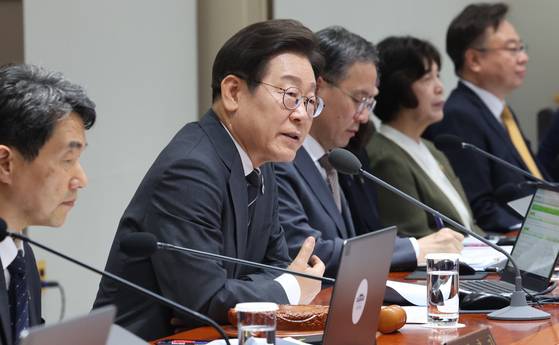
Lee Jae Myung administration’s market-friendly policies, including amendments to the Commercial Act to strengthen shareholder rights and plans to reform the tax system to encourage dividend payouts, have raised investor expectations for a sustained market boom.
Crossing the 3,000-point mark is considered a key psychological milestone for investors. The index first surpassed this level in January 2021 and reached a record high of 3,305 in July of that year.
Analysts say the index could soon exceed 3,100 points on the back of policy momentum.
“The Korean stock market continues to break through upper resistance levels,” said Han Ji-young, an analyst at Kiwoom Securities, in a June 19 report.
Han added that, unlike in Korea, markets in the United States and Japan are encountering resistance near their previous highs.
Kospi has jumped 12 percent since the beginning of June.
However, the rally’s sustainability may hinge on corporate earnings.
“If the rally had been backed by strong earnings, the market would have been more resilient to shocks. Since that’s not the case with the recent rally, investors may feel a stronger urge to take profits when shocks occur,” Kang said.
Many Korean industries — including petrochemical, steel and batteries — are losing their export competitiveness, according to Park Hee-chan, a researcher at Mirae Asset Securities.
"If the United States faces near-stagflation in the second half of the year, it will pressure the Korean market. The impact of tariffs could also make it difficult for domestic companies to sustain their earnings."
BY JIN MIN-JI, NAM YOON-SEO, KO SUK-HYUN [jin.minji@joongang.co.kr]
Copyright © 코리아중앙데일리. 무단전재 및 재배포 금지.
- U.S. bombed Iran’s deepest nuclear sites. Should North Korea be worried?
- Cha Eun-woo will meet fans for last time before military enlistment at July 12 event
- Korea moves to limit blowback from U.S. strikes on Iran
- President Lee Jae Myung to skip NATO summit as Middle East tensions escalate
- South Korea alarmed by Iranian penetration of Israel's missile shield
- Korean man accused of running porn website extradited from Ecuador
- Victory or foul? Jeong Hyun-gyu's win on 'The Devil's Plan' season two sparks viewer backlash
- Korea looks to plug into the global AI race with $5 billion Ulsan data center
- The Boyz former member Ju Hak-nyeon raises legal challenge over contract termination
- Police say Busan students found dead struggled with academic pressure, anxiety