E-9 foreign worker arrivals plunge 21% amid economic slump
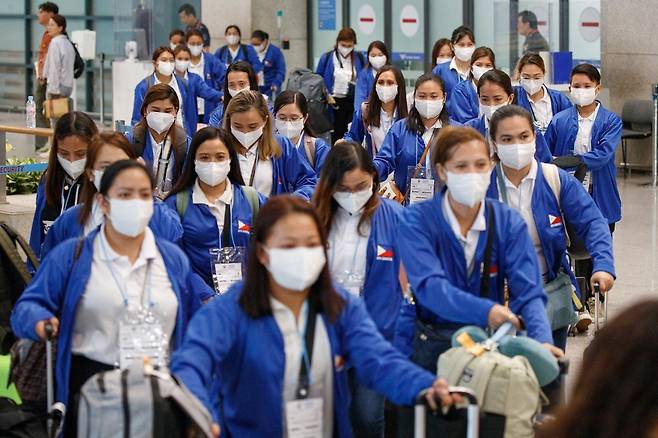
The number of foreign workers entering South Korea under the nonprofessional employment visa dropped by 21 percent in the first half of this year compared to the same period last year amid growing concerns over a slowing economy.
According to the Ministry of Employment and Labor, the number of workers arriving in Korea under E-9 visas through the Employment Permit System totaled 28,520 as of June 10, down 20.9 percent from the 36,048 who entered during the same period in 2024.
The Employment Permit System is a government program that allows employers facing chronic labor shortages to employ qualified foreign workers.
Foreign workers who are employed under the Employment Permit System receive the E-9 visa and work in industries such as agriculture and livestock, fishing, construction, manufacturing, services, mining and forestry.
According to the Labor Ministry, the number of workers coming into Korea under the E-9 visa sharply declined during the COVID-19 pandemic; it rebounded in 2022 and 2023, reaching 88,102 and 100,148 workers in those years, respectively.
However, the number fell again in 2024 to 78,025 — well below the government-set cap of 165,000 foreign workers.
“The economic slowdown has had an impact on demand for foreign workers, leading to the decrease,” said a Labor Ministry official.
While an annual quota is normally set by the government, only 21.9 percent of the 130,000-person cap for this year has been filled so far, according to the Labor Ministry.
When excluding flexible allocations for specific sectors, 29.1 percent of the 98,000 available slots have been filled.
By industry, the manufacturing sector — which typically takes up the largest share of E-9 visa holders — saw a significant drop in new arrivals. While a total of 28,887 workers were admitted in the manufacturing sector in 2024, the number fell 25.8 percent this year to 21,443.
Other industries also recorded notable declines.
A drop of 21.7 percent in the number of workers under the E-9 visa was seen in the fishing sector, while the construction sector saw a decrease of 33.1 percent compared to 2024.
Only the agriculture and livestock sector and the service sector saw an increase in worker numbers. However, these gains were small and were not enough to offset the broader decline.
The agriculture and livestock sector saw a 19.3 percent increase — from 3,379 laborers in the first half of 2024 to 4,031 in the first half of 2025 — and the service sector saw a 27.5 percent increase — from 207 workers last year to 254 workers this year.
Copyright © 코리아헤럴드. 무단전재 및 재배포 금지.