Gov’t to forgive personal debts under 50 million won delinquent for over 7 years
이 글자크기로 변경됩니다.
(예시) 가장 빠른 뉴스가 있고 다양한 정보, 쌍방향 소통이 숨쉬는 다음뉴스를 만나보세요. 다음뉴스는 국내외 주요이슈와 실시간 속보, 문화생활 및 다양한 분야의 뉴스를 입체적으로 전달하고 있습니다.
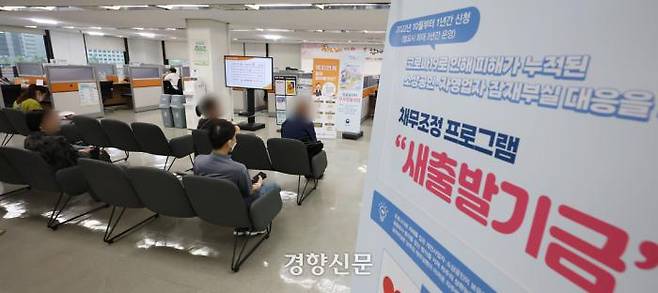
The government will write off the debts of approximately 1.13 million individuals who have been in arrears for more than seven years and owe less than 50 million won. It will also roll out expanded debt restructuring plans for self-employed and small business owners burdened by high interest rates, particularly those impacted by the coronavirus pandemic. This marks the first time the government is directly using public funds to address personal delinquent debt. However, since the government’s contribution accounts for only half of the estimated 800 billion won in project costs, securing the remaining funding is expected to be a key challenge.
According to the supplementary budget plan announced on June 19, the government has allocated 1.4 trillion won to support individuals and small business owners in restarting their economic lives. Of this, 400 billion won will be used to buy and write off long-term delinquent personal debts, while 700 billion won will be allocated to expand the existing “New Start Fund” aimed at supporting self-employed people affected by the coronavirus pandemic.
The centerpiece of the new initiative is the introduction of government-led personal debt restructuring. Individuals, including business owners, with unsecured debt under 50 million won and in delinquency for over seven years will be eligible for a full write-off. This initiative fulfills a campaign pledge by President Lee Jae-myung. Financial authorities explained that “the seven-year benchmark reflects the maximum period delinquency information is shared and aligns with the time required to reapply for bankruptcy discharge. The 50 million won threshold was set based on the average debt level of those applying for debt restructuring through the Credit Counseling and Recovery Service, which was about 44.56 million won.” A debt restructuring body will be established under Korea Asset Management Corporation (KAMCO) to purchase the eligible debts in bulk. After assessing applicants’ income and assets, the body will determine how to proceed with each case.
If a debtor’s income is below 60 percent of the median income and they have no disposable assets beyond those recognized under rehabilitation or bankruptcy, the debt will be written off. However, if the debtor has some repayment capacity but it is significantly insufficient compared to their debt, he or she will receive enhanced debt restructuring benefits beyond the current Credit Counseling and Recovery Service program. Options under consideration include up to an 80 percent principal reduction and repayment in installments over 10 years.
The government estimates that the new program could handle up to 1.134 million cases involving 16.4 trillion won worth of long-term delinquent personal debts. While 400 billion won has been allocated in the supplementary budget, the total required funding is estimated to be around 800 billion won. The Financial Services Commission plans to negotiate and encourage participation from the financial sector to secure the remaining 400 billion won.
This program is the first case in which government finances are being used specifically to handle personal, non-business debt. Although public institutions have previously bought and canceled personal delinquent loans, government funds were not used. The existing New Start Fund does involve public financing but is limited to personal business owners and corporations, making this effort significantly broader in scope.
The government will also strengthen support for the New Start Fund through the supplementary budget, extending the eligibility period to June of this year and expanding coverage to include business owners affected by former President Yoon Suk-yeol’s unlawful imposition of martial law on December 3 last year.
Debt relief measures will also be enhanced, from the current terms of “60 to 80 percent principal reduction and up to 10 years of installment repayment” to “up to 90 percent reduction and up to 20 years of repayment.” However, this expanded support is limited to low-income self-employed individuals with total unsecured debts of less than 100 million won and incomes under 60 percent of the median income.
An official from the Financial Services Commission said, “Given the unavoidable debt increase during the coronavirus pandemic response, it is appropriate for public finances to share the burden,” adding that, “recent delays in domestic demand recovery due to political and economic uncertainty were also considered.”
※This article has undergone review by a professional translator after being translated by an AI translation tool.
Copyright © 경향신문. 무단전재 및 재배포 금지.
- ‘윤석열을 파면한다’ 문자 노출한 치킨점에 이행강제금 부과···인천 남동구 “옥외광고물
- “일 홋카이도에서 규모9 지진 발생 임박···400년 만의 초대형 지진”
- 금 3000돈 들고 잠적한 금은방 업주 지인 구속···“증거인멸·도주 우려”
- ‘실물 교도소’ 보존 공간 둘러본 시민들 77%가 “사형제 찬성”
- ‘윤어게인’ 외친다는 전한길 음악회···태진아·이재용 이어 소프라노 정찬희도 “불참”
- 유시민 “미친 짓” 비판 ‘공소취소모임’, 민주당 의원 65% 참여 출범…“국정 조사 추진”
- ‘전쟁 4년’ 우크라 인구 1000만명 감소 분석···“최악의 인구 위기”
- ‘이재명 정부 비판’ 이학재 인천공항 사장, 인천시장 출마···25일 사직
- 경찰, 김성훈 전 경호처 차장 ‘해군 선상파티’ 피의자 조사
- 이 대통령, “영원한 동지” 룰라 최고 예우…포옹 환대로 시작해 ‘치맥 회동’ 마무리