South Korea says defense spending against GDP already ‘very high’
South Korea’s Defense Ministry on Friday hinted at concerns over an announcement by the Donald Trump administration that its Asian allies are subject to the “new standard” of spending 5 percent of gross domestic product on defense.
South Korea’s defense spending, which stands at some 51.2 trillion won ($37.5 billion) or 2.32 percent of its GDP, is already “very high,” the ministry noted in a statement.
"Among key US allies, South Korea is one of the countries that has an extremely high defense spending to GDP ratio," the ministry said in a statement. "We have continuously hiked our defense spending in consideration of our serious security situation involving North Korea’s nuclear and missile threats.”
South Korea will continue its efforts to maintain necessary capabilities and posture for the defense of the Korean Peninsula as well as regional peace and stability, the ministry said.
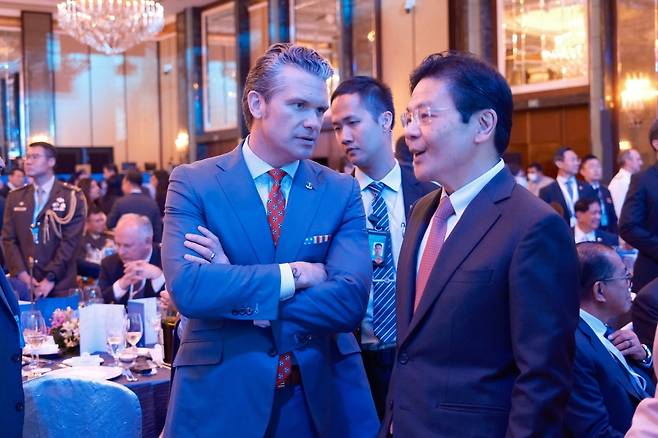
Seoul’s statement follows remarks made earlier this week by US Defense Secretary Pete Hegseth, regarding a “new standard” now in place for all US allies’ defense spending, “including in Asia.”
Hegseth’s remarks, made during a hearing before the Senate Armed Services Committee, are aligned with US President Donald Trump’s call for NATO members to increase their defense spending to 5 percent of their GDP. This is more than double the 2 percent defense spending guideline agreed upon by the leaders of the trans-Atlantic alliance in 2014.
Last month, Hegseth, during the Shangri-La Dialogue, an annual defense forum held in Singapore, said that it “doesn’t make sense” for key US allies in Asia to “spend less on defense” than countries in Europe, despite dealing with “more formidable threats,” including North Korea provocations.
Concerns are rising in South Korea over reports that Trump may shore up South Korea’s defense spending while the US adjusts the role and reduces the size of the US Forces Korea. A May report by The Wall Street Journal claimed that the Trump administration is mulling the option of pulling some 4,500 personnel out of the 28,500-strong USFK and relocating them to other locations in the Indo-Pacific region.
Last month, Hegseth directed Under Secretary of Defense Elbridge Colby to draw up a US national defense strategy that focuses on burden sharing with allies as the nation navigates to deter threats from China.
More than doubling defense spending would deal a heavy blow to South Korea, as it would cost Seoul over 100 trillion won to meet the “new standards” suggested by the Trump administration. An expert pointed out that it would require the government to significantly reduce other budgets allocated to areas, including welfare, to uphold such a scenario.
“It won’t be an easy process for Seoul as it would be required to cut back budgets set aside for other matters, including welfare, and funnel (the funds) into defense spending if the 5 percent of GDP rule is applied,” said Yang Uk, a research fellow at Asan Institute for Policy Studies.
Observers say that if South Korean President Lee Jae Myung decides to participate in the upcoming NATO summit scheduled for June 24-25 in the Netherlands, an opportunity might arise to discuss the defense cost issue with Trump. However, the presidential office here has yet to confirm whether Lee will attend the summit, as of press time, but said the previous day that it is coordinating the details of a potential summit with Trump.
First Vice Foreign Minister Park Yoon-joo said in a Friday interview with Yonhap News TV that “the current situation where the US has been requesting several countries to shore up their defense costs is true.” He vowed to review the matter in detail and continue “close negotiations” with Washington.
Copyright © 코리아헤럴드. 무단전재 및 재배포 금지.