Korea unveils W30.5tr stimulus to revive growth, ease household strain
전체 맥락을 이해하기 위해서는 본문 보기를 권장합니다.
"Fiscal soundness and adherence to balanced budgeting are important, but the current downturn is too severe for the government to stand by," Lee said during a Cabinet meeting on Thursday. "It is time to put public finances to use."
"Given current economic and fiscal conditions, rigidly adhering to the 3 percent deficit cap could harm both the economy and public finances," the vice minister said, adding, "While we remain committed to fiscal sustainability, strictly meeting the rule is unrealistic at this stage."
이 글자크기로 변경됩니다.
(예시) 가장 빠른 뉴스가 있고 다양한 정보, 쌍방향 소통이 숨쉬는 다음뉴스를 만나보세요. 다음뉴스는 국내외 주요이슈와 실시간 속보, 문화생활 및 다양한 분야의 뉴스를 입체적으로 전달하고 있습니다.
Just two weeks into office, President Lee Jae Myung’s administration has unveiled a proposal for a 30.5 trillion won ($22.1 billion) supplementary budget aimed at jump-starting the sluggish economy. The package includes a 10.3 trillion won revenue revision — the first in five years.
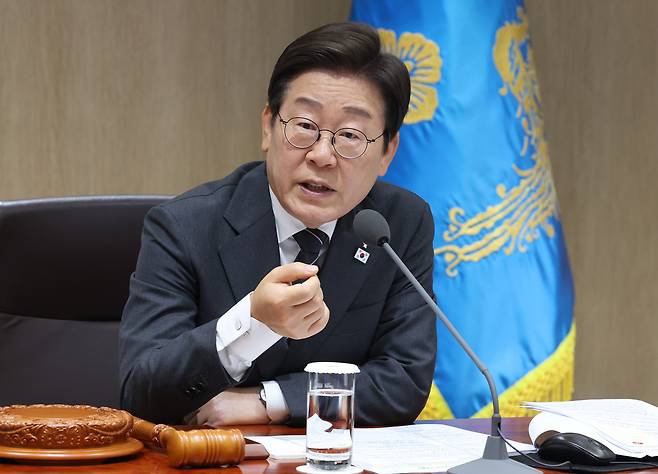
“Fiscal soundness and adherence to balanced budgeting are important, but the current downturn is too severe for the government to stand by,” Lee said during a Cabinet meeting on Thursday. “It is time to put public finances to use.”
Lee said the plan reflects two core priorities. “First, stimulating the economy. And second, ensuring the benefits are fairly distributed — whether universally or partially — according to who needs them most. These are also questions of values and ideology,” he said.
The bill, which includes universal cash payments for all Koreans, was approved Thursday by the Cabinet and is expected to be submitted to the National Assembly by Monday.
The measure marks the second spending package this year, following a 13.8 trillion won plan approved in May under the previous administration, which won rare bipartisan support during a politically volatile, post-impeachment transition.
According to the Finance Ministry, the proposal includes around 20.2 trillion won in new spending. Of this, 15.2 trillion won will go toward boosting economic activity, while 5 trillion won is earmarked for stabilizing livelihoods.
A key pillar of the stimulus is a 10.3 trillion won cash relief program distributed via so-called “spending coupons,” with payments ranging from 150,000 won to 500,000 won based on income levels. All Koreans will receive at least 150,000 won in the first phase, with larger amounts for lower-income households. In the second phase, the top 10 percent of earners will be excluded, while the remaining 90 percent will receive an additional 100,000 won.
The government also allocated 2.7 trillion won to the construction sector, which has posted four consecutive quarters of contraction and remains a significant drag on domestic demand.
To foster long-term growth, 1.2 trillion won will be invested in startups and emerging industries, including artificial intelligence and renewable energy.
The 5 trillion won earmarked for livelihood support mainly targets struggling small business owners and the self-employed, as recent data shows record-high default rates and involuntary closures. Of that, 1.4 trillion won will go toward easing the debt burden of chronically distressed borrowers, while 1.6 trillion won will be used to strengthen the employment safety net, through job-seeking benefits and aid for delayed wage payments.
The government is revising down its revenue projection by 10.3 trillion won, marking the first revenue correction since July 2020 during the COVID-19 pandemic.
As of end-April, the integrated fiscal balance, indicating the government’s underlying fiscal health, posted a deficit of 46.1 trillion won — the third-largest April shortfall on record after 2024 and 2020. That figure is set to grow, factoring in more than 30 trillion won in combined extra budget spending this year.
Fiscal conditions are set to worsen with expanded outlays. Full-year revenue is now projected at 642.4 trillion won, down from an initial estimate of 651.6 trillion won, while spending has been revised up to 702 trillion won from 673.3 trillion won.
As a result, the year-end integrated fiscal deficit is forecast to reach 110.4 trillion won, widening from 91.6 trillion won last year. As a share of gross domestic product, the deficit rate is projected to rise to 4.2 percent, up from an earlier forecast of 3.3 percent.
The national debt, which stood at roughly 1,200 trillion won as of end-April, is expected to exceed 1,300 trillion won by year’s end, pushing the debt-to-GDP ratio to 49 percent.
To finance the shortfall, the government plans to issue 19.8 trillion won in treasury bonds, with the remainder covered through about 10 trillion won in spending restructuring and available fund reserves.
Concerns over bond market pressure were downplayed.
“We see demand in the treasury bond market as very solid,” Second Vice Finance Minister Lim Ki-keun said during a briefing Wednesday, adding that yields are expected to remain stable, with expectations for an extra budget already priced in.
Despite concerns over fiscal health, the Finance Ministry said Korea’s debt remains manageable by global standards.
Lim underscored the administration’s emphasis on “sustainability,” calling for strategic spending paired with a long-term path to fiscal stability.
“Given current economic and fiscal conditions, rigidly adhering to the 3 percent deficit cap could harm both the economy and public finances,” the vice minister said, adding, “While we remain committed to fiscal sustainability, strictly meeting the rule is unrealistic at this stage."
The government expects the extra budget to boost economic growth by 0.1 to 0.2 percentage points, lifting it into the 1 percent range. The Bank of Korea projects 0.8 percent growth this year, while the International Monetary Fund forecasts a 1 percent expansion.
“The Korean economy now stands at an inflection point,” Lim noted. “To set growth on an upward trajectory, timely and bold fiscal intervention is more critical than ever. More spending cannot solve everything by itself, but this will be a vital first step.”
Copyright © 코리아헤럴드. 무단전재 및 재배포 금지.