Danny Boyle redefined zombie horror with '28 Days Later.' After more than 2 decades, he’s back to continue the story
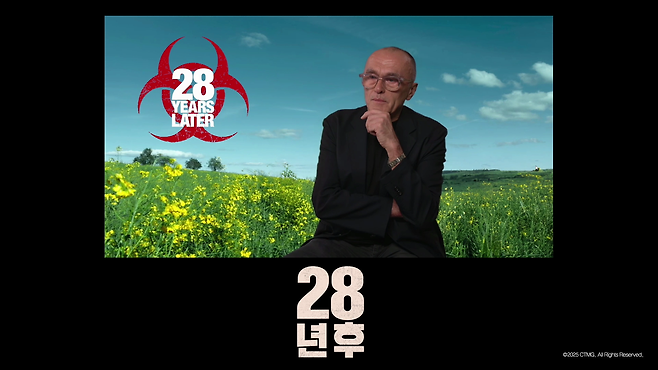
Danny Boyle opened Wednesday's virtual press conference with self-deprecating humor.
"I'm sorry I'm not in. I'd love to come to Korea, but I'm in London parked in front of a green screen," the director quipped. Humility aside, his timing couldn't be better.
"28 Years Later" has dominated Korean advance bookings for two consecutive days, moving nearly 50,000 tickets ahead of Thursday's theatrical release. The film's early momentum suggests audiences are primed for Boyle's return to the franchise that, over two decades ago, redefined the zombie horror genre with "28 Days Later."
The director was quick to credit screenwriter Alex Garland for drawing him back. "I think the absolute kernel of the truth is that it's a great script with a really surprising story at the heart of it," Boyle said.
Recent global events inevitably fed into their creative process. The pandemic and Brexit both informed the sequel's themes, though Boyle emphasized that "ultimately it was the enthusiasm for the audiences ... which has maintained itself even after over 20 years."
Beyond contemporary parallels, the new film explores how survivors have adapted in the nearly three decades of quarantine. Where "28 Days Later" imagined London emptied by the Rage Virus, the sequel examines evolved threats and communities.
Boyle detailed how the infected themselves have transformed. "The expectation of the authorities in isolating Great Britain was that the virus would burn itself out," he explained. "It didn't, and it evolved." Accordingly, the film presents multiple infected variants, including passive ground-dwellers and organized hunting packs led by massive "Alpha" figures.
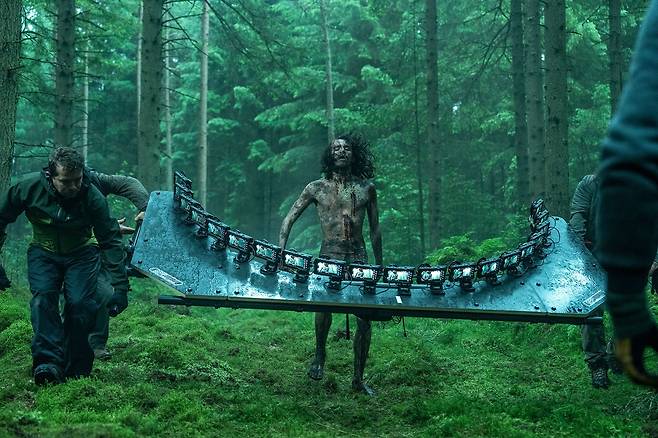
This evolution extends to the film's production methods. Boyle famously shot the original on consumer-grade digital cameras, and this time, he embraced smartphone technology alongside conventional equipment. "You can now record on smartphones at 4K, which is the resolution you need for a cinema screen," he noted.
The lightweight approach served practical purposes too: The film deploys up to 20 iPhones in semicircular rigs around infected actors, creating what Boyle described as "a poor man's bullet time" — a nod to the iconic slow-motion visual effect popularized by "The Matrix," reimagined here in more cost-efficient fashion to capture violence from dynamic new angles.
The director mapped out ambitious plans for the trilogy. The second film, already completed under Nia DaCosta's direction, explores "the nature of evil," while the third will center entirely on Cillian Murphy's return as Jim from the original. Murphy serves as executive producer on the current film but won't appear until the trilogy's conclusion.
"Each film is independent — you can watch each film alone," Boyle assured, while promising that the narrative threads will reconnect with the original.
"28 Years Later" opens in Korean theaters Thursday.
Copyright © 코리아헤럴드. 무단전재 및 재배포 금지.